The UKVI Inside Series, Complete: All Twenty Four Guides and a Reading Plan for Visitors, Students and Families From Pakistan
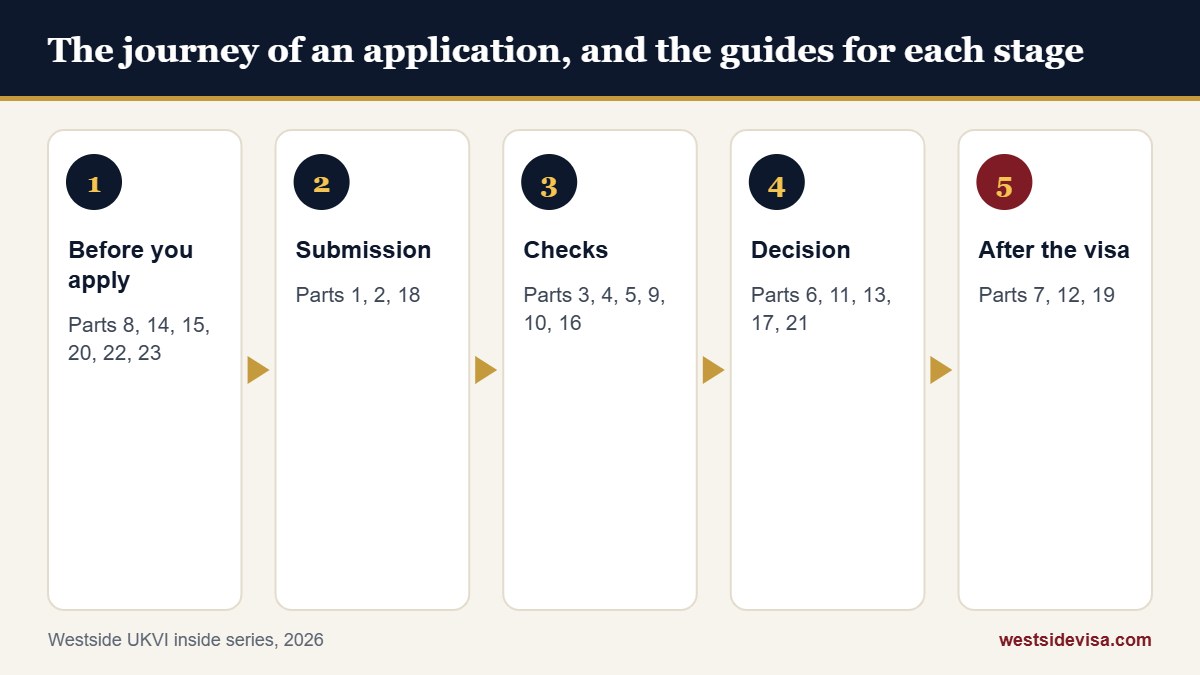
This series began with one question from a client in the Lahore office: “What actually happens to my file after I press submit?” Twenty three guides later, the answer covers the systems that receive an application, the automated checks that run before any person reads it, the calls made to banks and employers, the interview, the way a decision is written, and everything that surrounds it, from the university’s licence to the TB clinic. This final part is the map. It lists every guide in order, then gives a short reading plan for each kind of applicant, so that nobody needs to read twenty four articles to find the five that apply to them.
By Mujtaba Maharvi, CEO, Westside Visa Consultants · 18 November 2026
Based onPublished guidanceGOV.UK and Home Office documents
Reading timeAbout 10 minutes eachOr follow a plan below
How to use this series
Each guide answers one question about how UKVI handles an application, using the published caseworker guidance, GOV.UK pages and Home Office documents named at the foot of the article, together with what we see in decision letters at the office. None of it is inside information and none of it is a way around a requirement. The purpose is narrower and more useful: when you know what the officer sees and in what order, you stop preparing for an imagined process and start preparing for the real one.
Find your stage, then read the guides listed under it.
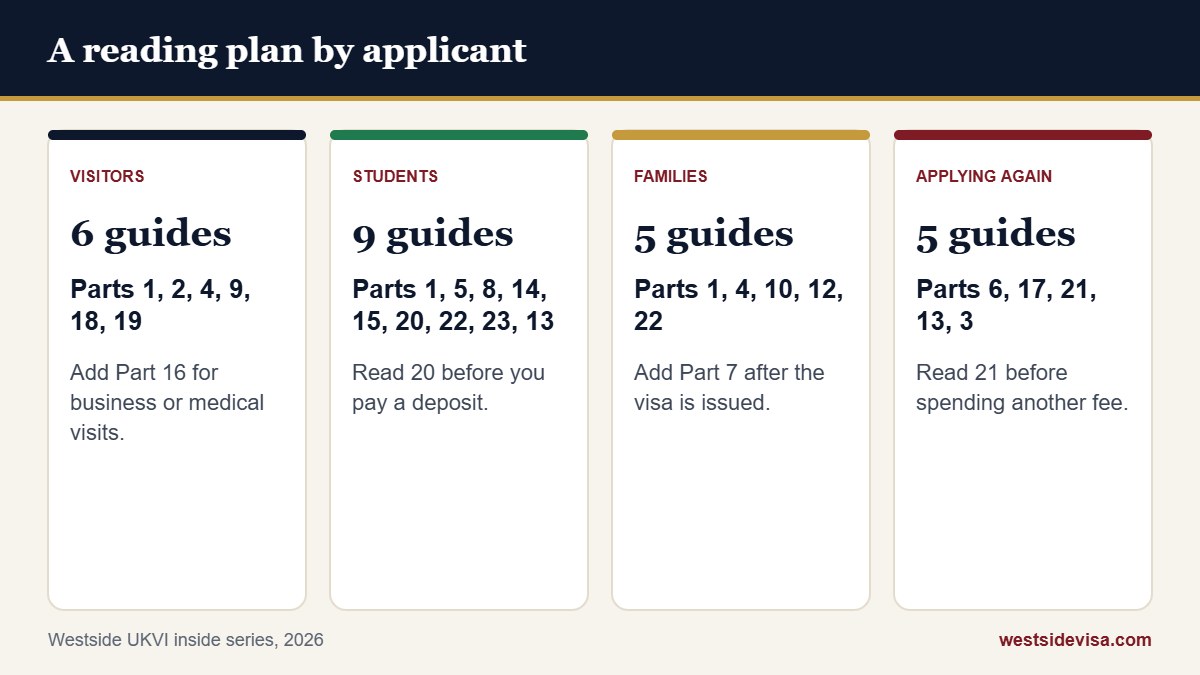
Reading plan for visitors
For a first family or tourist visit, read Part 1, Part 2, Part 4, Part 9 in that order: how the record is built, what happens in the first two days, how the bank statement and employer letter are verified, and how travel history is counted. Add Part 18 if you are considering the priority service and Part 19 before paying for a two, five or ten year visa. Business travellers and anyone coming for private medical treatment should add Part 16.
Five guides chosen well are worth more than twenty four skimmed. Photo: Unsplash.
Reading plan for students
Start before you pay anything, with Part 20 on checking the offer and the sponsor, and Part 8 on how the university itself is rated. Then prepare the three things only you can supply: funds (Part 15), English (Part 23) and the TB certificate (Part 22). Read Part 14 when the CAS arrives and Part 5 before any interview, whether with the university or the Home Office. Keep Part 13 for the day you need it. Parents funding the course should read Part 15 and Part 4 themselves, since it is their bank that will receive the call.
Start with the plan that fits, and follow the links inside each guide for the rest.
Reading plan for families
Spouses and partners should begin with Part 10, which explains how the relationship and the income are tested, then Part 4 on verification and Part 22 on the TB certificate. Where children are applying, Part 12 covers consent, biometrics and dependants. Once the visa is issued, Part 7 explains the eVisa and what the border officer already knows.
Reading plan after a negative decision
Read the decision letter beside Part 6, which explains how decisions are written and what each paragraph means. Request your file using Part 17 if the reasons are unclear, check whether a review is open to you in Part 13, and then read Part 21 before spending another fee. If an earlier decision from any country is involved, Part 3 explains how it is found. Part 11 covers withdrawing an application that is still pending.
The aim of the series is simple: fewer surprises between submission and decision. Photo: Unsplash.
Not sure how this applies to your case?
Send us your question on WhatsApp. A Westside adviser in DHA Lahore will reply, Monday to Saturday, 10:00 to 18:00.
Every guide carries the date on which its sources were checked. Fees, financial figures and clinic lists change, most often in spring and at the end of November, and the guidance documents are reissued several times a year. When a change affects a guide we add a dated update box at the top of it and say what changed. If you find a figure that differs from GOV.UK, GOV.UK is right; tell us and we will correct the guide.
Questions applicants ask
Where should I start if I only have time for one guide?
Part 1. It explains how your application becomes a record that every later officer reads, which makes every other guide easier to follow.
Is this official Home Office information?
No. Westside Visa Consultants is an independent firm. The guides are our explanation of published Home Office guidance and GOV.UK pages, each of which is linked in the guide.
Do the guides cover work visas?
No. The series covers visit, study and family routes only, which is the work of our office.
How current are the guides?
Each one states the date its sources were checked. Guides affected by later rule changes carry a dated update box.
Do I still need an adviser after reading these?
Many applicants with simple cases do not. The guides are written so that you can prepare your own file. Advice is worth paying for when there is a previous decision, complex funds or a tight date.
Are the guides available as videos?
Yes. Short videos for each part are being published on our YouTube channel and placed at the top of the matching guide.
Checked on 18 November 2026. Each guide lists its own sources. General information, not legal advice.
About the author
Mujtaba Maharvi
Mujtaba is the CEO of Westside Visa Consultants. He began his career in 2001 as Executive Secretary to the Consul General of the Republic of Korea in Karachi, co founded Westside in London in 2003, and has since guided more than 1,000 students and families through UK, European, North American and Australian visa decisions from the firm’s offices in DHA Lahore and the UK. He holds postgraduate degrees from the University of Karachi, the University of Padua, Loughborough University and the University of West London, and writes this series from more than twenty years of reading decision letters.
The guides explain how the system works. Your own file is a different question. Bring your documents to the DHA Lahore office and we will tell you where it is strong, where it is exposed and what to do first.
First Floor, 22 A, Sector A, Phase 5, DHA, Lahore · Monday to Saturday, 10:00 to 18:00
This guide is general information, not legal or migration advice. Westside Visa Consultants is an independent private advisory, not affiliated with any government, embassy or visa centre. Always check the official sources before you apply.
Watch: the whole series in 96 seconds. Part 24 of the UKVI inside series.
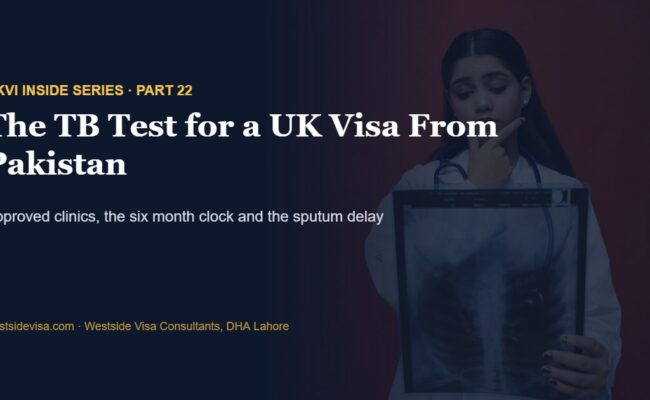
Anyone applying from Pakistan to stay in the UK for six months or more needs a TB certificate from a Home Office approved clinic. See the approved clinics in Lahore, Islamabad, Karachi and Mirpur, the fees, the six month validity, the rules for children and pregnant applicants, and what happens when a sputum test is ordered.
Apply on or before 31 December 2026 and you get 2 years. Apply on or after 1 January 2027 and you get 18 months. The date that matters is the date you submit the application, not the date your course ends.
Since 25 February 2026 most UK visit visas are eVisas, not stickers. Learn what the grant email means, how to set up and check your UKVI account, what airlines and Border Force see, and how to fix an error before you fly.
A UK PhD gives you a world class research degree, generous funding options, and, importantly, a post study advantage that survives the 2027 migration changes: doctoral graduates keep the full three year Graduate Route.
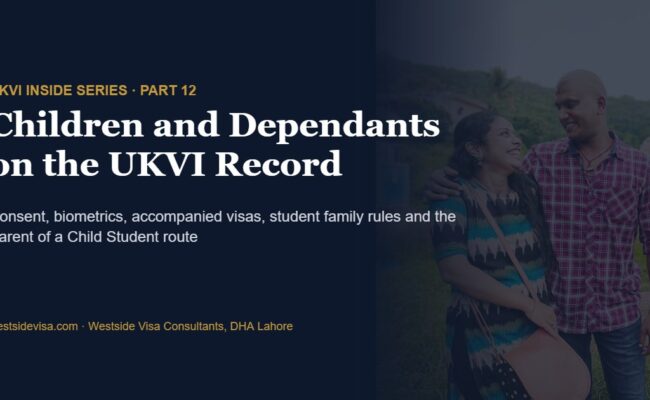
Every child on a UK visa application has their own record, their own biometrics and their own set of rules. Learn how UKVI handles parental consent, accompanied visas, child welfare checks, student dependants and the parent of a child student route.
UKVI can phone your bank, your employer and your university before deciding a UK visa. Here is who makes the call, the three possible outcomes, what a Document Verification Report records, and how to prepare.