How a UK Visa Decision Is Written: Templates, Paragraph Codes and What Each Route Lets You Do Next
Two applicants with different stories receive letters that read almost word for word the same. That is not laziness; it is the system. Decision notices are assembled from templates inside Atlas, built around a standard of proof, a set of paragraph codes and a fixed closing line about what you can do next. Learn to read the letter the way it was written and you will know exactly what went wrong and which door is still open.
By Mujtaba Maharvi, CEO, Westside Visa Consultants · 28 October 2026
Standard of proofMore likely than notThe balance of probabilities, on both sides
Visit visaReapplyNo administrative review; appeal only on human rights grounds
Student visaReview in 28 daysGBP 80, decided by a different officer
Reasons must be“Factual, clear, and relevant”And supported by evidence
The standard of proof and who carries it
Every UK visa decision is made on the balance of probabilities. The visit guidance says so in one line: “The standard of proof you must apply is the balance of probabilities,” which it defines as “more likely than not”. The same standard applies to the genuine student test, where the caseworker must be satisfied “on the balance of probability”.
Who has to prove what is the other half. The burden is on you for validity and eligibility: the funds, the purpose, the ties, the course. It shifts to the Home Office on suitability: if the officer says a document is false or a statement was dishonest, the officer must prove it, and after the Court of Appeal’s decision in Balajigari the evidence must be strong enough to justify a finding as serious as dishonesty. A letter that says “I am not satisfied that…” is telling you the eligibility burden was not met; a letter that cites a suitability paragraph is telling you the Home Office believes it has met its own burden.
A negative decision is a set of reasons, not a verdict on you. Read it the way it was written and the next application answers it. Photo: Unsplash.
Templates: why every letter sounds the same
As Part 1 explained, Atlas produces decision notices from templates. The visit guidance confirms the mechanics: visa decisions use the visit decision letter templates, border and extension decisions use “the case-working system template” with Appendix V paragraphs, and suitability decisions follow the Part Suitability guidance. There is a template for decisions that “attract a right of appeal on human rights grounds” and a “no right of appeal” template for everything else.
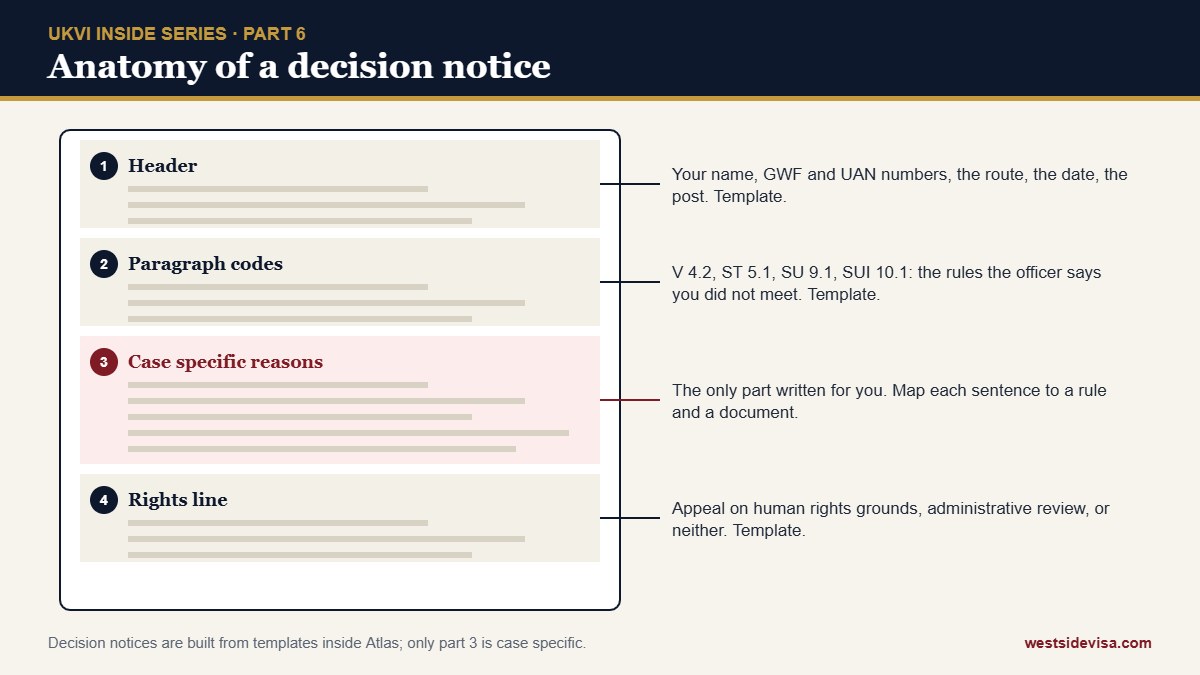
The officer chooses the template, selects the paragraph codes that apply, and types the case specific reasoning into the middle. That middle section is the only part written for you, and it is the only part worth analysing. The rest is boilerplate that tells you which template was used.
The paragraph codes and what they mean
The four parts of a decision notice. Only the third part is written for you.
Code in the letter
Route
What it says about your case
V 4.2 (a) to (c)
Visit
The officer was not satisfied you are a genuine visitor: that you will do only permitted activities, leave at the end of the visit, or not make the UK your home through frequent visits.
V 4.3 to V 4.6
Visit
Funds, maintenance and accommodation, or prohibited activities such as work or study beyond the permitted limits.
ST 5.1
Student
The genuine student requirement, almost always after an interview (Part 5).
ST 12 and Appendix Finance
Student
The money: the 28 day rule, the 31 day rule, or a bank that could not be verified (Part 4).
SU 9.1
Any
Mandatory decision for proven deception. Carries the 10 year bar.
SUI 10.1
Any
Discretionary decision for a false representation, false document or non disclosure where deception by you was not proven. No bar.
SUI 14.1(a)
Any
You did not attend an interview or supply requested information without a reasonable explanation.
Older letters from the CID era cite paragraph 320 of the Rules and the V 4.2 wording in its pre 2020 form. The numbering changed; the substance did not. If you are reapplying after an older decision, the new officer reads the old letter on your person record and maps it to the current codes.
What a decision notice must contain
The guidance sets a minimum. Reasons “must be factual, clear, and relevant to the application”, and any ground for a negative decision or cancellation “must be supported by evidence”. For students, a decision on credibility grounds must “clearly set out” the allegations, the reasoning and the argument, and must “accurately reflect the transcript” of any interview. For visit cases the officer must assess all the information provided and any relevant locally held information, and the Part Suitability guidance says when adverse information must be put to you before a decision is made.
What the letter need not contain is the Document Verification Report or the risk profile that routed your case. Both exist on the record; neither is sent. Part 4 explains how to ask for the DVR, and Part 1 how a subject access request shows the case notes.
When a letter is not good enough: Sughra v ECO
In 2022 the Court of Session in Scotland set aside a visit decision made against a Pakistani mother who wished to spend two months with her daughter in Glasgow. The officer accepted that the daughter could support her, but was “not satisfied” she would leave, writing: “You state that you are retired and are supported by your sons in your home country, however the documents you have submitted do not demonstrate this.” The sponsor had sworn a statutory declaration describing exactly that support, and the letter never mentioned it. Lord Ericht held that the applicant “is entitled to a clear statement of the reasons for rejection of the evidence”, especially where the evidence goes to the central issue, and that the court would not guess whether the officer had overlooked it or discounted it.
The lesson is not that every letter can be challenged in court; judicial review is slow, expensive and rare. The lesson is about reading. If your letter states a conclusion without engaging with a document you supplied on that exact point, the problem is the reasoning, not your case, and the cure is a reapplication that puts the same evidence back in front of a different officer, labelled so it cannot be missed.
The middle option: a shorter visa
Decisions are not always yes or no. For visit visas the guidance tells officers that where all the rules are met but “some aspects remain of concern, you should consider whether to grant a short duration visa”, and that residual doubts must be recorded. A six month visit visa where you asked for two years, or a single entry visa where you asked for multiple entry, is the visible sign of a recorded doubt. It will be on your person record when you next apply, so the next application should address the doubt even though the last one was granted.
Not sure how this applies to your case?
Send us your question on WhatsApp. A Westside adviser in DHA Lahore will reply, Monday to Saturday, 10:00 to 18:00.
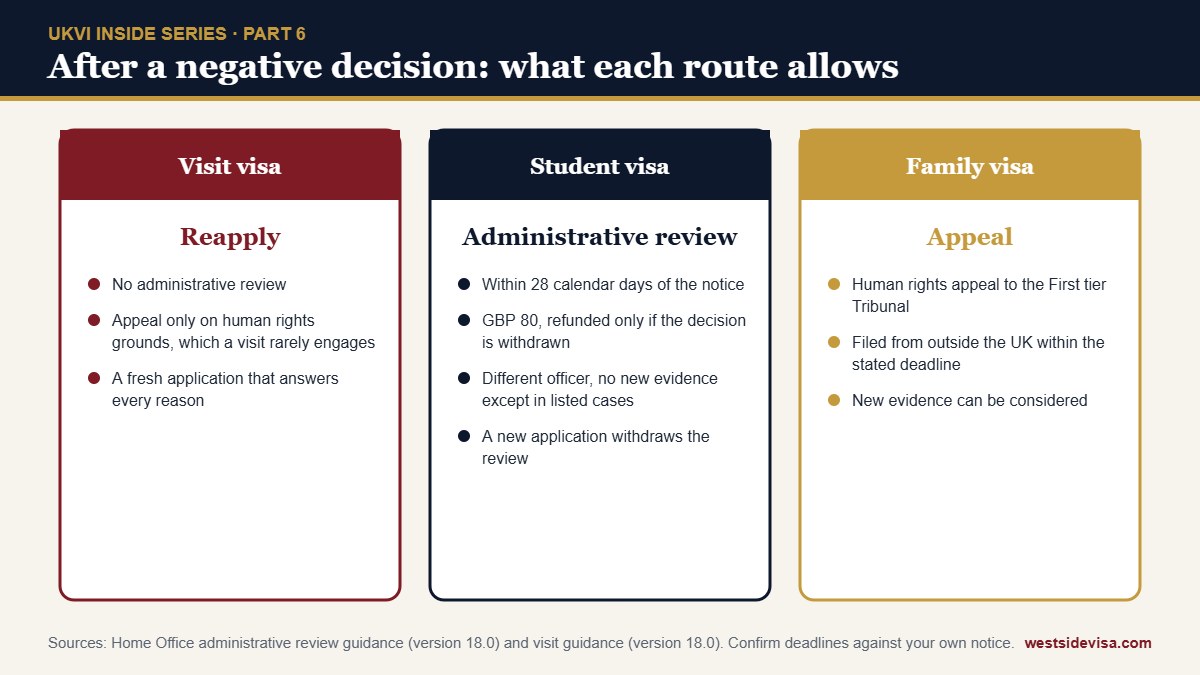
Three routes, three different doors. The closing line of your letter tells you which one you have.
Visit visa: there is no administrative review, and the overseas eligibility list in the administrative review guidance contains no visitor route. An appeal exists only where the decision engages human rights, which a tourism or family visit rarely does. The practical remedy is a fresh application that answers every reason in the letter.
Student visa: an administrative review of the decision is available, within 28 calendar days of receiving the notice, for GBP 80.
Family and settlement visas (spouse, partner, parent): most decisions carry a right of appeal to the First tier Tribunal on human rights grounds, filed from outside the UK. Appeals are a separate subject and we cover them in a later guide.
Administrative review, step by step
Administrative review is a paper check for “case working error”, carried out “by a different person on an independent team”; anyone who touched the original decision is excluded. The reviewer looks for an incorrect application of the Rules, a failure to apply published policy and guidance, an incorrect Part 9 or suitability decision, or a failure to request documents under evidential flexibility. The fee is GBP 80, refunded if the decision is withdrawn, not refunded if it is maintained.
Three rules decide whether it is worth it. First, the reviewer “cannot consider new evidence”, except in a few listed situations such as deception or false representation findings, where you normally get 14 days to respond. A review cannot fix a thin file; it can only fix a wrong reading of a good one. Second, making a new application while the review is pending means “the administrative review application will be treated as withdrawn”. Choose one path. Third, outcomes range from decision maintained, through maintained with incorrect reasons removed or new reasons added (which opens a second review), to withdrawn and remade, usually as a grant.
When we recommend review: the letter misstates a figure that is plainly on the bank statement; the officer applied an old rule to an application made after the rule changed; a genuineness decision was made with no interview and no exception applies; or the decision ignores a document that is clearly in the file. When the problem is the evidence itself, we recommend a reapplication instead.
Most visit applicants who reapply well travel within months. The letter tells you exactly what to fix. Photo: Unsplash.
Reapplying well
Map every sentence of the reasons to a rule paragraph and a document. The letter has three or four reasons at most; each one needs a specific answer, not a longer cover letter.
Assume the next officer has the last letter open. They do; it is on your Atlas person record. Address the earlier doubt directly in the first paragraph of your statement.
Change what was weak, not what was fine. A new sponsor, a new bank or a new purpose creates new questions. Strengthen the point that failed.
Fix verification before you file. If a document could not be verified, the same document will fail again. Part 4 explains how to make it verifiable.
Do not reapply within days. Nothing in the rules prevents it, but an identical file resubmitted a week later reads as hoping for a different officer, and the guidance tells officers to treat repeated near identical applications with suspicion.
This completes the first six guides in our series on how UKVI handles an application from the inside. Start from Part 1: how the Atlas system sees you if you have not read it, and watch this space for Part 7.
Questions applicants ask
What does “I am not satisfied that you are a genuine visitor” mean?
It means the officer applied V 4.2 and found, on the balance of probabilities, that the evidence did not show you would do only permitted activities and leave at the end of the visit. It is an eligibility finding, not an accusation of dishonesty.
Can I ask for an administrative review of a visit visa decision?
No. The overseas eligibility list for administrative review contains no visitor route. The remedy is a fresh application that answers each reason, or, rarely, a human rights appeal where the visit engages family life.
How long do I have to request a review of a student decision?
28 calendar days from receiving the decision notice, for a fee of GBP 80. New evidence is not considered except in listed cases such as deception findings.
Why did I get a six month visa when I applied for two years?
The guidance allows a shorter visa where the rules are met but some aspects remain of concern. The doubt is recorded on your person record, so address it in your next application.
Does a negative decision stay on my record?
Yes. The decision and its reasons sit on your Atlas person record and are visible to every future officer, in the UK and, through fingerprint sharing, in four other countries. Part 1 and Part 3 explain this.
Should I reapply straight away?
Only after fixing the specific point that failed. An identical application filed days later invites the same answer and a note about repeat applications on your record.
Checked on 28 October 2026. General information, not legal advice; appeal and review deadlines are strict and you should confirm them against your own notice.
About the author
Mujtaba Maharvi
Mujtaba is the CEO of Westside Visa Consultants. He began his career in 2001 as Executive Secretary to the Consul General of the Republic of Korea in Karachi, co founded Westside in London in 2003, and has since guided more than 1,000 students and families through UK, European, North American and Australian visa decisions from the firm’s offices in DHA Lahore and the UK. He holds postgraduate degrees from the University of Karachi, the University of Padua, Loughborough University and the University of West London, and writes this series from more than twenty years of reading decision letters.
Send Westside Visa Consultants the notice and we will map every reason to the rule and the document behind it, then tell you honestly whether to review, reapply or wait. No fee for the first reading.
First Floor, 22 A, Sector A, Phase 5, DHA, Lahore · Monday to Saturday, 10:00 to 18:00
This guide is general information, not legal or migration advice. Westside Visa Consultants is an independent private advisory, not affiliated with any government, embassy or visa centre. Always check the official sources before you apply.
Choosing where to do your PhD is one of the biggest decisions of your academic life, and the four leading English speaking destinations each offer something different.
You worked hard for your UK degree now stay and turn it into a career. The Graduate Route (post study work visa) lets you live and work in the UK after graduating, with no job offer and no sponsorship needed.
Submitted your UK visa application? Here is what UKVI does in the first 48 hours: validity checks, biometrics, the 240 day rule, allocation to a decision centre and why the clock starts later than you think.
Before an officer opens your UK visa file, your details are run against watchlists, past travel, fingerprint records in five countries and risk profiles. Here is what is checked and how to prepare.
Apply on or before 31 December 2026 and you get 2 years. Apply on or after 1 January 2027 and you get 18 months. The date that matters is the date you submit the application, not the date your course ends.