

How to Apply for a UK Visitor Visa for Under 18s from Pakistan
Planning to send your child to the UK for a holiday, to visit family, or for a short course?



Home / News and Articles / How UKVI works
UKVI inside series · Part 3By the time an officer opens your application, a good deal has already happened to it. Your identity has been matched against Home Office records, your fingerprints may have been checked in four other countries, your past travel has been pulled up, and a routing tool has decided how much scrutiny you get. This guide explains those checks, what is published about them, and what remains behind closed doors.
The first automated step is identity. Your fingerprints and facial image are matched against the Home Office’s biometric holdings, which include every previous visa enrolment, border records and asylum records. The published guidance lists the purposes: linking a person to their identity, “checking applications against existing records”, and confirming identity at the border when documents alone cannot. Checks against police databases are also permitted for preventing and investigating offences.
A match links your new application to your existing person record. That is how an officer sees a 2015 application made under a maiden name, or a visit made on an old passport, without you mentioning either.

Airlines send passenger details to the Home Office before every flight to the UK, and Border Force records entries and, through exit checks, departures. The result is a travel history on your record that the officer can compare with the one you declared. Gaps are noticed: a stay that ran longer than your visa allowed, or trips you forgot to list. Declare every UK trip, including transit, and make sure the dates match your passport stamps.
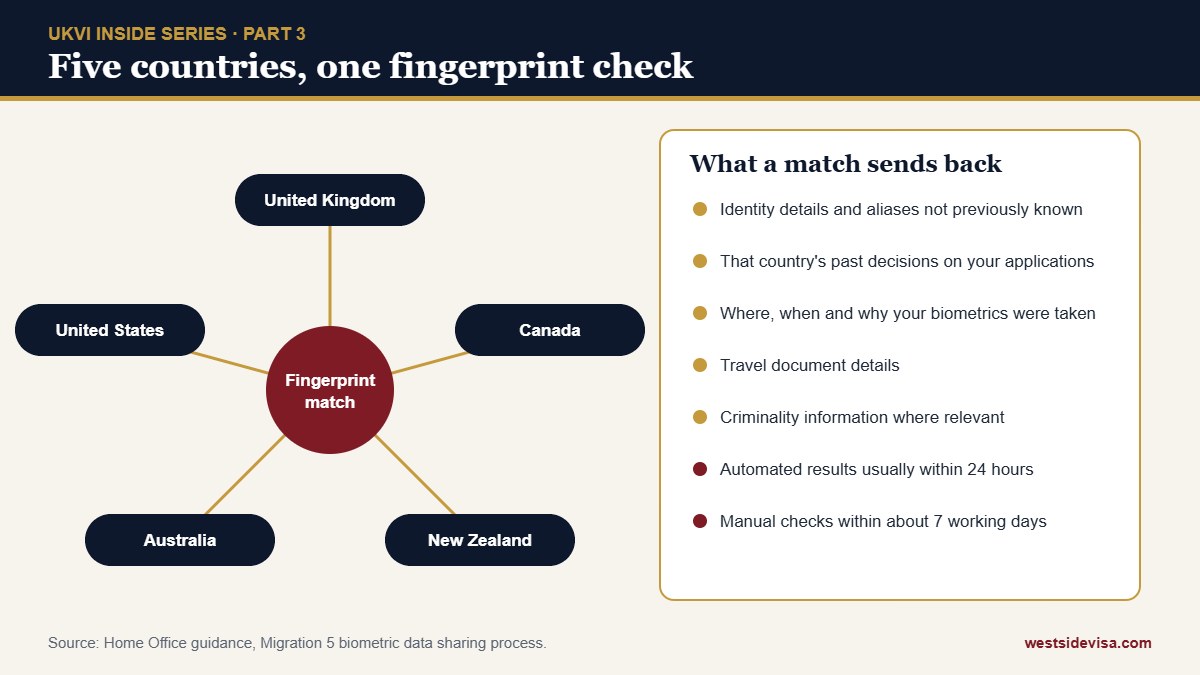
The UK, Australia, Canada, New Zealand and the United States share visa and border fingerprints under what the Home Office calls the Migration 5 arrangement. Its published guidance says a match “confirms that fingerprints captured by the Home Office belong to the same individual” held by another country, and can return “previously unknown identity details and aliases”, that country’s past decisions on your applications, where and when your biometrics were taken and why, travel document details and, where relevant, criminality information.
Timescales are short. Automated checks “will usually have results available within 24 hours”; manual checks within about 7 working days. Officers are told to record any new aliases on Atlas and to consider the match alongside the rest of the evidence.
The practical point: an undeclared negative decision from the United States, Canada or Australia is one of the easiest things for UKVI to find. The form asks about decisions by other countries; answer it fully.
From 2015 the Home Office used a “streaming tool” that rated every visa application red, amber or green. Nationality was one of the inputs, and nationalities on an internal risk list received an automatic red rating. Red cases needed more scrutiny and a senior officer’s sign off to grant. The figures later disclosed were stark: about 99.5% of green rated applications were granted against 48.6% of red rated ones.
In 2020 the Joint Council for the Welfare of Immigrants, represented by the law firm Foxglove, challenged the tool as discriminatory. On 3 August 2020 the Government Legal Department confirmed the Home Office would stop using it before the case was heard, and committed to a redesign in which nationality “will not be taken into account”.
The replacement, inspected in 2023, routes visit applications by four “person centric attributes” (recent travel, trip cost against income, two years of employment, and a stay under one month) plus a set of risk profiles. The inspector counted 42 profiles. One routed four low risk nationalities straight to the simple queue; the other 41 routed cases to the complex queue and covered 21 nationalities. Profiles may only differentiate by nationality for countries on a ministerial authorisation list that is meant to be refreshed twice a year.
The inspector also found practices outside policy: local “OneNote” notebooks and lists of bank accounts used as unofficial risk profiles, an age group routed to the simple queue with no written policy, a seven year travel look back where policy said five, and at one centre first time travellers from Africa referred for senior review with no clear basis. The Home Office accepted a recommendation to stop practices that did not comply with policy.
What this means for you: complexity routing is based mostly on what you declare and what the record already shows, not on your passport alone. But local practice varies, and an application that matches a profile goes for “enrichment” (extra checks) before any decision.
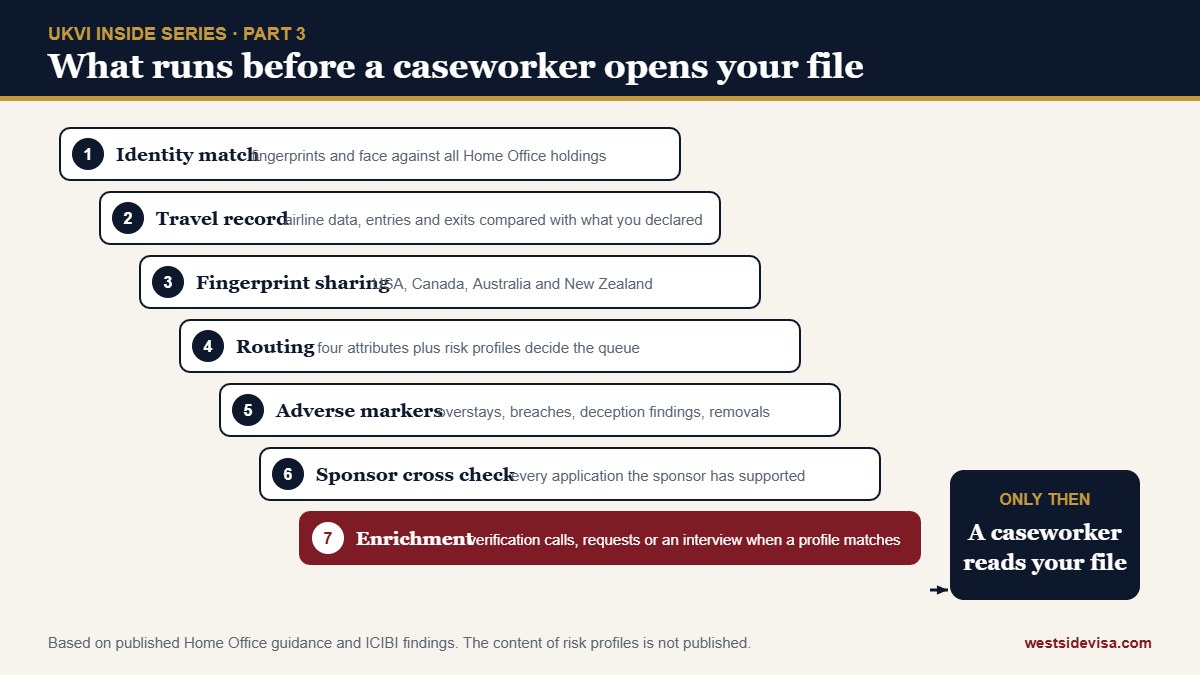
Certain events stay on a person record and are checked automatically: a previous overstay, a breach of visa conditions, a finding of deception, a removal or a deportation order. The biometrics guidance allows fingerprints to be kept for longer in such “high harm” cases, including past deportation or exclusion orders and absconding. A deception finding carries a possible 10 year bar from entry clearance, and it travels with you across every future application.
Not sure how this applies to your case?
Send us your question on WhatsApp. A Westside adviser in DHA Lahore will reply, Monday to Saturday, 10:00 to 18:00.
Ask on WhatsAppA UK sponsor’s name and address are cross referenced against every application they have ever supported. A relative in Bradford who has invited six visitors in two years, one of whom overstayed, is a known quantity to the system before your application is read. The same applies to UK addresses, employers and, for students, the university’s sponsor record and its visa outcome rate.
For family routes, the Home Office can verify a sponsor’s declared income against HMRC records and benefit claims against DWP records; the data protection documents for the digital status service list DVLA, DWP, HMRC, the NHS and the Student Loans Company among the bodies with linked access. For visit visas these checks are less routine, but a UK sponsor’s claimed income can still be tested where the trip relies on it.
Caseworker guidance allows open source checks where there is a reason to doubt an application. The Home Office does not publish how often this happens. The safe assumption is that a public profile which contradicts your application (a job you did not declare, a relative in the UK you did not mention, a relationship you said does not exist) can be found and used.
Part 4 of this series, coming shortly, will explain how UKVI verifies Pakistani documents, including the calls made to banks and employers. Start from Part 1: how UKVI sees your application if you have not read it yet.
The streaming tool was withdrawn in August 2020. The replacement routes applications by declared attributes and risk profiles. Nationality can only feature for countries on a ministerial authorisation list, and most profiles are based on other factors.
Very likely. Fingerprints are shared with the United States, Canada, Australia and New Zealand, and a match returns that country’s past decisions and any aliases.
Yes. Sponsors are cross referenced against every application they have supported, and the outcomes of those applications form part of the picture.
Generally up to 15 years from enrolment for prints taken from July 2021, longer for settled status or high harm cases, and reusing them on a new application can restart the period.
Guidance permits open source checks where there is reason to doubt an application. How often this happens is not published.
Checked on 27 October 2026. The Home Office does not publish the content of its risk profiles; this guide relies on the inspector’s published findings. General information, not legal advice.

Mujtaba is the CEO of Westside Visa Consultants. He began his career in 2001 as Executive Secretary to the Consul General of the Republic of Korea in Karachi, co founded Westside in London in 2003, and has since guided more than 1,000 students and families through UK, European, North American and Australian visa decisions from the firm’s offices in DHA Lahore and the UK. He holds postgraduate degrees from the University of Karachi, the University of Padua, Loughborough University and the University of West London, and writes this series from more than twenty years of reading decision letters.
Connect with Mujtaba on LinkedIn · About Westside · WhatsApp the office
Confirmed visa changes for Pakistani students, visitors and families, checked against official sources.
Westside Visa Consultants reviews your history, your sponsor and your evidence the way UKVI will, before anything is submitted. Honest advice from DHA Lahore, fees quoted in writing.
First Floor, 22 A, Sector A, Phase 5, DHA, Lahore · Monday to Saturday, 10:00 to 18:00
This guide is general information, not legal or migration advice. Westside Visa Consultants is an independent private advisory, not affiliated with any government, embassy or visa centre. Always check the official sources before you apply.


A curated list of the most popular travel packages based on different destinations.
Planning to send your child to the UK for a holiday, to visit family, or for a short course?
Seeking world class medical care in the UK? It’s absolutely within reach.
UK visa decision letters are built from templates inside Atlas. Learn the standard of proof, the paragraph codes (V 4.2, ST 5.1, SU 9.1, SUI 10.1), what a letter must contain, and the options for visit, study and family applicants.
Dreaming of studying at a world class UK university?
Already in the UK as a visitor and wondering if you can stay longer or switch to another visa? The honest answer is: it’s possible in some cases, but far more limited than most people think.
The Home Office has raised the money you must show for a UK Student visa. From 30 November 2026 the monthly figure goes up to £1,570 in London and £1,203 outside London. If you are aiming for a January 2027 start, the date you apply now decides which…
Some families are separated by borders but they don’t have to stay that way. The UK Family visa lets a parent or child join their family member who is British or settled in the UK, and build a permanent life together.
A UK PhD gives you a world class research degree, generous funding options, and, importantly, a post study advantage that survives the 2027 migration changes: doctoral graduates keep the full three year Graduate Route.