
How to Apply for a UK Visitor Visa for Under 18s from Pakistan
Planning to send your child to the UK for a holiday, to visit family, or for a short course?



Home / News and Articles / How UKVI works
UKVI inside series · Part 5An email arrives inviting you to an interview. Most applicants assume it means something is wrong. Usually it means something in the file matched a pattern, or that the officer cannot decide a genuineness question without hearing you. This guide explains how UKVI decides whom to interview, how the student credibility interview and the visit interview are run, the questions that come up, and why the written transcript, not the conversation, is what decides the case.
The published guidance describes three situations in which a person is interviewed before a decision.
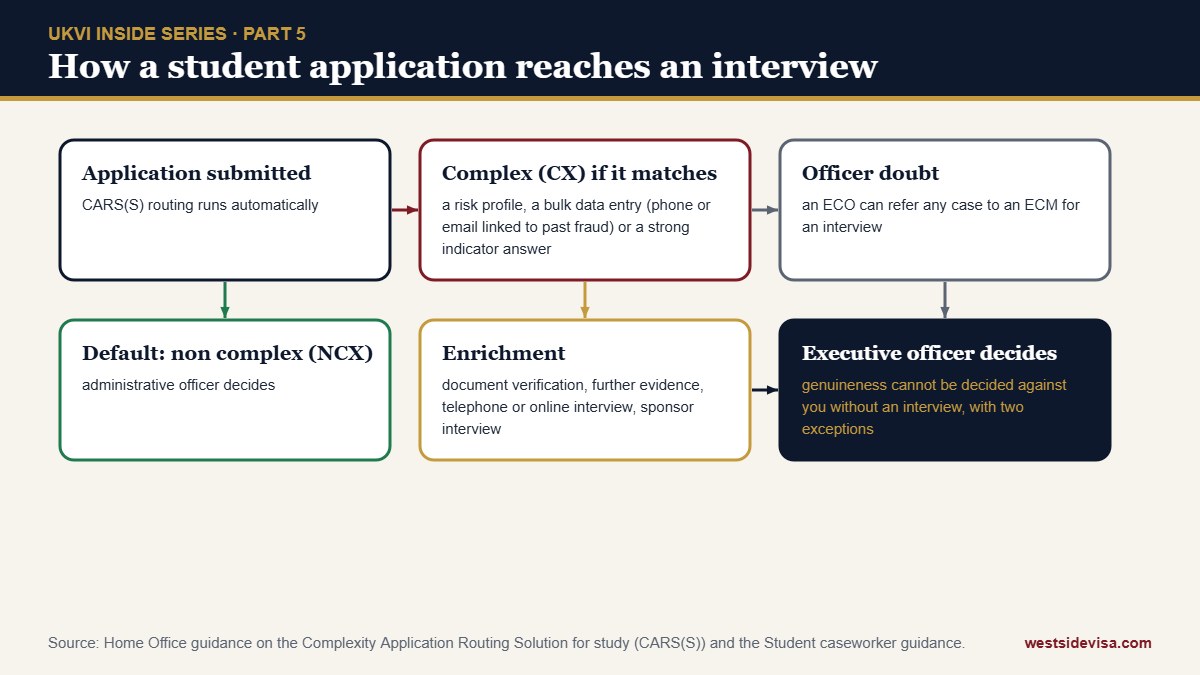
For students, the Home Office publishes the routing logic. The Complexity Application Routing Solution for study, CARS(S), has applied to Student applications since 14 August 2023. It “is a fully automated routing solution” but “is not automated decision making or machine learning”; it only decides which grade of officer sees the file. The guidance says “the default routing for all applications at the start of this process is NCX”, that is non complex. An application becomes complex when it matches a risk profile (“combinations of attributes” linked to past harm to the system), a bulk data table entry (email addresses and phone numbers linked to past fraud) or a strong indicator answer on the form, the example given being “answering yes to any criminality question”.
Complex cases go for “more rigorous scrutiny”, which can include enrichment, a senior caseworker referral or a decision assurance check. Enrichment includes “document verification, requests for further evidence, and interviews of the applicant or a sponsor”, with a “telephone or online interview” named specifically. Any bulk data match must be confirmed by the enrichment team; a wrong match sends the case to an executive officer without enrichment. Nationality based profiles are only permitted for countries covered by a ministerial authorisation.
Outside the automated routing, an officer who doubts an application can refer it. For overseas student cases the Entry Clearance Officer refers to an Entry Clearance Manager, who authorises the interview and considers the risk factors. University advice sheets describe selection as either random or based on “the perceived level of risk”. Both are correct: sampling exists, and so does targeting.
Students have a protection visitors do not. The caseworker guidance says an application must not be decided against on genuineness grounds without an interview, with two exceptions: where the applicant was previously turned down on the same ground and nothing material has changed, or where a sample of a large number of near identical applications at that post was interviewed and found not genuine. So a first time student applicant from Lahore who is thought not to be genuine must be given the chance to explain before the decision is made. If your student application is turned down on genuineness grounds and you were never interviewed, that is itself a point for administrative review.
For in country cases the caseworker submits an interview referral, authorised by a manager, to an interview administration team, which schedules the interview and sends an invitation letter. Overseas, after Entry Clearance Manager authorisation, you are contacted by email or telephone and given “a designated time and location”. University guidance adds the practical point: “Check your emails regularly (junk folder too).” Interviews are conducted by telephone or online; the applicant on a telephone interview must first confirm they can hear and answer questions. Parts of the interview section of the guidance are marked restricted and withheld.

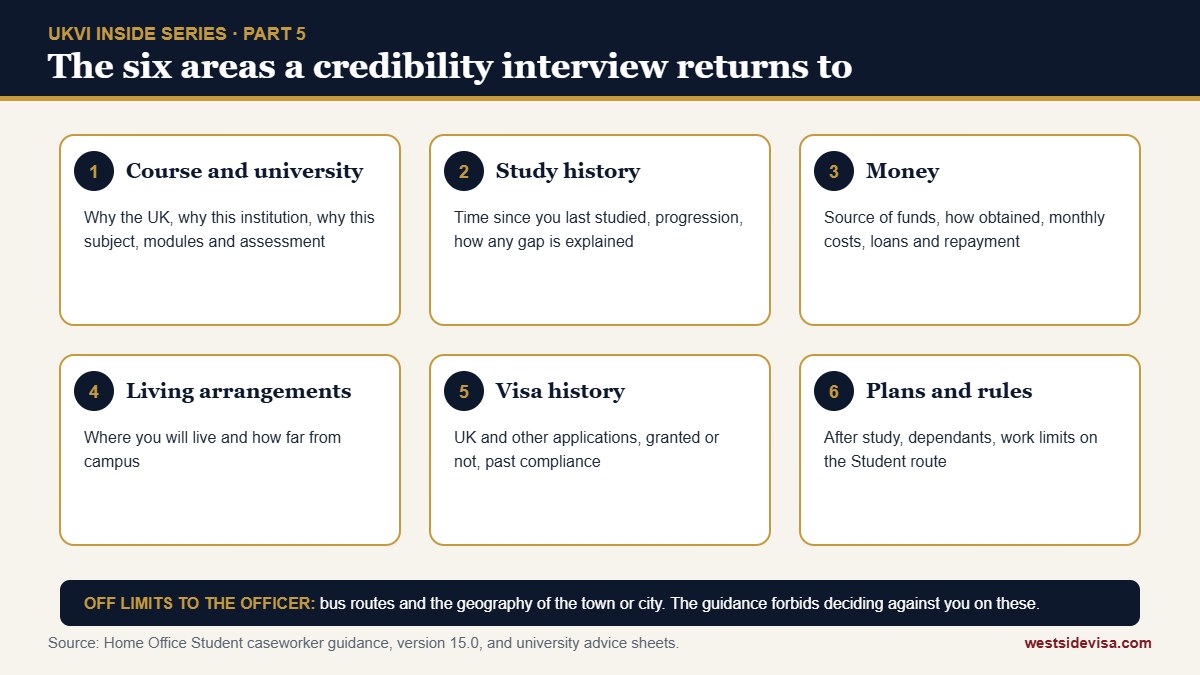
The caseworker guidance lists the factors behind the genuine student test, and the interview follows them. Expect questions on:
The guidance also names two institutional factors: whether the provider “is under investigation” or is otherwise of concern to UKVI, and whether the agent is one “the Home Office has concerns about”. Those are not questions you can answer at interview; they are reasons to choose your university and your adviser with care.
Caseworkers are told they must not decide against an applicant based on “a lack of knowledge of bus routes, or of the geography of the town or city”. A decision on credibility grounds must “clearly set out” the allegations, the reasoning and the argument. Where a main reason for the application appears to be benefits for dependants, the caseworker must consider genuineness carefully, but the guidance does not treat having a family as a mark against you. English ability can be used as a factor only if the decision letter justifies it.
Not sure how this applies to your case?
Send us your question on WhatsApp. A Westside adviser in DHA Lahore will reply, Monday to Saturday, 10:00 to 18:00.
Ask on WhatsAppThe interview is in English without an interpreter. You already proved English for the CAS, so the officer is not testing grammar. What they listen for is whether your answers are your own: a rehearsed paragraph about “world class education and multicultural exposure” reads as coached; a halting but specific answer about why you chose a data science conversion course after three years in a Karachi bank reads as genuine. Short, concrete, personal answers do better than fluent generic ones.
If you fail to attend “without reasonable explanation”, the caseworker must consider deciding against you under SUI 14.1(a). A new date is only possible where the reasons are adequate and the interview team is reasonably satisfied; where the interviewer confirms non attendance with no reason or an unacceptable one, the guidance is blunt: the caseworker must decide against the application. A missed email is not a reasonable explanation. Check the inbox you used on the form every day from the moment you pay.
This is the part most applicants misunderstand. The person who interviews you is often not the person who decides. The interviewer produces a transcript; the decision maker reads it. The guidance requires that a negative decision “must accurately reflect the transcript or transcripts of the interview”, cover the information obtained at interview, and explain the reasons fully. It adds that credibility decisions are subjective and that the record matters for any administrative review.
Three consequences. First, what you meant does not count; what was typed counts. Speak slowly and let the interviewer finish writing. Second, every answer should be consistent with the application form and the CAS, because the decision maker has both in front of them. Third, ask for the transcript. University advice sheets tell students to write down their answers immediately afterwards and to “ask to receive a transcript of the interview”. If a decision later misquotes you, the transcript is your evidence.
If you admit to a false document or statement at interview, the guidance requires the decision to be made under SUI 10.1 and your credibility across the whole file is gone. If a document in your file was supplied by someone else and you doubt it, say so before the interview, not during it. Part 4 explains why.

Part 6 of this series explains how a UK visa decision is actually written, and what each route lets you do next.
Not necessarily. Student interviews are either sampled or triggered by a risk profile or data match, and the guidance says the rule must be targeted where there is evidence of risk. It is a chance to confirm what the file already says.
Only in two situations: a previous decision on the same ground with no material change, or a sampled batch of near identical applications. Otherwise the guidance requires an interview first.
An interviewer produces a transcript; the decision maker, who may be a different officer, reads it. The decision must accurately reflect the transcript.
The caseworker must consider deciding against you under SUI 14.1(a). A new date is only given where the interview team accepts your reason.
The interview is of you alone, and your answers must be your own. Preparation happens before, not during.
They may, but the guidance forbids deciding against you for “a lack of knowledge of bus routes, or of the geography of the town or city”. Course, money and plans matter far more.
Checked on 28 October 2026. Parts of the interview guidance are withheld as restricted; this guide relies on what is published. General information, not legal advice.

Mujtaba is the CEO of Westside Visa Consultants. He began his career in 2001 as Executive Secretary to the Consul General of the Republic of Korea in Karachi, co founded Westside in London in 2003, and has since guided more than 1,000 students and families through UK, European, North American and Australian visa decisions from the firm’s offices in DHA Lahore and the UK. He holds postgraduate degrees from the University of Karachi, the University of Padua, Loughborough University and the University of West London, and writes this series from more than twenty years of reading decision letters.
Connect with Mujtaba on LinkedIn · About Westside · WhatsApp the office
Confirmed visa changes for Pakistani students, visitors and families, checked against official sources.
Westside Visa Consultants runs mock interviews in Lahore that follow the published question areas, so your answers are your own and match your file. Book a session on WhatsApp.
First Floor, 22 A, Sector A, Phase 5, DHA, Lahore · Monday to Saturday, 10:00 to 18:00
This guide is general information, not legal or migration advice. Westside Visa Consultants is an independent private advisory, not affiliated with any government, embassy or visa centre. Always check the official sources before you apply.




A curated list of the most popular travel packages based on different destinations.
Planning to send your child to the UK for a holiday, to visit family, or for a short course?
Some families are separated by borders but they don’t have to stay that way. The UK Family visa lets a parent or child join their family member who is British or settled in the UK, and build a permanent life together.
Seeking world class medical care in the UK? It’s absolutely within reach.
Moving to the UK is only truly complete when your loved ones are with you. The Dependant visa lets the partner and children of a UK visa holder join them to live, work, and study in the UK.
UKVI can phone your bank, your employer and your university before deciding a UK visa. Here is who makes the call, the three possible outcomes, what a Document Verification Report records, and how to prepare.
A UK PhD gives you a world class research degree, generous funding options, and, importantly, a post study advantage that survives the 2027 migration changes: doctoral graduates keep the full three year Graduate Route.
Yes, you really can visit the UK and it’s more achievable than you think.
Some UK universities have paused Pakistani applicants under stricter Home Office rules. Here is why, and how to choose a university that will issue your CAS for 2027.