How UKVI Verifies Your Documents: Bank Statements, Employer Letters and the Document Verification Report
Somewhere between your biometrics and the decision, a person you will never meet may telephone your bank in Gulberg, email your employer’s HR department or write to your university. What they are told, or not told, can decide your case. This guide explains how verification works, who does it, the three outcomes it can produce, and the one document most applicants never see: the Document Verification Report.
By Mujtaba Maharvi, CEO, Westside Visa Consultants · 28 October 2026
Who is checkedBanks, employers, universitiesAny issuer of a supporting document
OutcomesThreeGenuine, false, or unable to verify
Unverifiable fundsNot countedStudent applications fail on the money
Proven deception10 year barMandatory since 1 December 2020
Why documents are verified at all
The Home Office puts the burden on you. Its guidance says plainly that “the burden of proof is on the applicant to show that they meet the requirements of the Rules.” A bank statement or an employer letter is only evidence if the officer believes it, and the officer is told to check “if they have any doubts about whether the supporting documents an applicant has submitted are genuine”.
In Part 3 we explained how a visit application that matches a risk profile is sent for “enrichment” before any decision. Document verification is the most common form of enrichment. It is not an accusation; it is a routine check that is applied more often to some countries, some document types and some patterns than others.
Every statement and letter in your file can be traced back to the organisation that issued it. Photo: Unsplash.
Validation and verification are different things
Home Office guidance separates two processes. Validation is the examination of the document itself: “we will check for damage, counterfeiting or potential fraudulent tampering.” Passports and travel documents are examined by trained staff, by the Risk and Liaison Overseas Network (RALON) at the visa post, or by the National Document Fraud Unit, and the result goes on a Document Examination Record.
Verification is the process of “confirming the authenticity of a document and the information on it” by going to the source. For supporting documents (bank statements, employment letters, degree certificates, sponsorship letters) that means contacting the organisation that issued it. Digital documents are verified on the issuing authority’s official website, never by scanning a QR code, and the guidance tells staff to treat every digital document as non contemporaneous, which is why a printed, stamped statement still carries weight.
Who makes the call
The published verification guidance names the teams. Overseas, the visa post’s “enrichment” team carries out checks and records the result; posts without such a team must still produce the fullest report they can. Inside the UK, verification is done by the Temporary Migration Enrichment Unit, the Permanent Migration Fraud and Verification Team, or through the British High Commission in the applicant’s country. For UK based sponsors, HMRC records can be used to check declared earnings.
RALON has a second role. It distributes intelligence notifications about document types known to be falsified in a particular country, and its trend reports can themselves be cited as evidence that a document is false. If a particular style of employer letter or a particular bank branch has featured in past fraud, every application carrying that document type is read with that knowledge.
What your bank or employer is asked
The guidance gives staff example questions for each type of issuer. For a bank: does the account exist, is it in this name, do the balances and transactions match the statement supplied, and when was the statement issued. For an employer: is this person employed, in what role, since when, at what salary, and did you issue this letter. For a university or college: did you issue this certificate or offer, did this person complete the course, and are the dates and grades correct. A Confirmation of Acceptance for Studies is not verified with the university at all; it is checked against the Home Office’s own sponsor management system.
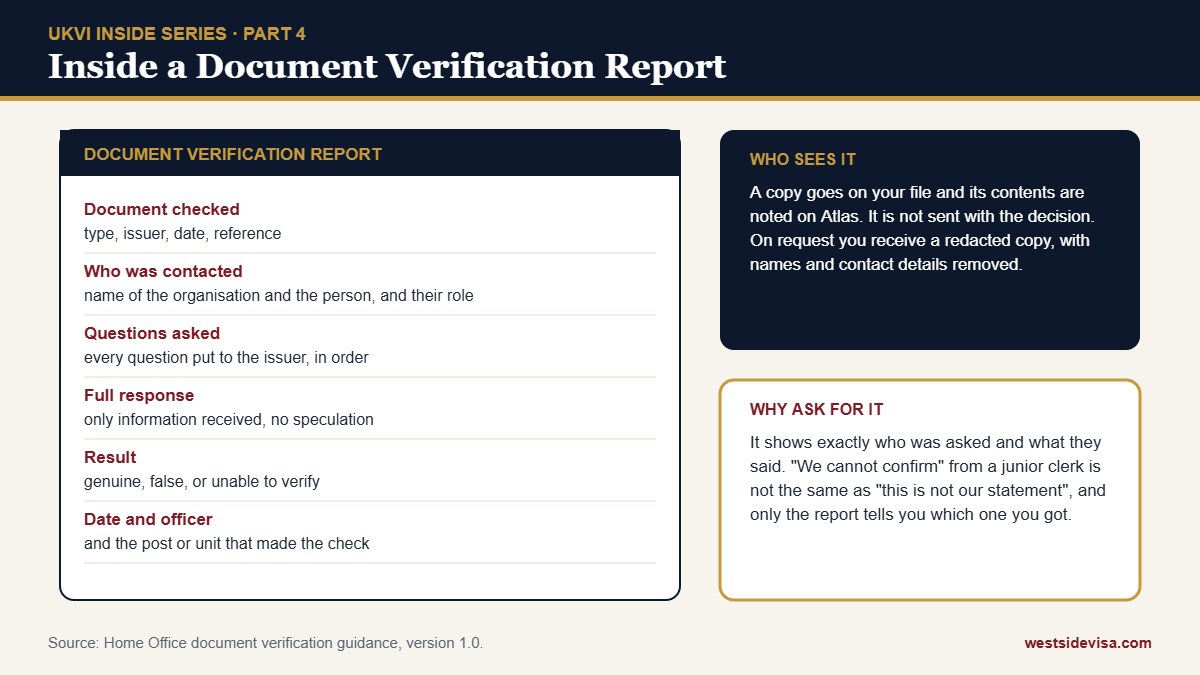
The verifying officer must record who they spoke to and in what role, the questions asked, and the full response, “including only information received” and without speculation. That record becomes the Document Verification Report described below.
The three outcomes
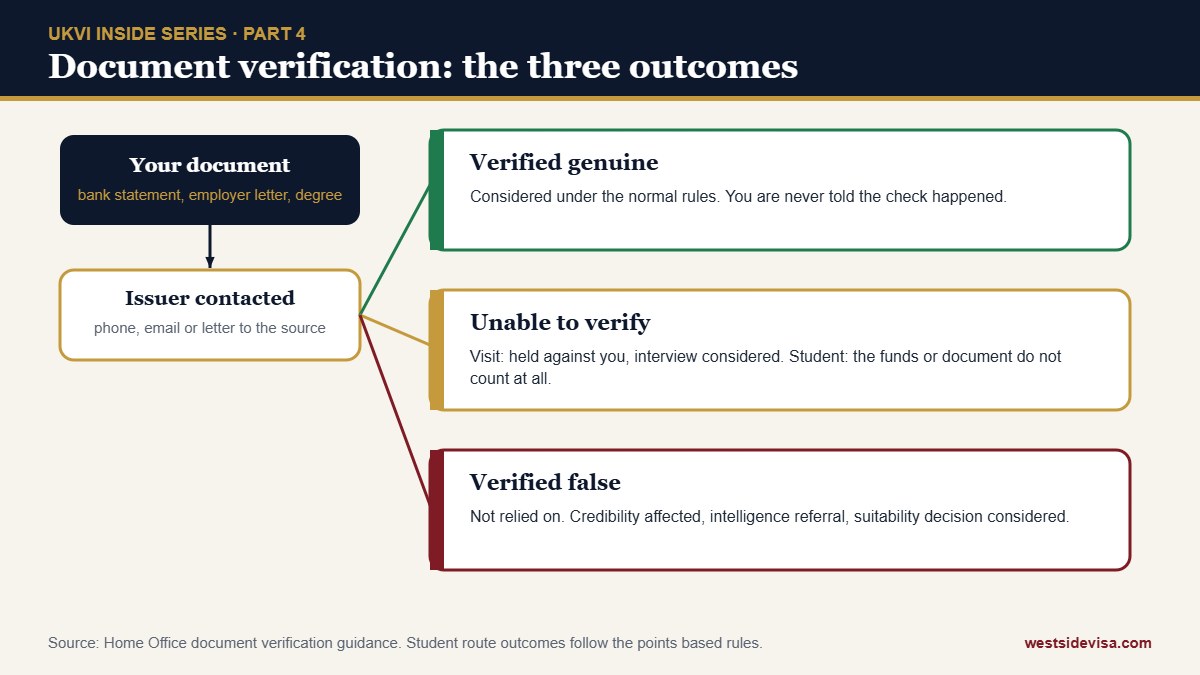
Verification ends one of three ways, and the middle outcome is the one that catches honest applicants.
Verified genuine. The document is considered under the normal rules, and nothing further happens. You are never told the check was made.
Verified false. The information “must not be relied on”. Your credibility is affected across the whole application, an interview may follow, an intelligence referral must be made, and the application is considered for a negative decision under the suitability rules.
Unable to verify, or inconclusive. The issuer did not answer, could not be reached, gave an ambiguous reply, or declined to confirm. What happens next depends on the route, and this is where Pakistani applicants most often lose cases they should have won.
“Unable to verify”: the outcome that hurts honest applicants
The guidance splits the inconclusive outcome by application type:
Visit visas: the failure to verify is “taken into account” alongside everything else, and an interview is considered. The visit guidance lists “it has not been possible to verify information provided by the applicant” as a reason to doubt the application.
Points based routes, including the Student route: points cannot be awarded for a document that could not be verified, so the application is not granted and the decision explains the steps that were taken. In practice, a student bank statement the bank will not confirm is treated as if it did not exist.
Documents checked only under “other checks”: where the check was not a formal verification and the result is inconclusive, the document must be accepted at face value under the points based system.
The Pakistani reality: branch staff who answer a call from an unknown UK number with questions about a customer’s balance often decline to answer, citing confidentiality. That objection is recorded as “unable to verify”. The officer is not required to try again, and the guidance sets no timescale within which the issuer must reply. Tell your bank in writing that a verification request may come, and give the branch manager’s direct line on the statement cover letter.
Not sure how this applies to your case?
Send us your question on WhatsApp. A Westside adviser in DHA Lahore will reply, Monday to Saturday, 10:00 to 18:00.
Appendix Finance of the UK visa rules adds a layer above verification. Under FIN 2.1, funds held in an institution are not considered at all where “the decision maker is unable to make satisfactory verification checks”, where the institution “is not regulated by the appropriate regulatory body for the country”, or where “the financial institution does not use electronic record keeping”. The most recent statement must be dated within 31 days of the application (FIN 7.1), and the required balance must be held for 28 consecutive days ending within that window.
In 2024 a document claiming that UKVI had banned five Pakistani banks (UBL, MCB, National Bank, Faysal and Allied) for student applications circulated widely on WhatsApp. The British High Commission in Islamabad said on 28 May 2024 that it was “a fake document” and asked people to delete it. No such list exists. What does exist is FIN 2.1: an account at any regulated Pakistani bank is acceptable, provided the bank can and will confirm it when asked.
False documents, innocent mistakes and the 10 year bar
The suitability guidance, version 1.0 of 11 November 2025, defines the terms. “False” means “not true or misleading”. “Deception” means “an act which deliberately causes someone to believe something that is not true”. A false document includes one that has been “altered or tampered with”, a counterfeit, one used by an imposter, one “fraudulently obtained or issued”, or one carrying a falsified visa or endorsement.
Two things follow. First, where deception is proven, the decision is mandatory under SU 9.1 and the guidance states that future applications must be turned down “for a 10 year period”. That rule has applied to applications made on or after 1 December 2020 and it attaches to you, not to the application. Second, where a document or statement is false but deception by you is not proven, the decision is discretionary under SUI 10.1 and no ban follows.
The guidance is also clear about honest errors: officers must not decide on deception or false representation grounds “if there may have been an innocent mistake”. Officers are told to weigh how easy the error was to make, whether it benefits you, whether other answers contradict it and whether it recurs across applications. Following the Court of Appeal in Balajigari, the officer must be satisfied that you were dishonest, not merely that the information was wrong, and the standard, while still the balance of probabilities, reflects the seriousness of a dishonesty finding.
Agents and third parties: where a document was submitted by someone else, the guidance tells the officer to consider whether you “has a plausible explanation for not knowing the document was false” and whether the third party would benefit. If you probably did not know, the application can still fail under the rules, but without the deception wording and without the 10 year bar. This is why we insist that every document in a Westside file comes from the client or the issuer directly, never from an intermediary.
The Document Verification Report
The DVR is the evidence behind a false document finding. You can ask for a redacted copy.
A Document Verification Report, or DVR, is “usually produced for false documents”. It records the issuer contacted, the person spoken to and their role, every question put and every answer received, the result and the date. A copy is attached to the file and its contents are noted on the caseworking record, which in 2026 means Atlas (see Part 1). The verifying officer keeps an unredacted copy.
The report is “not automatically sent” with a negative decision. On request, you are given a redacted copy with names, contact details and sensitive data removed. For anyone told that a document was found to be false, requesting the DVR is the first step: it shows exactly who was asked and what they said, and it is the only way to discover that, for example, a junior clerk at the branch said “we cannot confirm” rather than “this is not our statement”.
Sponsor letters and family support are verified too: the officer may ask the sponsor the same questions. Photo: Unsplash.
How to prepare
Make every document verifiable. Bank statements printed and stamped by the branch, with a cover letter naming a manager and a working direct line. Employer letters on letterhead with a named HR contact, an email on the company domain and a landline that is answered.
Warn the issuer. Tell your bank and employer, in writing, that the British High Commission may contact them, and ask them to confirm the facts when asked. Confidentiality objections become “unable to verify”.
Keep the money story simple. Appendix Finance requires 28 days of held funds ending within 31 days of application. Large deposits inside that window invite a verification request and an explanation requirement. Show where the money came from before you are asked.
Never let anyone “improve” a document. A corrected date, a retyped salary or a merged statement is an altered document, and an altered document is a false document whatever the intention.
After a negative decision that mentions a false document, request the DVR and the case notes through a subject access request before doing anything else. Part 1 explains how.
They can, and for some profiles they do. The verification guidance tells staff to contact the issuing organisation with specific questions, and the visa post’s enrichment team or the British High Commission makes the contact.
What if my bank declines to give information to UKVI?
The result is recorded as “unable to verify”. For a visit visa that is held against the application; for a student visa the funds cannot be counted at all. Tell your bank in advance that a check may come.
Has the UK banned certain Pakistani banks?
No. The British High Commission called the 2024 list a fake document. The rule is Appendix Finance FIN 2.1: the bank must be regulated, keep electronic records and be able to confirm the account when asked.
Is a mistake on my form the same as deception?
No. The guidance says an application must not be decided on deception grounds “if there may have been an innocent mistake”. Deception requires a deliberate act, proved to the officer’s satisfaction.
Can I see the Document Verification Report?
Yes, on request, in redacted form with names and contact details removed. It is not sent automatically with the decision.
My agent submitted a document I never saw. Am I barred for 10 years?
Only if the officer finds you personally used deception. Where you probably did not know the document was false, the case can still fail under the rules, but without the deception finding and without the 10 year bar. You will need to show how the document reached the file.
Checked on 28 October 2026. Parts of the verification guidance are marked official sensitive and withheld; this guide relies on what is published. General information, not legal advice.
About the author
Mujtaba Maharvi
Mujtaba is the CEO of Westside Visa Consultants. He began his career in 2001 as Executive Secretary to the Consul General of the Republic of Korea in Karachi, co founded Westside in London in 2003, and has since guided more than 1,000 students and families through UK, European, North American and Australian visa decisions from the firm’s offices in DHA Lahore and the UK. He holds postgraduate degrees from the University of Karachi, the University of Padua, Loughborough University and the University of West London, and writes this series from more than twenty years of reading decision letters.
Westside Visa Consultants reviews each statement and letter for verifiability before your file is submitted, and briefs your bank and employer on what to expect. Fees quoted in writing.
First Floor, 22 A, Sector A, Phase 5, DHA, Lahore · Monday to Saturday, 10:00 to 18:00
This guide is general information, not legal or migration advice. Westside Visa Consultants is an independent private advisory, not affiliated with any government, embassy or visa centre. Always check the official sources before you apply.
Before an officer opens your UK visa file, your details are run against watchlists, past travel, fingerprint records in five countries and risk profiles. Here is what is checked and how to prepare.
Moving to the UK is only truly complete when your loved ones are with you. The Dependant visa lets the partner and children of a UK visa holder join them to live, work, and study in the UK.
What UKVI actually sees when you apply: how the Home Office moved from CID to Atlas, what a person record links to you, your reference numbers, and how to read your own file.
The Home Office has raised the money you must show for a UK Student visa. From 30 November 2026 the monthly figure goes up to £1,570 in London and £1,203 outside London. If you are aiming for a January 2027 start, the date you apply now decides which…
Already in the UK as a visitor and wondering if you can stay longer or switch to another visa? The honest answer is: it’s possible in some cases, but far more limited than most people think.
Apply on or before 31 December 2026 and you get 2 years. Apply on or after 1 January 2027 and you get 18 months. The date that matters is the date you submit the application, not the date your course ends.
You worked hard for your UK degree now stay and turn it into a career. The Graduate Route (post study work visa) lets you live and work in the UK after graduating, with no job offer and no sponsorship needed.