
How to Apply for a UK Study Visa from Pakistan Full Checklist & Process
Dreaming of studying at a world class UK university?



Home / News and Articles / How UKVI works
UKVI inside series · Part 2Pressing submit feels like the finish line. Inside UKVI it is the starting gun for a series of checks that decide whether your application even counts as “made”, which queue it joins, and which grade of officer will decide it. Here is what happens in those first hours, taken from the Home Office’s own published guidance and the inspector’s findings.
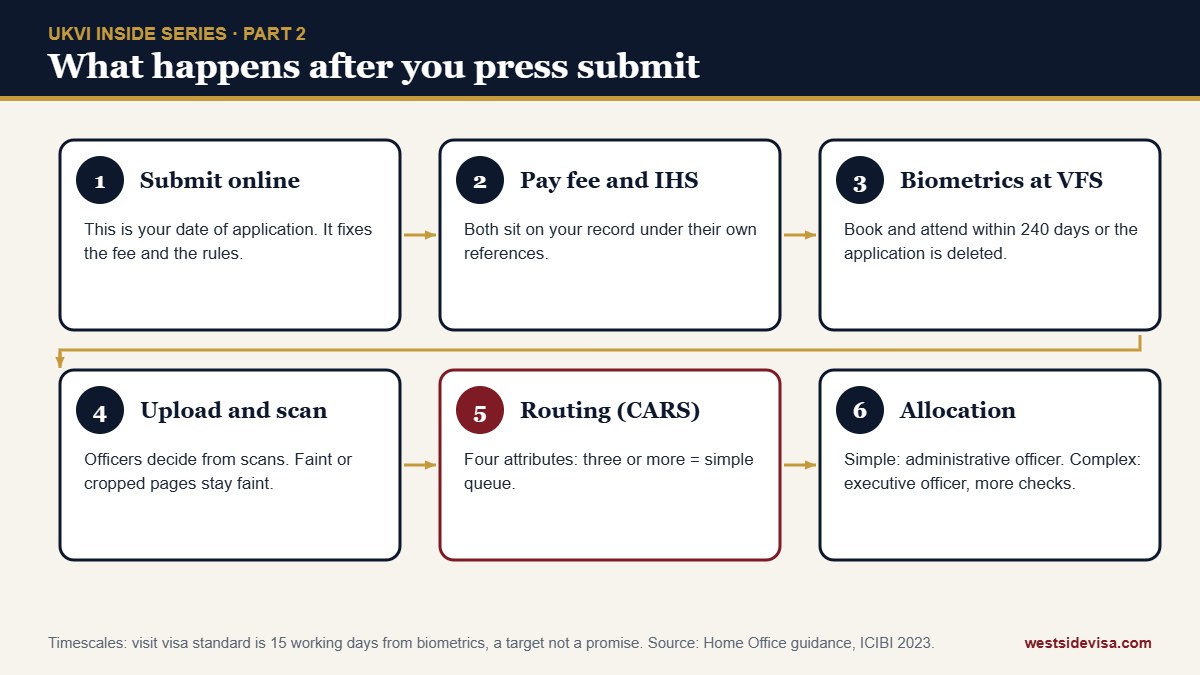
The Home Office guidance on validation is clear: “The date of application for an online application is the date it is submitted.” That date fixes which rules and which fee apply to you. If the rules change the week after you submit, you are judged under the rules in force on your submission date.
But submitted is not the same as complete. Until you have paid, enrolled your biometrics and provided what the form requires, the Home Office does not treat the application as ready for a decision. Those steps are the “validity” stage, and they happen before any officer looks at your evidence.
Every UK application passes through three stages in order: validity, suitability, eligibility. Validity asks whether the application is properly made at all. The guidance puts the burden on you: “The burden of proof is on the applicant to show they meet the validity requirements.”
The checklist is short:
For applications made outside the UK there is a useful safety net. The guidance says overseas applications “can’t be rejected as invalid” on most routes; where something is missing, UKVI normally sends a reminder giving 14 days to fix it. Inside the UK, an invalid application is rejected, refunded minus an administration fee, and treated as if it were never made. The difference matters for anyone extending a visa from inside the UK, because a rejected application gives no protection against overstaying.
The fee you pay is “the one that applies on the date of application”. The health surcharge is paid at the same time and sits on your record under its own reference. If the surcharge payment fails or is paid under a different name or application, the case can stall silently at the validity stage. When an application is not granted, the surcharge is refunded automatically; the application fee is not.
This is the rule most applicants have never heard of. The guidance states that applicants outside the UK must book and attend a biometrics enrolment “within 240 days of their online application being submitted”. If you miss it, “the application is not complete” and is “automatically deleted”. There is no decision, no letter and no refund route through the normal process.
Your biometrics enrolment also creates the record that lets caseworking begin. Fingerprints and a facial image are enrolled, matched against existing Home Office holdings, and linked to your person record. If you have given fingerprints before, the system may reuse them instead of asking again; the Home Office’s biometric reuse guidance allows this when a recent, good quality record exists. Being asked to enrol again is usually about quality or age of the record, not suspicion.
In Pakistan you attend VFS Global in Lahore, Islamabad or Karachi. VFS is a commercial partner. It collects your biometrics, scans your documents and returns your passport. It does not see the officer’s notes, does not know the stage your case is at, and cannot speed up or influence the decision. When VFS says “your application has been forwarded” or “a decision has been made”, it is relaying an Atlas status message, nothing more.
Officers decide from scans, not originals. Your passport is the only physical document that travels. Everything else is either uploaded by you or scanned at VFS. A faint bank statement, a cropped page or a photo of a document at an angle is what the officer will see. Documents uploaded after submission are visible to the officer only if the upload window is still open; once the case has moved into decision, late documents may never be seen.
Not sure how this applies to your case?
Send us your question on WhatsApp. A Westside adviser in DHA Lahore will reply, Monday to Saturday, 10:00 to 18:00.
Ask on WhatsAppApplications from Pakistan are decided by UKVI decision making centres, most of which are now in the UK (Croydon, Liverpool and Sheffield), with some overseas hubs. The inspector’s 2023 report on visit visas describes the process in unusual detail:
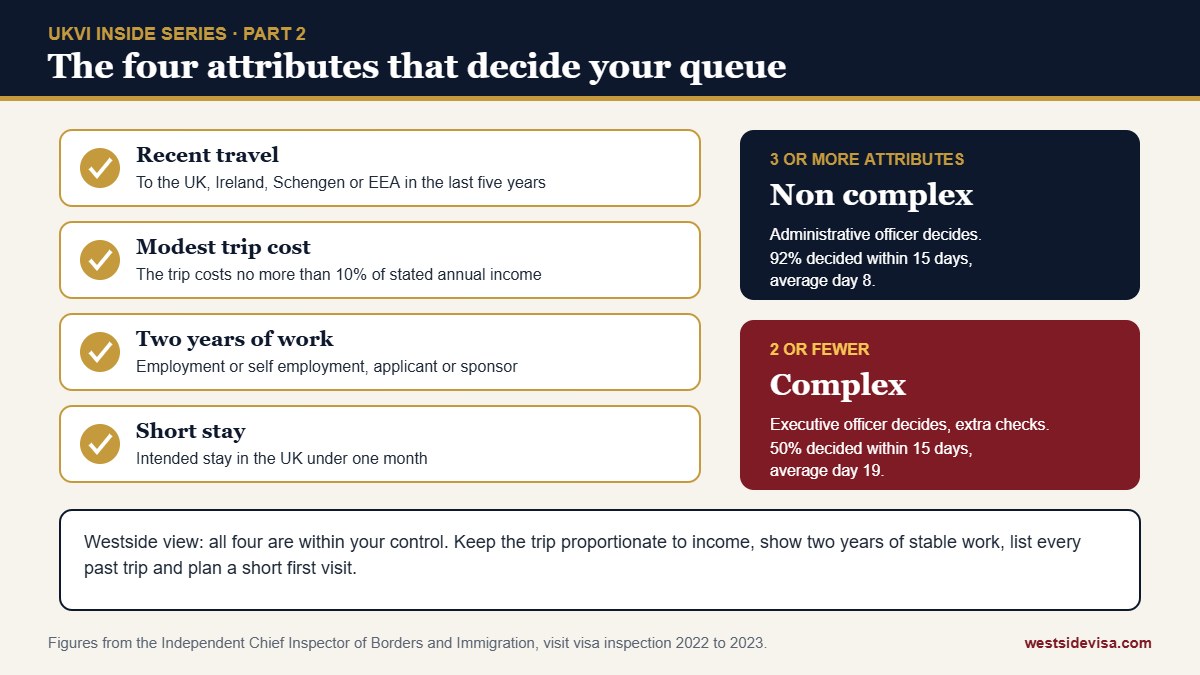
In the inspector’s sample, 92% of non complex visit visa cases were decided within 15 working days. Only 50% of complex cases were. The average non complex case was decided on day 8; the average complex case on day 19. Same fee, very different experience.
Why this matters for Pakistani applicants: the four attributes are within your control. Recent travel history, a trip that is modest against your declared income, stable employment and a short planned stay all push an application into the quicker, simpler queue. We shape applications around these points for exactly this reason.
UKVI’s published service standards (15 working days for visits, 3 weeks for most study and work routes) are counted from the day you complete biometrics, not the day you submit online. The standard is a target, not a promise: it is reported as the share of applications decided in time, and complex cases routinely fall outside it. Waiting for verification replies, interviews or a manager’s review all pause progress without pausing the published clock.
Priority (5 working days) and super priority (next working day) buy a place at the front of the allocation queue. They do not reduce the checks. If your case is routed as complex or matches a profile for enrichment, it can be pulled out of the quick queue and the priority fee is not refunded. Priority is worth paying for a clean, simple case with a real deadline; it is poor value for a case with a previous negative decision or thin evidence.
The day you submit online. That fixes the fee and the rules that apply. Processing time targets, though, are counted from the biometrics date.
The application is automatically deleted as incomplete. You would need to apply again and pay again.
No. VFS sees only status messages and does not have access to caseworker notes or reasons.
Most likely routing. Applications scored as non complex go to a quicker queue; complex ones go to a more senior officer and often wait for extra checks.
No. It changes the order in which cases are picked up, not the checks or the standard applied.
Only while the upload window is open. Once the case is in decision the officer may not see it. Submit a complete file from the start.
Checked on 27 October 2026. General information, not legal advice. Routing and allocation details are taken from the inspector’s report and may have changed since.

Mujtaba is the CEO of Westside Visa Consultants. He began his career in 2001 as Executive Secretary to the Consul General of the Republic of Korea in Karachi, co founded Westside in London in 2003, and has since guided more than 1,000 students and families through UK, European, North American and Australian visa decisions from the firm’s offices in DHA Lahore and the UK. He holds postgraduate degrees from the University of Karachi, the University of Padua, Loughborough University and the University of West London, and writes this series from more than twenty years of reading decision letters.
Connect with Mujtaba on LinkedIn · About Westside · WhatsApp the office
Confirmed visa changes for Pakistani students, visitors and families, checked against official sources.
Westside Visa Consultants builds UK visit, study and family applications around the attributes UKVI scores first. Honest assessment before you pay a single fee.
First Floor, 22 A, Sector A, Phase 5, DHA, Lahore · Monday to Saturday, 10:00 to 18:00
This guide is general information, not legal or migration advice. Westside Visa Consultants is an independent private advisory, not affiliated with any government, embassy or visa centre. Always check the official sources before you apply.


A curated list of the most popular travel packages based on different destinations.
Dreaming of studying at a world class UK university?
Some UK universities have paused Pakistani applicants under stricter Home Office rules. Here is why, and how to choose a university that will issue your CAS for 2027.
Moving to the UK is only truly complete when your loved ones are with you. The Dependant visa lets the partner and children of a UK visa holder join them to live, work, and study in the UK.
Seeking world class medical care in the UK? It’s absolutely within reach.
Choosing where to do your PhD is one of the biggest decisions of your academic life, and the four leading English speaking destinations each offer something different.
A UK PhD gives you a world class research degree, generous funding options, and, importantly, a post study advantage that survives the 2027 migration changes: doctoral graduates keep the full three year Graduate Route.
Already in the UK as a visitor and wondering if you can stay longer or switch to another visa? The honest answer is: it’s possible in some cases, but far more limited than most people think.
Apply on or before 31 December 2026 and you get 2 years. Apply on or after 1 January 2027 and you get 18 months. The date that matters is the date you submit the application, not the date your course ends.