Administrative Review From the Inside: Who Re reads Your File, What Counts as an Error, and Why Visitors Cannot Use It
Part 6 explained what a decision notice contains and which doors it leaves open. One of those doors is administrative review, and it is the most misunderstood of the three. Families in Lahore often treat it as a second application with better documents. It is not. It is a desk check, by a different officer, of whether the first officer made a specific kind of mistake with the file as it stood. This guide explains who does it, what they may and may not correct, the GBP 80 fee, the 28 day clock, the five outcomes, and the two groups of applicants for whom the review does not exist.
By Mujtaba Maharvi, CEO, Westside Visa Consultants · 3 November 2026
WhoA different officerOn a separate team, never the original decision maker
Deadline28 daysFrom receipt of the notice, for overseas applicants
FeeGBP 80Refunded only if the decision changes
VisitorsNo reviewReapply or judicial review only
What a review is, and is not
Administrative review was created in 2015 when appeal rights were removed from most points based routes. It is governed by Appendix AR of the UK visa rules and by a caseworker guidance document, now at version 18.0, published for staff in August 2026. The guidance describes it as a review of an eligible decision “to consider whether there has been a case working error”. That phrase carries the whole system. The reviewer is not asked whether you deserve the visa, whether the outcome was harsh, or whether a better file would have succeeded. The reviewer is asked whether the first officer, working from the documents in front of them, applied the rules, the policy and the evidence flexibility provisions correctly.
The review form asks you to identify the error, not to re argue the case. Photo: Unsplash.
Who gets a review and who does not
Overseas, a review is available only against a negative entry clearance decision on the listed points based routes: Student, Child Student, Graduate, Skilled Worker and the other sponsored and talent routes, with their dependants. Two large groups have no review right. Visitors have none; a visit visa decision can be challenged only by a fresh application or, in rare cases, judicial review. Family route applicants under Appendix FM have none either, because they have something better: a right of appeal to the First tier Tribunal on human rights grounds, which Part 10 touched on. So for a Pakistani family the practical map is simple. Student and dependant decisions: review. Visit decisions: reapply. Spouse and child settlement decisions: appeal.
Who reads the file the second time
The guidance is firm that “the original decision maker, or anyone involved in the original decision, must not conduct the review”. Reviews are handled by separate administrative review teams within UKVI, working from the same Atlas record (Part 1). The reviewer sees everything the first officer saw: the application, the uploaded documents, the verification notes from Part 4, any interview transcript from Part 5, the decision notice and the officer’s internal notes. The reviewer also sees your review form, in which you are expected to state the error. Interviews are not part of the process; the guidance says plainly that “it is not possible to interview applicants as part of the administrative review process”. A reviewer may write to ask for information, usually with 14 days to answer, and may refer a case back to the original team where facts need rechecking.
What counts as a case working error
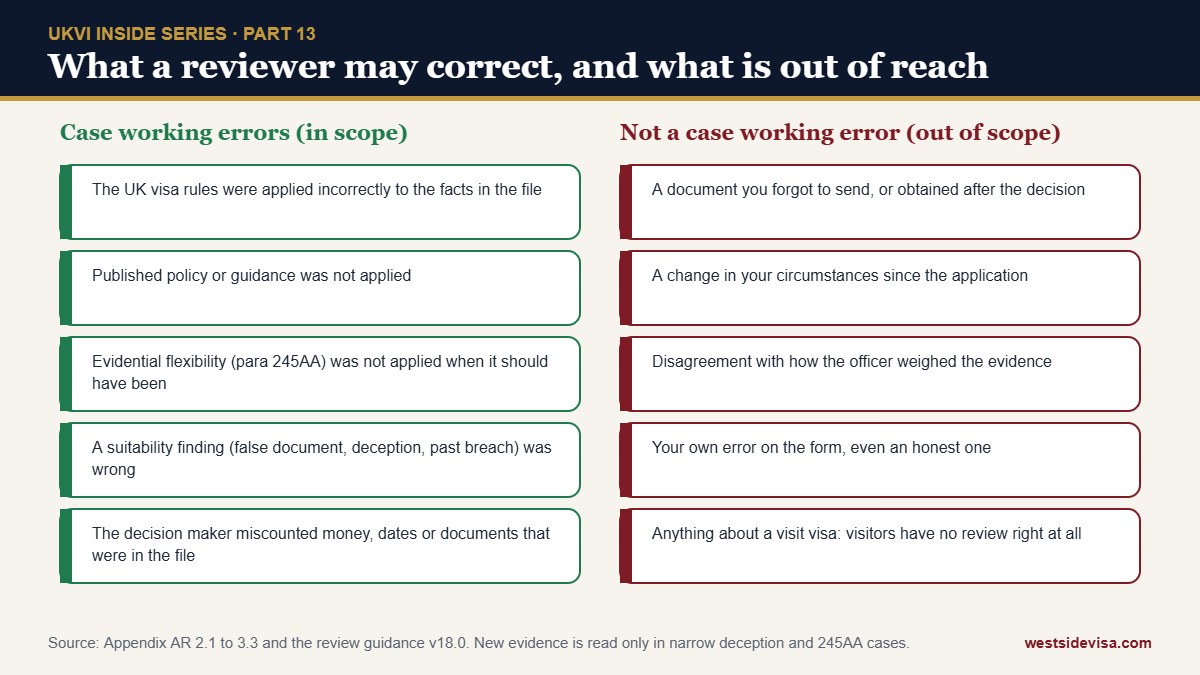
In scope and out of scope, from Appendix AR and the review guidance.
Appendix AR lists the errors a reviewer may correct. The UK visa rules were applied incorrectly. Published policy or guidance was not applied. Evidential flexibility under paragraph 245AA, the provision that lets an officer ask for a missing document in a sequence or a document in the wrong format, was not used when it should have been. A suitability finding, such as a false document or deception finding, was wrong. And plain miscounting: an officer who added the 28 days wrongly, misread a bank statement that was in the file, or missed a document that was uploaded. These are the arguments that win. Everything else, however sympathetic, is out of scope: the document you did not send, the circumstance that changed, the weight the officer gave to an answer, your own mistake on the form.
New evidence: the narrow exceptions
The default is that “the reviewer will not consider any evidence that was not before the original decision maker”. There are three exceptions, and each is narrow. New evidence may be read where the decision rested on a suitability finding of false representations, false documents or deception, because you are entitled to answer an accusation you did not know was coming. It may be read where the decision relied on a previous breach of visa conditions. And it may be read where the officer should have asked for a document under evidential flexibility and did not, in which case the document can be supplied now. Outside those three, sending a new bank statement with a review request is wasted effort; the reviewer must set it aside.
The clock, the fee and the form
Overseas applicants have 28 calendar days from receipt of the decision notice; in country applicants have 14, and seven if detained. Late requests are “normally rejected” and are accepted only where it would be unjust not to waive the limit. The fee is GBP 80, refunded if the request is rejected as invalid or the decision is changed, not refunded if the decision is maintained. Only one review request may be made per decision, unless the review itself produces new reasons. And making any other visa application while the review is pending withdraws the review automatically and forfeits the fee. That last rule catches students who file a review and a fresh application in the same week to be safe. You must choose.
Not sure how this applies to your case?
Send us your question on WhatsApp. A Westside adviser in DHA Lahore will reply, Monday to Saturday, 10:00 to 18:00.
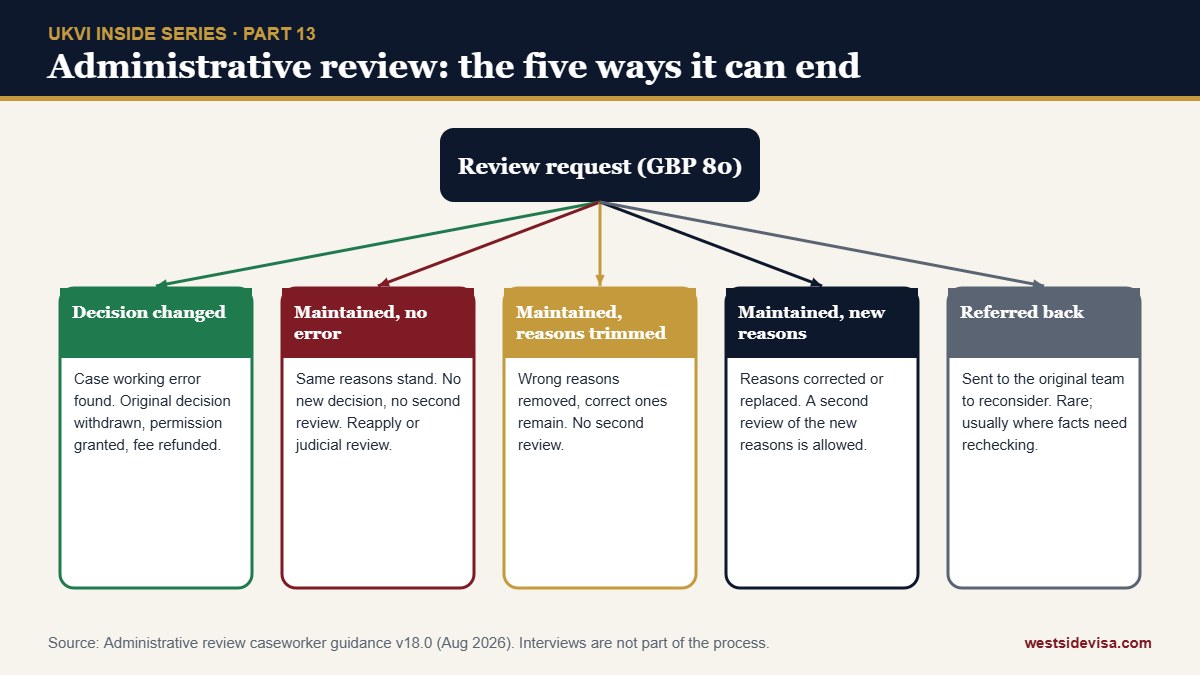
Five exits, from the review guidance version 18.0. Only one refunds the fee.
Decision changed. A case working error is found, the original decision is withdrawn and permission is granted. The fee comes back.
Maintained, no error. The reasons stand as written. No new decision is issued and there is no further review.
Maintained, reasons trimmed. The reviewer removes reasons that were wrong but finds the remaining ones sufficient. No further review.
Maintained, new or corrected reasons. The reviewer replaces or adds reasons. Because these are new, you may request a second review of them.
Referred back. The case returns to the original team for reconsideration, usually where facts need rechecking rather than law.
GOV.UK says a result “usually takes 28 days or more” for overseas cases; in practice we see six to twelve weeks for Student reviews from Pakistan, longer in the September peak. The outcome arrives by email as a review notice generated from an Atlas template, in the same family of documents as the decision notice Part 6 dissected.
Review or reapply is a family decision, and the calendar usually decides it. Photo: Unsplash.
What the record shows afterwards
A review that succeeds does not erase the first decision. The person record shows the original negative decision, the review request, the reviewer’s reasoning and the changed outcome. That history is harmless; it shows a system correcting itself. A review that fails adds a second set of reasons, written by a second officer, confirming the first. The next application, and the next officer, will read both. This is the quiet cost of a weak review request: it turns one adverse decision into two concurring ones.
Review or reapply: how we decide
Read the notice against the file, paragraph by paragraph. Was each reason actually wrong on the documents that were uploaded? If yes, review.
If the problem was a missing or weak document, reapply. The review cannot read it and a fresh application can, usually within the same intake window.
Check the calendar. A course starting in January with a review filed in November is a course missed. A fresh application with a corrected file is often faster than a review.
If the reason is a deception finding, review, and review well, because the finding carries a ten year consequence (Part 4) and the review is where new evidence is allowed.
Never file both. A new application withdraws the review and forfeits GBP 80.
Write the request as a lawyer would: the rule, the document, the page, the error. Not the story.
Can I ask for an administrative review of a UK visit visa decision?
No. Visit visa decisions carry no review right. The options are a fresh application or, in rare cases, judicial review.
Can I send new bank statements with my review request?
Usually not. The reviewer may only read evidence that was before the original officer, except where the decision rested on a deception or false document finding, a past breach of conditions, or a failure to apply evidential flexibility.
How long do I have, and what does it cost?
Twenty eight days from receipt of the notice for applications made outside the UK, and GBP 80, refunded only if the decision is changed or the request is rejected as invalid.
Who actually does the review?
An officer on a separate administrative review team who had no part in the original decision, working from the same Atlas record and your written request. There is no interview.
Can I apply again while the review is pending?
You can, but doing so withdraws the review automatically and the GBP 80 is not refunded. Choose one route.
If the review fails, can I ask for another?
Only where the reviewer added new reasons. If the original reasons were simply maintained, there is no second review; the next step is a fresh application or judicial review.
Checked on 3 November 2026. General information, not legal advice; deadlines run from receipt of the notice and should be confirmed for your case.
About the author
Mujtaba Maharvi
Mujtaba is the CEO of Westside Visa Consultants. He began his career in 2001 as Executive Secretary to the Consul General of the Republic of Korea in Karachi, co founded Westside in London in 2003, and has since guided more than 1,000 students and families through UK, European, North American and Australian visa decisions from the firm’s offices in DHA Lahore and the UK. He holds postgraduate degrees from the University of Karachi, the University of Padua, Loughborough University and the University of West London, and writes this series from more than twenty years of reading decision letters.
Westside reads the decision notice against your file and tells you honestly whether a review, a fresh application or an appeal is the route. Advice from DHA Lahore, Monday to Saturday.
First Floor, 22 A, Sector A, Phase 5, DHA, Lahore · Monday to Saturday, 10:00 to 18:00
This guide is general information, not legal or migration advice. Westside Visa Consultants is an independent private advisory, not affiliated with any government, embassy or visa centre. Always check the official sources before you apply.
Every child on a UK visa application has their own record, their own biometrics and their own set of rules. Learn how UKVI handles parental consent, accompanied visas, child welfare checks, student dependants and the parent of a child student route.
Some UK universities have paused Pakistani applicants under stricter Home Office rules. Here is why, and how to choose a university that will issue your CAS for 2027.
A UK spouse or partner application is tested three ways: the sponsor’s income against specified evidence, the relationship against a graded evidence scale, and the whole file against the marriage investigation triggers. Here is how each check works.
You worked hard for your UK degree now stay and turn it into a career. The Graduate Route (post study work visa) lets you live and work in the UK after graduating, with no job offer and no sponsorship needed.
Before an officer opens your UK visa file, your details are run against watchlists, past travel, fingerprint records in five countries and risk profiles. Here is what is checked and how to prepare.
UK visa decision letters are built from templates inside Atlas. Learn the standard of proof, the paragraph codes (V 4.2, ST 5.1, SU 9.1, SUI 10.1), what a letter must contain, and the options for visit, study and family applicants.