
How to Apply for a UK Spouse Visa from Pakistan
Ready to build your life together in the UK?



Home / News and Articles / How UKVI works
UKVI inside series · Part 17Sixteen parts of this series have described a record: the Atlas person file, the verification notes, the interview transcript, the entry and exit data, the decision reasons and the reviewer’s comments. Under UK data protection law you are entitled to see most of it, free of charge, within a month. Very few Pakistani applicants ask. This guide explains the subject access request: the three types, what each returns, how to apply from Lahore, what is held back, and how we use the result to build the next application around what the officer already believes.
A subject access request is the right, under the UK GDPR and the Data Protection Act 2018, to obtain the personal data an organisation holds about you. For the Home Office that covers UKVI, Border Force and the enforcement directorates, and the requests are handled by a dedicated Subject Access Request Unit in Croydon. The GOV.UK page says plainly that “all requests are free of charge” and that you will receive a response “within 1 month once we have all the supporting documents to process your request”, with an extension only “in exceptional circumstances” where a request is complex. You do not need a lawyer, a UK address or a pending application to ask.
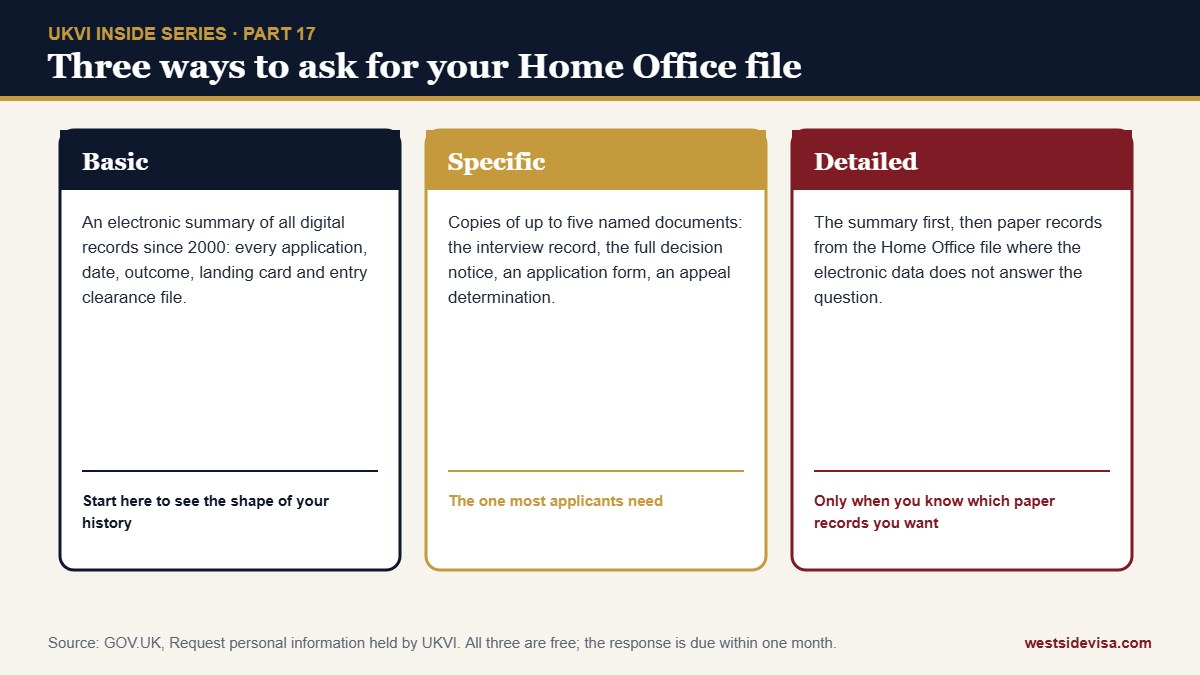
In practice we ask for a basic request to see the shape of the history, and a specific request naming the interview transcript, the decision notice and the document verification report (Part 4) for the application that went wrong. A single request may contain both.
The summary is a table: each application with its reference, route, date of application, date of decision and outcome, plus entry and exit events where the Home Office holds them, and the records that led to any suitability finding. The specific documents arrive as scanned copies. The interview record is the question and answer transcript the officer typed; the decision notice is the full version, which for a visit application is usually longer than the letter you were emailed. Verification outcomes appear as notes: “unable to verify”, “confirmed by HR on” a date, or a document verification report summary. What you are reading is the officer’s own working, and it answers the question every family asks after a negative decision: what did they actually think?

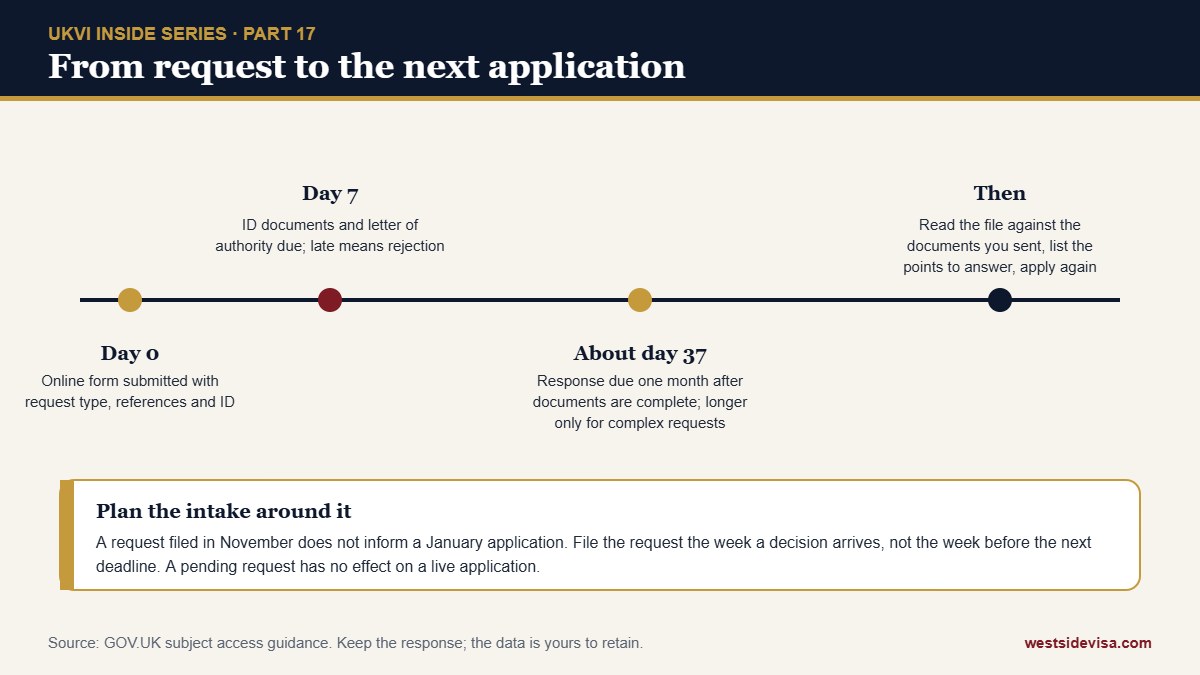
There is an online form on the Home Office online service, and the GOV.UK page gives an email address for people with no UK address and a postal address for the unit in Croydon. You may apply for yourself or for “someone else who has given you permission to act on their behalf”, which lets a son in Manchester request his mother’s file or a parent request a child’s. The form asks which request type you want, which documents (for a specific request), the applicant’s details and passport numbers, and the Home Office or GWF reference numbers if you have them. The reference numbers are not required, but they shorten the search and are worth copying from old emails before you start.
The unit will not open a request without proof of identity: a colour copy of a passport, national identity card, driving licence or travel document, or a recent photograph if you have none. A representative also sends a letter of authority signed and dated by the data subject within the last six months, and a request for a child under twelve needs proof of the relationship. The deadline is unforgiving: “your application will be automatically rejected if we do not receive your supporting documents within 7 days.” Upload everything with the form, not afterwards. The one month clock starts when the documents are complete, not when you submitted.
The right is to your personal data, not to the Home Office’s. Expect redactions where a record contains another person’s data, where disclosure would prejudice crime prevention or border control, and where the material is internal legal advice or policy deliberation. The risk profile that routed your file (Part 3) will not be named, and the referral reasons behind an interview may be summarised rather than quoted. The guidance also says not to use a subject access request to prove your status or UKVI account details; that comes through the eVisa account from Part 7. The absence of a record is itself information: a file with no verification note and no interview tells you the decision was made on the papers alone.
Not sure how this applies to your case?
Send us your question on WhatsApp. A Westside adviser in DHA Lahore will reply, Monday to Saturday, 10:00 to 18:00.
Ask on WhatsAppAsk after a negative decision you do not understand, before a second attempt; after an interview, when you want the transcript for a review (Part 13); before a spouse application where the sponsor has an older history (Part 10); and when a family member’s old visit was declined for reasons nobody remembers. Do not ask with a deadline pressing. A request filed in November will not inform a January 2027 intake application. For students, we file the request and the fresh application in parallel only where the first file’s problem is already obvious; otherwise the month is worth waiting for. A pending request does not delay or affect a live application; the two systems do not speak to each other in that way.
We read a returned file in the order the officer wrote it. First the summary, to see what the officer saw before opening the application: how many previous applications, how many decisions each way, any entry or exit anomaly, any suitability flag. Then the decision notice, paragraph by paragraph against the documents submitted, to separate reasons that were wrong on the file from reasons that were right. Then the interview record, looking for the answer that contradicted a document, because that is the sentence the next officer will read first. The result is a short list of things the next application must address head on, in the covering letter, in the officer’s own terms. An application that answers the previous officer’s doubts without being asked reads very differently from one that pretends they were never raised.

Part 18 looks at the priority and super priority services: what paying extra changes inside UKVI, and what it does not.
Yes. A specific subject access request for the decision notice and any interview record returns the officer’s reasoning as recorded. It is free and takes about a month.
Yes. The basic request covers digital records since 2000, and GOV.UK lists visa applications submitted from outside the UK as part of entry clearance among them.
Nothing. The response is due within one month of the unit receiving your identity documents, extendable only for complex requests.
Yes, with a letter of authority signed and dated by you within the last six months and a copy of your identity document.
No. The request is handled by a separate unit and has no effect on the decision or its timing.
Other people’s data, material that would prejudice border control or crime prevention, and internal legal or policy advice. Risk profile names and some referral reasons are typically withheld or summarised.
Checked on 3 November 2026. General information, not legal advice.

Mujtaba is the CEO of Westside Visa Consultants. He began his career in 2001 as Executive Secretary to the Consul General of the Republic of Korea in Karachi, co founded Westside in London in 2003, and has since guided more than 1,000 students and families through UK, European, North American and Australian visa decisions from the firm’s offices in DHA Lahore and the UK. He holds postgraduate degrees from the University of Karachi, the University of Padua, Loughborough University and the University of West London, and writes this series from more than twenty years of reading decision letters.
Connect with Mujtaba on LinkedIn · About Westside · WhatsApp the office
Confirmed visa changes for Pakistani students, visitors and families, checked against official sources.
Westside files the subject access request, reads the response against the documents you sent and builds the next application around what the officer actually wrote. Honest advice from DHA Lahore, Monday to Saturday.
First Floor, 22 A, Sector A, Phase 5, DHA, Lahore · Monday to Saturday, 10:00 to 18:00
This guide is general information, not legal or migration advice. Westside Visa Consultants is an independent private advisory, not affiliated with any government, embassy or visa centre. Always check the official sources before you apply.


A curated list of the most popular travel packages based on different destinations.
Ready to build your life together in the UK?
Thinking of withdrawing a UK visa application? Learn how withdrawal, variation and voiding work under the Home Office rules, what is refunded, when UKVI can decline a withdrawal, and what stays on your record.
Every child on a UK visa application has their own record, their own biometrics and their own set of rules. Learn how UKVI handles parental consent, accompanied visas, child welfare checks, student dependants and the parent of a child student route.
What UKVI actually sees when you apply: how the Home Office moved from CID to Atlas, what a person record links to you, your reference numbers, and how to read your own file.
Submitted your UK visa application? Here is what UKVI does in the first 48 hours: validity checks, biometrics, the 240 day rule, allocation to a decision centre and why the clock starts later than you think.
Already in the UK as a visitor and wondering if you can stay longer or switch to another visa? The honest answer is: it’s possible in some cases, but far more limited than most people think.
There is no 180 day rule for UK visitors, but UKVI does count your days. Learn how travel history is recorded, what “frequent or successive visits” means, the factors officers weigh, and how long term visa holders stay on the right side.
A UK PhD gives you a world class research degree, generous funding options, and, importantly, a post study advantage that survives the 2027 migration changes: doctoral graduates keep the full three year Graduate Route.