How UKVI Counts Your Visits: Travel History, the Frequent Visitor Question and the 180 Day Myth
Ask ten frequent travellers to the UK about the rules and nine will tell you about “180 days in a year”. The rule does not exist. What exists is a record of every entry and exit, a guidance section on frequent and successive visits, and an officer’s judgement about whether you are making the UK your home. This guide explains how your travel history is built, what the officer is told to look for, and how parents and grandparents on long term visas stay on the right side of it.
By Mujtaba Maharvi, CEO, Westside Visa Consultants · 3 November 2026
Per visitUp to 6 monthsOr less if the officer grants less
Per yearNo fixed cap“There is no specified maximum period”
The testGenuine visitorNot living in the UK through frequent or successive visits
Look back12 monthsCumulative time and pattern of travel
Where the 180 day idea comes from
The number almost certainly migrated from UK tax law, where spending 183 days or more in a tax year can make a person tax resident, and from other countries’ visa regimes that do cap days in a rolling period. UK visa lawyers who have searched the UK visa rules, past and present, have found no visitor rule with a yearly cap. The Home Office’s own visit guidance says, in terms, that “there is no specified maximum period” a person can spend in the UK as a visitor.
What the rules actually say
Appendix V defines a visitor as someone coming for a temporary period, normally up to six months on each entry. The genuine visitor requirement at V 4.2 asks the officer to be satisfied that you will leave at the end of the visit and, in the words of the quick guide, that you “will not make the UK their home through frequent or successive visits”. That is a judgement, not a count. The guidance goes on: if travel history shows a person is “seeking to remain for extended periods or making the UK their home”, the application should not succeed. There is no number in that guidance, and that is deliberate.
Every entry and exit is recorded; what matters is the pattern they form. Photo: Unsplash.
How your travel history is built
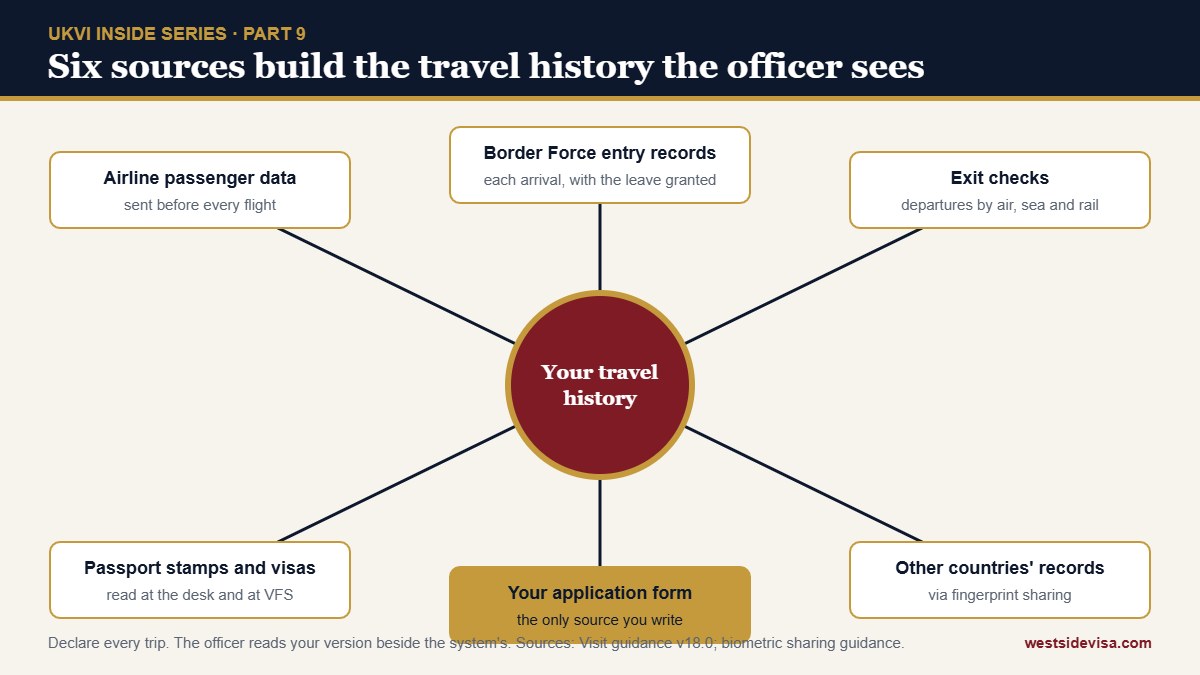
Six sources feed the travel history the officer sees. Only one of them is written by you.
Part 3 explained that airlines send passenger details before every flight and that Border Force records entries and, through exit checks, departures. Those records sit on your person record in Atlas (Part 1). The visit guidance adds that travel history is also taken “from the passport or travel document and the application form”, so the officer has your version and the system’s version side by side. Gaps between them are noticed. A visit you forgot to list, a stay that ran a month longer than you declared on the last form, or a departure the exit check never captured because you left by ferry, all appear as questions.
Two practical points follow. Keep your own log of every UK trip, with entry and exit dates, and declare all of them, including transits. And if a stay was longer than planned, say so and say why, because the guidance tells officers that staying much longer than stated “may be a reason to question the applicant’s overall intentions” even where it is not decisive on its own.
The factors the officer must weigh
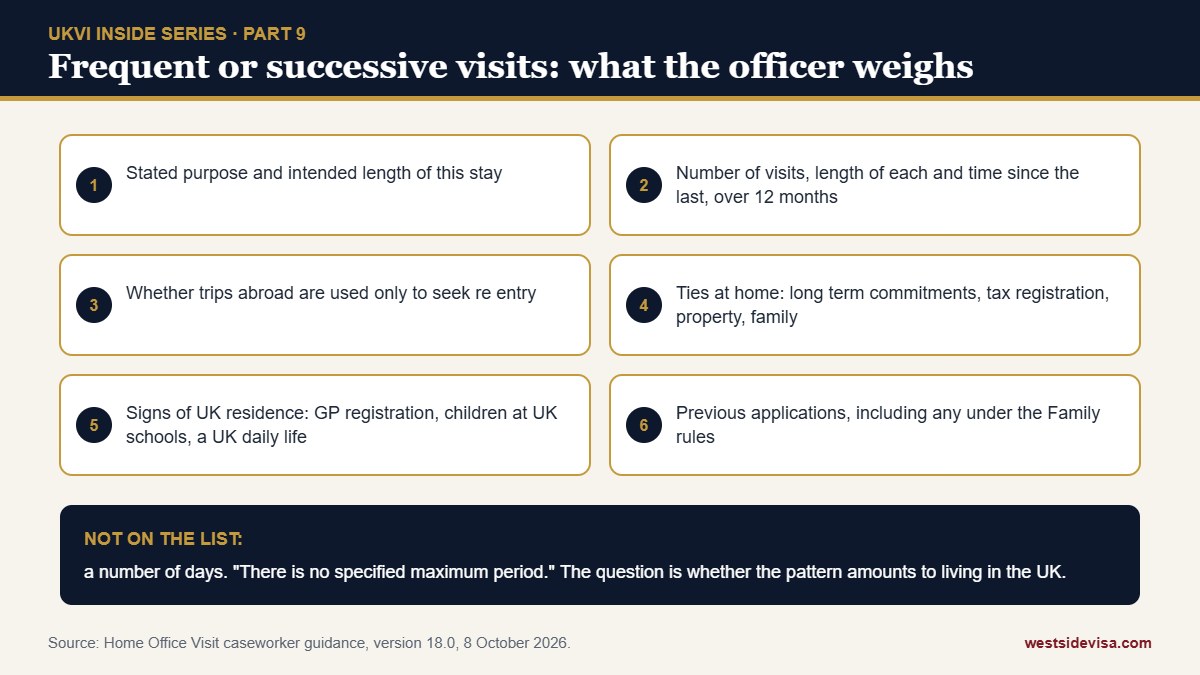
The frequent visitor factors from the visit guidance, version 18.0. None of them is a number of days.
For frequent or successive visits the guidance lists what to consider: the stated purpose and intended length of stay; the number of visits, the length of each and the time since the last over the past twelve months; whether return trips abroad are “used only to seek re entry”; ties to the home country, including “any long term commitments” and whether the applicant is registered for tax there; evidence of UK residence such as GP registration or children at UK schools; and previous applications, including any under the Family rules. The officer is told to look at “cumulative UK time and the last 12 months of travel” and to ask whether this amounts to “de facto residence”.
Read that list as a profile. A retired father who spends four months a year with his son in Manchester, returns to his own house in Lahore, pays Pakistani tax on a pension and has no UK GP registration is a frequent visitor with strong ties. The same man, after his wife’s death, with the house sold and a UK GP card in his wallet, is on his way to being a resident in the officer’s eyes, whatever the day count says.
“De facto residence” and the Ezeh case
The Upper Tribunal’s decision in R (Ezeh) v Secretary of State for the Home Department shows where the line falls. The applicant had made about twenty visits in sixteen months, spent 220 days in the UK in 2023, had children at UK boarding schools and had bought property. The tribunal upheld the negative decision on the basis that she intended to make the UK her main home. Note what carried the case: not the 220 days alone but the schools, the property and the rhythm of trips that looked like a resident popping abroad. That is the pattern the factors list is designed to catch.
Long term visit visas are built for people with a life at home and family in the UK. Photo: Unsplash.
Long term visit visas: what they are and are not
Two, five and ten year visit visas remove the need to reapply before each trip. They do not change the six month limit per visit, and they do not create a yearly allowance. The guidance notes that holders of long term multiple entry visas may have reasons for visiting that change over time, which is acceptable as long as they still intend only permitted activities. What a long term visa does change is scrutiny: each time you fly, the carrier check and the border desk are the only gates, and an officer who sees a pattern of near continuous presence can give a short entry, refer you for questioning, or in extreme cases cancel the visa at the border. A ten year visa is a privilege that is reviewed every time it is used.
Not sure how this applies to your case?
Send us your question on WhatsApp. A Westside adviser in DHA Lahore will reply, Monday to Saturday, 10:00 to 18:00.
Part 7 explained what the officer can see on arrival. For visitors, the guidance tells the officer to “ask the applicant to explain what they are coming to do and for how long”, and to grant the period the stated purpose needs rather than an automatic six months where there are doubts. Residual doubts are recorded. So a Pakistani visitor who says “two weeks for a wedding” and is given one month has been given exactly what the rules intend; a visitor who says “six months to help my daughter after the baby” for the third year running has invited the frequent visitor question, and may be asked how her affairs at home continue without her.
Parents and grandparents: the Pakistani pattern
The commonest frequent visitor in our office is a parent whose children have settled in the UK. The honest route exists: the Family rules provide for an Adult Dependent Relative, with a demanding care test, and the guidance specifically tells officers to consider “whether the visitor route is being used to avoid the Family rules”. Using repeated six month visits as a substitute for that route is the single pattern most likely to end a long term visa. The sustainable version is shorter, purposeful visits, a visible life in Pakistan (home, tax, medical care, other children, community), and an application that says plainly what the visits are for and how they fit around that life.
Our working rule: keep total time in the UK comfortably under half of any twelve month period, keep each visit shorter than the last entry allowed, let several months pass between visits, and keep home ties in your own name. Not because 180 days is a rule, but because a pattern below that line rarely raises the de facto residence question at all.
How to keep a clean pattern
Keep a trip log with every UK entry and exit date, and declare every trip, including transits.
Match the stay to the purpose. Ask for the time the event needs, not the maximum.
Leave gaps. Returns that look like a resident’s weekend abroad are the pattern the guidance names.
Keep home ties in your name: property, tax registration, pension, medical care, memberships, other family.
Avoid UK residence markers: GP registration, a UK bank account used for daily life, children’s schooling, a UK mobile contract.
If the real need is to live with family, ask about the Family rules rather than stretching the visit route. We will tell you honestly whether the care test can be met.
Is there a 180 day limit for UK visitors in a year?
No. The UK visa rules contain no yearly cap and the Home Office guidance says there is no specified maximum period. The limit is up to six months per visit, judged against the genuine visitor requirement.
How does UKVI know how long I stayed last time?
From airline passenger data, Border Force entry records and exit checks, held on your person record, compared with your passport and the dates you declare on the form.
Can a ten year visit visa be cancelled at the border?
Yes. Each entry is a fresh decision. A pattern that looks like residence can lead to a short entry, questioning or cancellation.
My mother visits for six months every year. Is that a problem?
It invites the frequent visitor question, especially if her life at home has thinned out. Shorter visits with gaps, strong home ties and no UK residence markers keep the pattern defensible. If the real aim is to live with family, the Family rules are the honest route.
What is “de facto residence”?
The guidance’s phrase for a pattern of visits that amounts to living in the UK: cumulative time, trips abroad used only to re enter, and residence markers such as a GP or schools. The Ezeh case is the clearest example.
Should I declare a trip I think the system missed?
Yes. The officer compares your declaration with the record; an omission is a credibility problem whatever the record shows.
Checked on 3 November 2026. General information, not legal advice. Border decisions are discretionary and depend on the facts of each entry.
About the author
Mujtaba Maharvi
Mujtaba is the CEO of Westside Visa Consultants. He began his career in 2001 as Executive Secretary to the Consul General of the Republic of Korea in Karachi, co founded Westside in London in 2003, and has since guided more than 1,000 students and families through UK, European, North American and Australian visa decisions from the firm’s offices in DHA Lahore and the UK. He holds postgraduate degrees from the University of Karachi, the University of Padua, Loughborough University and the University of West London, and writes this series from more than twenty years of reading decision letters.
Visiting family in the UK often? Keep the pattern defensible
Westside Visa Consultants plans visit applications and long term visa use around the frequent visitor factors, and tells you honestly when the Family rules are the better route.
First Floor, 22 A, Sector A, Phase 5, DHA, Lahore · Monday to Saturday, 10:00 to 18:00
This guide is general information, not legal or migration advice. Westside Visa Consultants is an independent private advisory, not affiliated with any government, embassy or visa centre. Always check the official sources before you apply.
UK visa decision letters are built from templates inside Atlas. Learn the standard of proof, the paragraph codes (V 4.2, ST 5.1, SU 9.1, SUI 10.1), what a letter must contain, and the options for visit, study and family applicants.
Already in the UK as a visitor and wondering if you can stay longer or switch to another visa? The honest answer is: it’s possible in some cases, but far more limited than most people think.
Your Schengen visa gets you on the plane, but the border is where your trip is really checked. Since April 2026 Europe records every short stay visitor’s fingerprints and photo in a new digital system called EES.
Moving to the UK is only truly complete when your loved ones are with you. The Dependant visa lets the partner and children of a UK visa holder join them to live, work, and study in the UK.
Since 25 February 2026 most UK visit visas are eVisas, not stickers. Learn what the grant email means, how to set up and check your UKVI account, what airlines and Border Force see, and how to fix an error before you fly.
Priority buys a place at the front of the queue, not a different officer or a lighter check. Learn how the 5 working day and next working day services work from Pakistan, when the clock starts, why verification and interviews take a file outside the service, the no refund rule and when the extra fee is worth it.