Business and Medical Visitors: What the Officer Checks on a Company Letter, a Hospital Letter and the Permitted Activities List
Most of this series has followed tourists, students and families. Two other kinds of visitor pass through the Lahore office every week: the exporter flying to Manchester for a trade fair, and the family taking a parent to London for treatment. Both apply on the same Standard Visitor form, and both are judged against lists the officer keeps open on the second screen: the permitted activities in Appendix Visitor, and the medical treatment requirements. This guide explains how each list is applied, what the officer looks for in an employer letter and a consultant’s letter, and where business and medical files most often go wrong.
By Mujtaba Maharvi, CEO, Westside Visa Consultants · 3 November 2026
BusinessPermitted activitiesMeetings, deals, conferences, training; never a role
Paid workOverseas onlyEmployed and paid outside the UK throughout
MedicalPrivate, finite, fundedUK consultant letter with cost and duration
Long treatment11 month visaWith TB certificate and the same letter
The list the officer reads from
Appendix Visitor: Permitted Activities is a schedule of what a visitor may do in the UK, and the Visit caseworker guidance, version 18.0 of October 2026, tells the officer how to apply it. The structure matters. A visitor does not need permission for an activity on the list; a visitor cannot be granted a visa for an activity that is not on it, however harmless. So the officer’s first question for a business file is not “is this person genuine” but “is the stated activity on the list, and does the evidence show that activity rather than another one”. The guidance puts it this way: the applicant must explain their main reason for coming, and it must be a permitted activity. The genuine visitor test from Part 9 comes second.
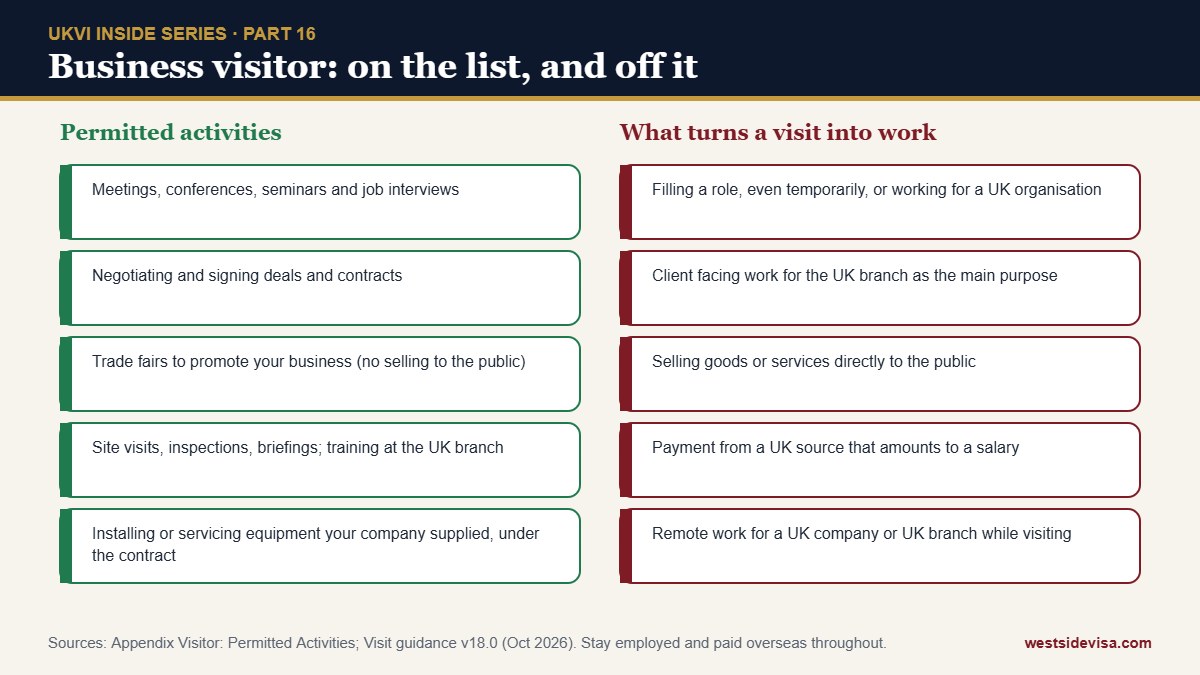
Permitted and not permitted, from Appendix Visitor: Permitted Activities and the Visit guidance, version 18.0.
What a business visitor may do
The general business activities are the familiar ones: attend meetings, conferences, seminars and interviews; negotiate and sign deals and contracts; attend trade fairs to promote your business, without selling direct to the public; carry out site visits and inspections; gather information for your overseas employment; be briefed on a UK customer’s requirements, provided any work is done outside the UK. The guidance expects these to be linked to employment overseas, to be under six months and, where possible, prearranged. A conference, it says, should reasonably last “no more than a couple of weeks”; a longer event is to be checked to make sure it is not work. Intra corporate activities, where an employee of an overseas company visits the UK branch, are allowed for advice, consultancy, troubleshooting, training or sharing knowledge on a specific internal project, as long as client facing work is not the primary purpose. An employee of an overseas manufacturer may install, dismantle, repair or service equipment the company has supplied, under the original contract.
What turns a visit into work
The prohibited activities are the mirror image. A visitor may not take employment, fill a role even temporarily, do work for a UK organisation or as a self employed person, sell goods or services directly to the public, or receive payment from a UK source beyond narrow exceptions. The guidance tells the officer to decline a file where the applicant is “coming to fill a role” that belongs under a sponsored route, and where payment from a UK source “amounts to a salary”. The cases the guidance uses as examples are instructive: installers sent to fit equipment in a private household (not a company to company contract) and a service engineer sent for work “not linked to the original supply” are both outside the list. The line is not whether the person is paid in Pakistan; it is whether the activity in the UK is the kind of thing the list describes.
Remote work and the 2024 changes
Since January 2024 the rules have accepted that a visitor will answer emails, take calls and join remote meetings for their overseas job while in the UK. The guidance now says visitors may do so, but their primary purpose must be another permitted activity, and remote work for a UK company or a UK branch is not allowed. A Lahore software consultant who spends three months in a cousin’s house in Leeds working for a Karachi client is, on paper, within the rules; the guidance adds that a stay over 90 days is not automatically a problem but, in the guidance’s words, “may prompt questions”, and Part 9’s frequent visitor factors apply. The same changes widened intra corporate work and let scientists, researchers and legal professionals do more, while keeping the prohibition on working directly for UK clients independently of a UK led project.
Meetings, negotiations and signing are permitted; delivering the service in the UK is not. Photo: Unsplash.
How the employer letter is tested
For a visa application the officer expects an employer letter where the business purpose relies on employment, and reads it for three things. First, that you “continue to be employed and paid overseas”, which is why the letter should state your role, start date, salary and that you remain on the overseas payroll during the trip. Second, that the activity described matches a permitted activity in plain words: “to attend the Spring Fair at the NEC from 1 to 5 February and meet three existing UK buyers” reads as a visit; “to support our UK operations for six weeks” reads as a role. Third, that the letter can be verified: a landline, a named signatory, a website that exists, a company registered with SECP or a chamber of commerce. Part 4 explained what happens when the officer calls and nobody confirms. Invitation letters from the UK side are read the same way, with attention to whether the inviting company is real and whether its letter describes a meeting or a job.
Permitted paid engagements
A narrow exception lets certain professionals be paid by a UK organisation for a short engagement: an academic invited to examine or lecture, a professional artist, entertainer or sportsperson invited to perform, a qualified lawyer invited to advise on a specific case. The guidance requires a formal invitation before travel, the engagement to take place within the first 30 days of arrival, and the invitation to show why this person was chosen, how the engagement relates to the inviting body and how long it lasts. Overseas employment must be in a relevant field. A fully retired expert doing a one off engagement must be turned down, in the guidance’s words, where a semi retired expert still working qualifies. The inviting organisation must be legitimate, and the officer is told to check it.
Not sure how this applies to your case?
Send us your question on WhatsApp. A Westside adviser in DHA Lahore will reply, Monday to Saturday, 10:00 to 18:00.
Private medical treatment is listed as a complex category in the visit guidance, which in Part 2’s terms means the file goes to a more experienced officer with specific documents expected. The requirements, in Appendix Visitor, are that the treatment is for a medical condition requiring consultation or treatment, that satisfactory arrangements have been made, that the applicant has enough money to pay for the treatment and to live in the UK without working or using public funds, that the treatment is of finite duration, and that the applicant does not present a danger to public health. Where the treatment will last longer than six months, a visa of up to eleven months can be granted on the strength of a UK doctor’s or consultant’s letter, with a tuberculosis certificate from an approved clinic, which Pakistani applicants need for any stay over six months in any case. An accompanying relative applies as an ordinary visitor and cannot normally stay beyond six months; the guidance allows an exception only in “compelling, compassionate, or exceptional” circumstances through the Referred Casework Unit.
What the consultant’s letter must say
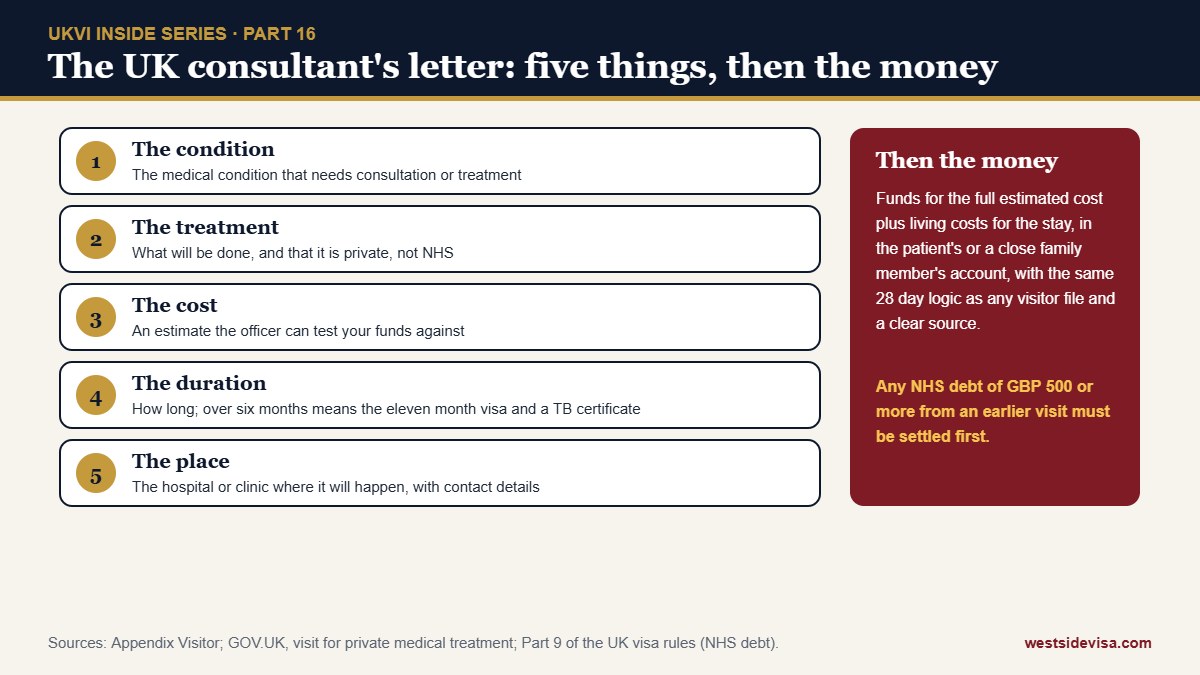
Five things the officer looks for in the UK medical letter, plus the money to match. From the Visit guidance and GOV.UK.
The letter from the UK doctor or consultant is the medical file’s equivalent of the CAS: the officer builds the sum from it. It should state the condition needing consultation or treatment, the proposed treatment, the estimated cost, the likely duration, and where the treatment will take place. A letter that says “Mr Khan has been accepted for assessment” with no cost and no duration fails on the arithmetic even if the condition is serious, because the officer cannot test the funds against anything. Private means private: a letter from an NHS trust must make clear the treatment is under a private contract, and where a reciprocal healthcare arrangement is relied on, evidence from the relevant government is required. The medical file also needs the ordinary visitor evidence from Part 9: ties at home, a reason to return, and travel history, because a long illness is read by some officers as a reason to stay.
The NHS question and the GBP 500 ground
Visitors are not entitled to free NHS treatment, apart from emergency care in an accident and emergency department and a short list of exemptions. An officer deciding a medical visit checks that the treatment will be paid for privately and that the funds exist. There is a longer shadow. Part 9 of the UK visa rules, the suitability grounds, allows an application to be turned down where the applicant owes the NHS GBP 500 or more in unpaid charges. A relative who fell ill on an earlier visit, was treated in hospital and left without settling the invoice has that debt on the record Part 1 described, and will meet it on the next application. Settle NHS invoices before you reapply, and keep the receipt.
The treatment plan, the cost and the duration must all be in writing from the UK side before you apply. Photo: Unsplash.
How to prepare
Name the activity in the list’s own words on the form and in the employer letter: trade fair, meetings with named buyers, training at the UK branch.
Keep the payroll overseas and say so in the letter, with salary, role and start date.
Match the dates to the activity. A five day fair does not need a six week trip; if you are staying on as a tourist, say that too.
For medical visits, get the consultant’s letter first, with condition, treatment, cost, duration and venue, then build the funds file to that figure plus living costs.
Book the TB test for any stay over six months, and apply for the eleven month visa if the treatment plan needs it.
Clear any NHS debt from earlier visits before applying, and keep the proof.
Can I attend a trade fair in the UK on a visit visa?
Yes. Attending a trade fair to promote your business is a permitted activity, as long as you do not sell directly to the public and you remain employed and paid overseas.
Can I work remotely for my Pakistani employer while visiting the UK?
Yes, since 2024, provided remote work is not the main reason for the visit and the work is for an overseas employer, not a UK company or branch. Long stays will prompt questions about where you really live.
What must my UK consultant’s letter say for a medical visa?
The condition, the proposed treatment, the estimated cost, the likely duration and where the treatment will take place. The officer tests your funds against that letter.
Can my wife come with me for my treatment?
She applies as an ordinary visitor and can normally stay up to six months. Longer stays for an accompanying relative are granted only in compelling or compassionate circumstances.
How long can a medical visit visa last?
Six months as standard, or up to eleven months where a UK doctor or consultant confirms the treatment will take longer, with a TB certificate.
My father was treated by the NHS on his last visit and did not pay. Does it matter?
Yes. An unpaid NHS debt of GBP 500 or more is a suitability ground under Part 9 of the UK visa rules. Settle it and keep the receipt before the next application.
Checked on 3 November 2026. General information, not legal advice.
About the author
Mujtaba Maharvi
Mujtaba is the CEO of Westside Visa Consultants. He began his career in 2001 as Executive Secretary to the Consul General of the Republic of Korea in Karachi, co founded Westside in London in 2003, and has since guided more than 1,000 students and families through UK, European, North American and Australian visa decisions from the firm’s offices in DHA Lahore and the UK. He holds postgraduate degrees from the University of Karachi, the University of Padua, Loughborough University and the University of West London, and writes this series from more than twenty years of reading decision letters.
Travelling for business or treatment? Build the file to the list
Westside drafts the employer letter in the permitted activity’s own words, checks the consultant’s letter against the five points the officer needs, and builds the funds file to match. Honest advice from DHA Lahore, Monday to Saturday.
First Floor, 22 A, Sector A, Phase 5, DHA, Lahore · Monday to Saturday, 10:00 to 18:00
This guide is general information, not legal or migration advice. Westside Visa Consultants is an independent private advisory, not affiliated with any government, embassy or visa centre. Always check the official sources before you apply.
Apply on or before 31 December 2026 and you get 2 years. Apply on or after 1 January 2027 and you get 18 months. The date that matters is the date you submit the application, not the date your course ends.
You worked hard for your UK degree now stay and turn it into a career. The Graduate Route (post study work visa) lets you live and work in the UK after graduating, with no job offer and no sponsorship needed.
Moving to the UK is only truly complete when your loved ones are with you. The Dependant visa lets the partner and children of a UK visa holder join them to live, work, and study in the UK.
Not every UK visa applicant is interviewed. Here is how UKVI selects who is, how student credibility and visit interviews are run, what is asked, and why the transcript matters more than the conversation.
What UKVI actually sees when you apply: how the Home Office moved from CID to Atlas, what a person record links to you, your reference numbers, and how to read your own file.
A UK PhD gives you a world class research degree, generous funding options, and, importantly, a post study advantage that survives the 2027 migration changes: doctoral graduates keep the full three year Graduate Route.
Fully funded UK master’s and PhD for 2027/28. HEC nominates 26 master’s and 30 PhD candidates. HAT 60, two portals, deadline 20 October 2026 at 4:00 pm.
A UK spouse or partner application is tested three ways: the sponsor’s income against specified evidence, the relationship against a graded evidence scale, and the whole file against the marriage investigation triggers. Here is how each check works.