How UKVI Counts Your Money: The 28 Day Rule, the 30 November 2026 Figures and the Parent’s Account
More Pakistani student files fail on money than on anything else, and almost never because the family is short of it. They fail because the officer counts in a particular way and the file was built in another. This guide sets out the arithmetic from Appendix Finance and the Financial requirement caseworker guidance: the figures that apply to applications from 30 November 2026, how the nine months are counted, what is added for fees and taken off for accommodation, which accounts count, how a parent’s money is used, and what the officer is actually looking for on the statement.
By Mujtaba Maharvi, CEO, Westside Visa Consultants · 3 November 2026
From 30 Nov 2026GBP 1,570 / 1,203Per month, London / elsewhere, up to 9 months
Held for28 consecutive daysLowest balance, not closing balance
Statement end dateWithin 31 daysOf the application date
Parent’s accountAllowedWith consent letter and proof of relationship
The figures, and which set applies to you
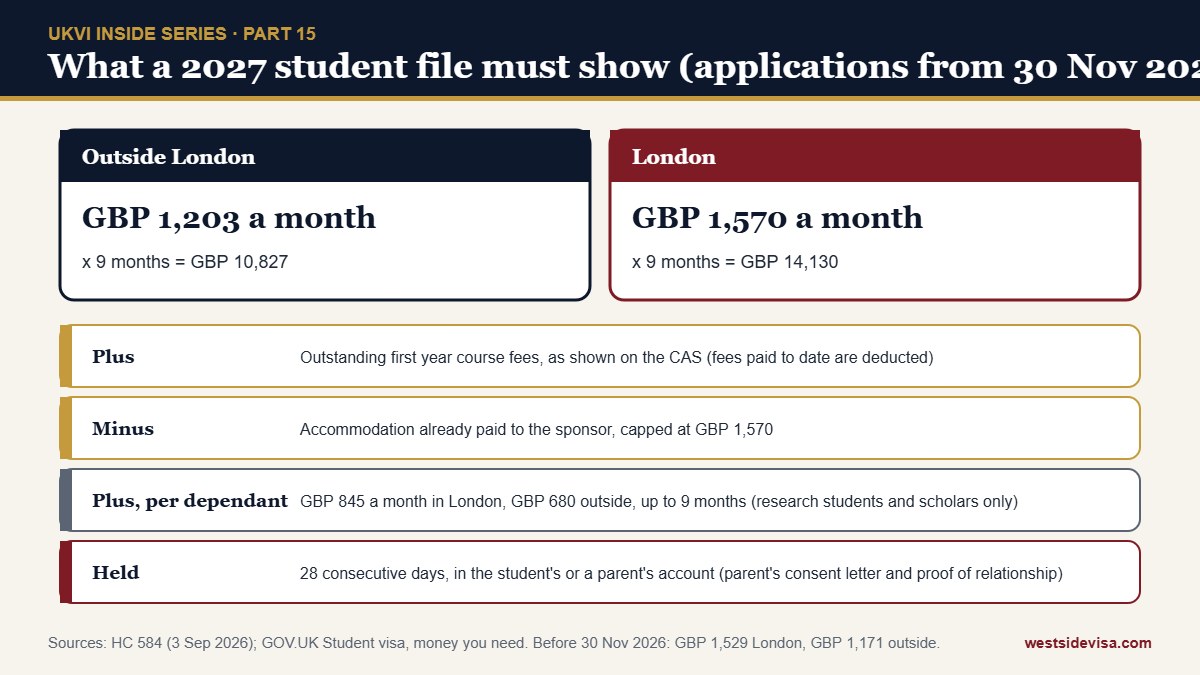
The living cost figures sit in Appendix Student and change by statement of changes. For applications made on or after 30 November 2026, under HC 584 of 3 September 2026, a student must show GBP 1,570 a month for a course in London and GBP 1,203 a month elsewhere, for each month of the course up to a maximum of nine. The figures for applications made up to 29 November 2026 are GBP 1,529 and GBP 1,171. What fixes the set is the date of application (Part 2), not the CAS date, the course start date or the date on the bank statement. A January 2027 intake student applying in early December is on the new figures. Dependants, where permitted at all (Part 12), add GBP 845 a month in London and GBP 680 elsewhere, each, for the same number of months.
The sum the officer builds from your CAS and your statement. Figures from HC 584 and GOV.UK.
Building the sum
Start with the months. A course of eight months and two weeks counts as nine; anything over nine months is capped at nine. Multiply by the monthly figure for your location, as shown on the CAS. Add the outstanding first year course fees, which is the fee on the CAS less the “fees paid to date” the sponsor has recorded (Part 14); a payment the CAS does not show needs a sponsor receipt. Subtract accommodation already paid to the sponsor, up to a cap of GBP 1,570 from 30 November, and only for accommodation arranged by the sponsor, not a private landlord. The result is the amount that must sit in an acceptable account, every day, for 28 consecutive days.
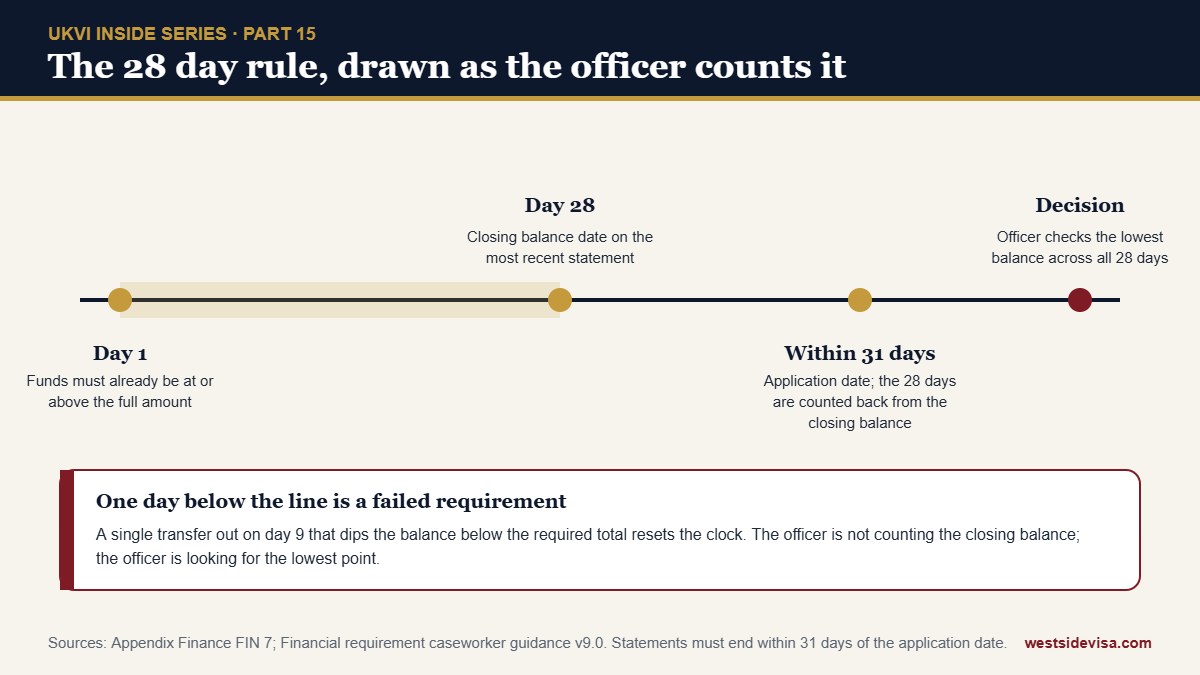
The 28 day window as the officer draws it
Counted backwards from the closing balance, with the lowest day as the test. From Appendix Finance and the caseworker guidance, version 9.0.
The guidance tells officers that the applicant “must show they have held the funds for 28 days”, counting “back from the date of the closing balance” on the most recent statement, and that the closing balance must be dated within 31 days of the application. So the 28 days are the last 28 days of the statement, and the statement must be fresh. Within those days the test is the lowest balance, not the closing one. A statement that opens at GBP 25,000, dips to GBP 14,000 on day nine for a tuition deposit, and closes at GBP 25,000 again has failed if GBP 14,000 is below the required total, even though both ends look fine. The remedy is simple and often missed: wait, and let a clean 28 days run from the day after the dip.
Most Pakistani student files run on a parent’s account, which the rules allow if the paperwork is right. Photo: Unsplash.
Which accounts count
Appendix Finance accepts cash funds in a current, deposit or savings account that the applicant, the applicant’s partner or, for students, a parent or legal guardian holds. The institution must keep electronic records, be regulated in its country and be willing to verify; the guidance says that where an institution declines to verify, its evidence is set aside, which is Part 4 again. Excluded: overdrafts, credit cards, shares, bonds, pension funds and any money that cannot be withdrawn immediately. Excluded in practice: hand written passbook entries and “mini ATM statements”, which the guidance calls “not satisfactory evidence of funds”. Fixed deposits are a frequent question from Lahore. A term deposit that can be broken on demand, confirmed in a bank letter, has generally been accepted; one locked until maturity has not. Joint accounts count if your name, or the parent’s, is on them.
Using a parent’s money
A student may rely on funds held by a parent or legal guardian, and the file then needs two extra documents. First, proof of the relationship: a birth certificate, or, the guidance accepts, “a government issued household register”, which for Pakistan means the NADRA Family Registration Certificate. Second, “written consent from the parent or guardian to use the funds”, a short signed letter naming the student, the account and the purpose. Funds held by an uncle, an elder brother or a family business do not qualify, however willing. If the money is in a sibling’s name, it must move into the parent’s or the student’s account and sit there for a fresh 28 days, with the transfer explained. A loan taken by a parent is not treated as a student loan; it is simply the parent’s cash once it lands.
Official sponsors and loans
Where a licensed Student sponsor funds you, the CAS is sufficient evidence and only any uncovered balance is checked. Other official financial sponsors, such as HEC, a provincial government scheme, the British Council or a university scholarship, must give a letter naming you, the amount or what is covered, the dates and the sponsor’s contact details. A student loan counts if the lender is a government, a government backed company or a regulated academic loan scheme, with the lender’s letter; the 28 day rule does not apply to loan or official sponsorship money.
Not sure how this applies to your case?
Send us your question on WhatsApp. A Westside adviser in DHA Lahore will reply, Monday to Saturday, 10:00 to 18:00.
Rupee balances are converted at the rate “on the date of the application”, normally from OANDA. The guidance names the source so that applicant and officer use the same number. Two practical consequences: build in a margin of several percent for a weakening rupee between statement and application, and do not rely on a bank’s own exchange table. Funds in a foreign currency account are converted the same way.
What the officer does with the statement
The officer identifies the required total from the CAS, checks the account holder, scans the 28 days for the lowest balance, checks that the closing date is within 31 days, converts, and then, for a Pakistani file, considers verification. Large unexplained credits inside the window are the commonest trigger; an officer who sees GBP 15,000 arrive on day three will want to know where it came from, and the genuine student test in the Student guidance asks whether the applicant “has a credible source of funds”. A savings history, a sale deed, a salary record or a business account explaining the credit turns a question into a non issue. The officer can also request receipts from the sponsor and, where the shortfall is large, interview you (Part 5).
Shortfalls at the point of decision
The guidance has a specific rule for funds that have fallen since the statement. If the officer finds at decision that the balance has dropped by more than one month’s accommodation plus fees paid, further checks follow; a smaller drop needs none. Where the officer is not satisfied the reduction was spent on fees or accommodation, the application is turned down. The lesson for families is not to spend the maintenance money on flights or deposits between application and decision without keeping the receipts that explain it.
The arithmetic is dull; the result is not. Photo: Unsplash.
How to prepare
Compute the total from the CAS, on the figure set that matches your application date, and add a currency margin.
Move the money once, into the student’s or a parent’s account, explain the source, and then leave it alone for 28 clean days.
Order the statement to end within 31 days of applying, on bank letterhead or stamped, with the account holder’s name and the lowest balance visible.
If a parent holds the funds, add the consent letter and the NADRA FRC or birth certificate.
Tell the bank to expect a verification call (Part 4).
Do not touch the money until the decision, or keep receipts for anything paid to the sponsor.
How much money do I need for a UK student visa in 2027?
For applications from 30 November 2026: GBP 1,570 a month in London or GBP 1,203 elsewhere, for up to nine months, plus any unpaid first year course fees shown on the CAS, less sponsor accommodation already paid (capped at GBP 1,570).
Does the balance have to stay above the amount every single day?
Yes. The officer looks for the lowest balance in the 28 days before the closing date. One day below the total fails the requirement, and the clean 28 days must start again.
Can my father’s account be used?
Yes, a parent’s or legal guardian’s account is allowed, with a signed consent letter and proof of relationship such as the NADRA Family Registration Certificate. A sibling’s or uncle’s account is not.
Is a fixed deposit acceptable?
Only if the money can be withdrawn immediately, confirmed in a bank letter. A deposit locked until maturity is excluded.
Which exchange rate will UKVI use?
The OANDA rate on the date of application. Build in a margin for rupee movement between your statement date and the day you apply.
Can I spend some of the money after I apply?
Only on fees or sponsor accommodation, with receipts. A larger drop at the point of decision triggers further checks and can end the application.
Checked on 3 November 2026. Figures change by statement of changes; confirm the current amounts on GOV.UK before you apply. General information, not legal advice.
About the author
Mujtaba Maharvi
Mujtaba is the CEO of Westside Visa Consultants. He began his career in 2001 as Executive Secretary to the Consul General of the Republic of Korea in Karachi, co founded Westside in London in 2003, and has since guided more than 1,000 students and families through UK, European, North American and Australian visa decisions from the firm’s offices in DHA Lahore and the UK. He holds postgraduate degrees from the University of Karachi, the University of Padua, Loughborough University and the University of West London, and writes this series from more than twenty years of reading decision letters.
Build the money file the way the officer counts it
Westside computes the exact total from your CAS, checks the 28 days on your statements and prepares the parent consent and relationship documents before you apply. Honest advice from DHA Lahore, Monday to Saturday.
First Floor, 22 A, Sector A, Phase 5, DHA, Lahore · Monday to Saturday, 10:00 to 18:00
This guide is general information, not legal or migration advice. Westside Visa Consultants is an independent private advisory, not affiliated with any government, embassy or visa centre. Always check the official sources before you apply.
Your university creates your CAS inside the Home Office’s own system, so UKVI reads it before you upload anything. Learn what fields the sponsor fills in, the eight CAS statuses, the sponsor note, the six month limit and how the officer compares the CAS with your form.
Moving to the UK is only truly complete when your loved ones are with you. The Dependant visa lets the partner and children of a UK visa holder join them to live, work, and study in the UK.
Saad was living in Tbilisi and felt stuck. Westside handled his KEDGE Business School admission and French student visa from Lahore. Why France beats Georgia for 2027.
Thinking of withdrawing a UK visa application? Learn how withdrawal, variation and voiding work under the Home Office rules, what is refunded, when UKVI can decline a withdrawal, and what stays on your record.
Not every UK visa applicant is interviewed. Here is how UKVI selects who is, how student credibility and visit interviews are run, what is asked, and why the transcript matters more than the conversation.
Everything this series describes, the officer’s notes, interview records, verification results and travel history, sits in a file you can ask to see. Learn the three request types, what each returns, the one month timescale, how to apply from Pakistan and how to read the result before a new application.
There is no 180 day rule for UK visitors, but UKVI does count your days. Learn how travel history is recorded, what “frequent or successive visits” means, the factors officers weigh, and how long term visa holders stay on the right side.
Since 25 February 2026 most UK visit visas are eVisas, not stickers. Learn what the grant email means, how to set up and check your UKVI account, what airlines and Border Force see, and how to fix an error before you fly.