
How to Apply for a UK Standard Visitor Visa from Pakistan
Yes, you really can visit the UK and it’s more achievable than you think.



Home / News and Articles / How UKVI works
UKVI inside series · Part 11“Can I just withdraw it?” is the question we hear the moment a family realises a document is wrong, a date has slipped or an interview has gone badly. The answer is usually yes, but withdrawal is not an undo button. The Home Office has rules on when a withdrawal takes effect, when it can be declined, what happens if you make a second application while the first is pending, what is refunded, and what the record shows afterwards. This guide sets them out from the validation guidance, version 12.0 of October 2026.
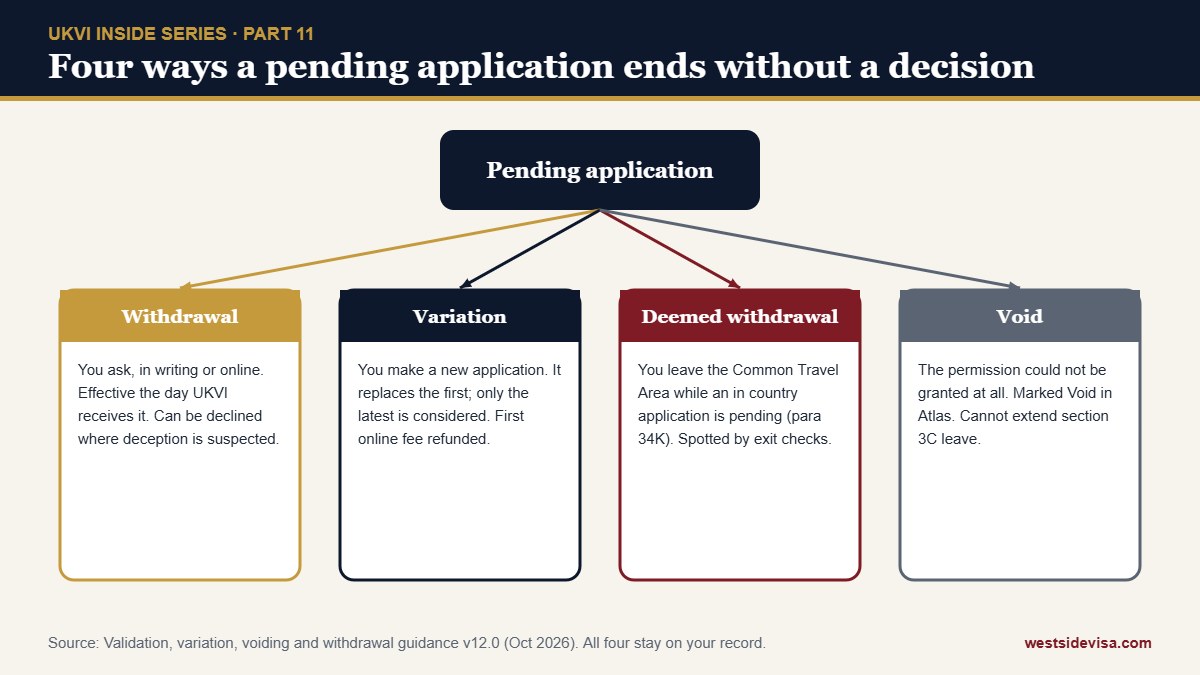
You can ask to withdraw an application for entry clearance, permission to enter or permission to stay “at any time before a decision is made on the application”. The request goes through the online cancellation service on GOV.UK (for app based applications, the “Withdraw this application” button on the UKVI account dashboard), or by email or post. If the request is unclear the caseworker must confirm it with you, and once UKVI has received it, it cannot be reversed. The withdrawal takes effect on the date the Home Office receives the request, counted by the same rules as a date of application. Any visa application centre booking has to be cancelled separately.

This surprises people. The guidance says there is no duty to accept a withdrawal, and that “the most common reason” for declining one is suspected deception, for example where fraudulent documents appear to have been knowingly submitted. In that case you are told with the withdrawal template that the request is declined, and the application may be decided, with the suitability consequences Part 4 described. Withdrawing after a verification call has gone wrong does not stop the finding; it may be the moment the officer decides to make it.
A withdrawn application is not a negative decision, and you can say so truthfully on future forms where they ask about decisions. But it is not invisible either. The application, its contents, the date of withdrawal and any notes made before it sit on your Atlas person record (Part 1). The visit visa form asks whether you have ever applied for a visa to the UK or elsewhere, and the student and family forms ask about previous applications in similar terms; a withdrawn application is an application and must be declared. The next officer will read what you submitted the first time beside what you submit the second time, so a withdrawal followed by a changed story is worse than the original problem.
Under paragraph 34BB of the rules, a new application made while an earlier one is undecided varies the earlier one: “the latest application varies the previous application and only the new application will be considered”. There is only ever one live application. For an online variation the fee for the first application must be refunded. The date of application usually stays as the original date, which matters for which rules and fees apply (Part 2); dependants added in the variation take the variation’s date. If you file the second application after the first has already been decided, the second is treated as new. Where it is unclear which application is the latest, UKVI writes asking you to choose within 14 days, and if you do not reply all of them are treated as invalid.
For applications made inside the UK there is a trap: leaving the Common Travel Area before a decision means the application is treated as withdrawn on the day you left, under paragraph 34K, whether or not you told UKVI. The guidance notes it can be identified through an exit check (Part 3). The fee is not refunded if biometrics or documents were already submitted, and dependants left behind receive a letter telling them their own applications may no longer meet the rules and inviting a fresh application within 14 days. A student in Manchester who flies home for a wedding while a further permission application is pending has withdrawn it at the departure gate.
An application is void when the permission applied for could not be granted at all: an application for limited permission by someone who already has settlement, or by a person exempt from control. It is marked Void in Atlas and you are told with the void template. A void application cannot extend permission inside the UK, and an application made during an administrative review ends that review.
Not sure how this applies to your case?
Send us your question on WhatsApp. A Westside adviser in DHA Lahore will reply, Monday to Saturday, 10:00 to 18:00.
Ask on WhatsApp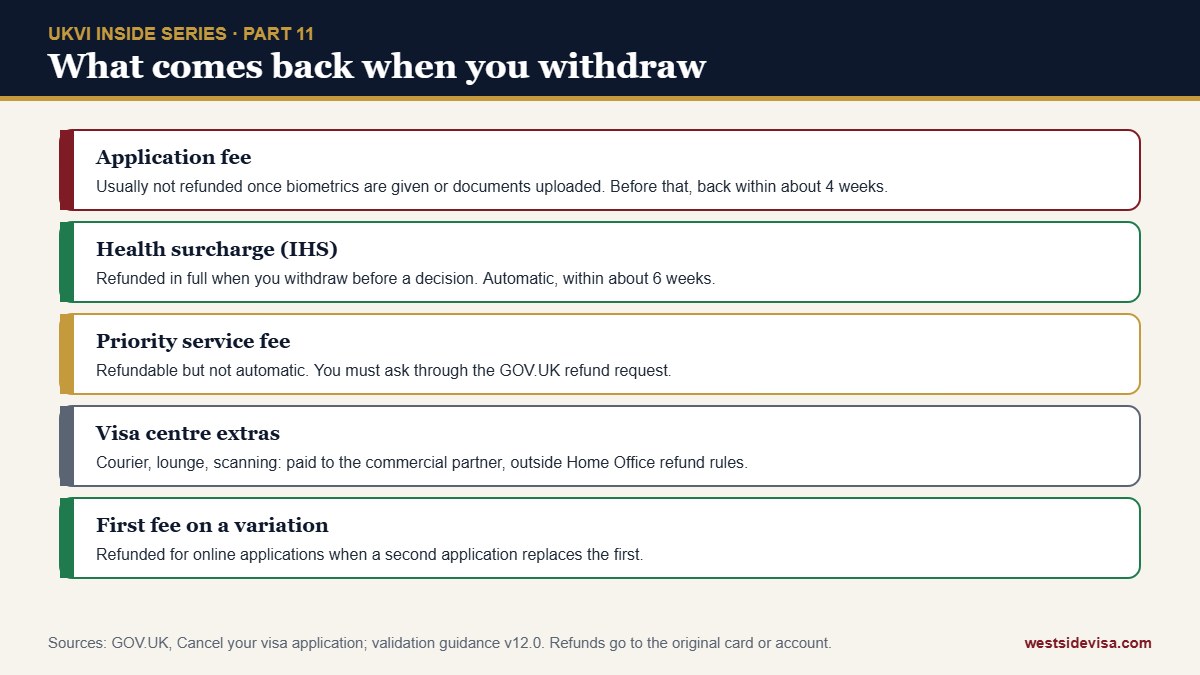
Refunds go back to the original card or account, which is why a chargeback or a closed card causes delay, and the guidance warns applicants not to send new bank details unless UKVI asks.
For anyone extending permission from inside the UK, withdrawal interacts with section 3C, the provision that extends your permission while a valid application is pending. The guidance gives three outcomes. If your permission has not expired, it continues. If your permission expired and the application was valid, your permission ends on the day you withdraw. If the application was never valid, your permission ended on the day the earlier grant expired, and you have been without permission since. GOV.UK puts it bluntly: “you may lose your permission to stay here if you’re in the UK”. Never withdraw an in country application without first knowing which of the three you are in.

Passports are returned through the visa application centre once a case is withdrawn or decided. Asking for the passport back without withdrawing is a separate request and, for overseas applications, usually means the application cannot proceed to decision until it is returned; in practice it stalls the case. If you need to travel elsewhere while a UK application is pending, tell us first: the better route is often to let the decision come, or to time the withdrawal so that the surcharge refund and the new application line up.
Part 12 looks at children and dependants on the UKVI record: consent, biometrics, accompanied visas and the student dependant rules.
Yes, at any time before a decision, but the application fee is generally not refunded once you have given biometrics or uploaded documents. The health surcharge is refunded in full.
It is not a negative decision, but it stays on your record and must be declared as a previous application. What you submitted the first time will be read beside your next file.
Yes. There is no duty to accept a withdrawal, and the usual reason for declining one is suspected deception. The case may then be decided.
The new application varies the old one. Only the latest is considered, the first fee is refunded for online applications, and the original date of application usually stays.
It depends on your section 3C position. If your old permission has expired and the application was valid, your permission ends on the day you withdraw. Take advice first.
Application and priority fees within about four weeks, the health surcharge within about six weeks, to the original card or account.
Checked on 3 November 2026. General information, not legal advice; in country withdrawals affect your permission and need individual advice.

Mujtaba is the CEO of Westside Visa Consultants. He began his career in 2001 as Executive Secretary to the Consul General of the Republic of Korea in Karachi, co founded Westside in London in 2003, and has since guided more than 1,000 students and families through UK, European, North American and Australian visa decisions from the firm’s offices in DHA Lahore and the UK. He holds postgraduate degrees from the University of Karachi, the University of Padua, Loughborough University and the University of West London, and writes this series from more than twenty years of reading decision letters.
Connect with Mujtaba on LinkedIn · About Westside · WhatsApp the office
Confirmed visa changes for Pakistani students, visitors and families, checked against official sources.
Westside Visa Consultants will tell you honestly whether to fix, vary or withdraw, and what each choice leaves on your record. DHA Lahore, fees quoted in writing.
First Floor, 22 A, Sector A, Phase 5, DHA, Lahore · Monday to Saturday, 10:00 to 18:00
This guide is general information, not legal or migration advice. Westside Visa Consultants is an independent private advisory, not affiliated with any government, embassy or visa centre. Always check the official sources before you apply.



A curated list of the most popular travel packages based on different destinations.
Yes, you really can visit the UK and it’s more achievable than you think.
Choosing where to do your PhD is one of the biggest decisions of your academic life, and the four leading English speaking destinations each offer something different.
UK visa decision letters are built from templates inside Atlas. Learn the standard of proof, the paragraph codes (V 4.2, ST 5.1, SU 9.1, SUI 10.1), what a letter must contain, and the options for visit, study and family applicants.
Seeking world class medical care in the UK? It’s absolutely within reach.
Everything this series describes, the officer’s notes, interview records, verification results and travel history, sits in a file you can ask to see. Learn the three request types, what each returns, the one month timescale, how to apply from Pakistan and how to read the result before a new application.
Every child on a UK visa application has their own record, their own biometrics and their own set of rules. Learn how UKVI handles parental consent, accompanied visas, child welfare checks, student dependants and the parent of a child student route.
Submitted your UK visa application? Here is what UKVI does in the first 48 hours: validity checks, biometrics, the 240 day rule, allocation to a decision centre and why the clock starts later than you think.
Moving to the UK is only truly complete when your loved ones are with you. The Dependant visa lets the partner and children of a UK visa holder join them to live, work, and study in the UK.