Children and Dependants on the UKVI Record: Consent, Biometrics, Accompanied Visas and the Student Family Rules
A child is never “on” a parent’s visa. Each child has an application, a fee, a biometric enrolment, a person record and, since 2026, a UKVI account of their own. The officer who reads the file also carries a legal duty towards that child that does not exist for adults. This guide explains how children are handled inside the system: whose consent is needed, how the accompanied visa endorsement works, what happens at the border, which students may still bring family, and the route for a parent who wants to live near a young child at a UK school.
By Mujtaba Maharvi, CEO, Westside Visa Consultants · 3 November 2026
Each childOwn applicationOwn fee, biometrics, record and UKVI account
Under 5Photo onlyFingerprints from age 5
UnaccompaniedComplex routingWelfare checks on the host in the UK
Student familiesResearch and scholarship onlySince 1 January 2024
A child’s own record
Part 1 explained that Atlas works from person records. A child gets one at the first application, linked to the parents’ records by the biographical details and the documents, and from age five by fingerprints: children under five give a facial image only. That record persists. A child visitor at eight becomes a student applicant at eighteen with ten years of history already on file, including every parent’s application the child appeared in. Since the eVisa rollout (Part 7), each child also needs a UKVI account of their own, which can share a parent’s email and phone number but not a parent’s account.
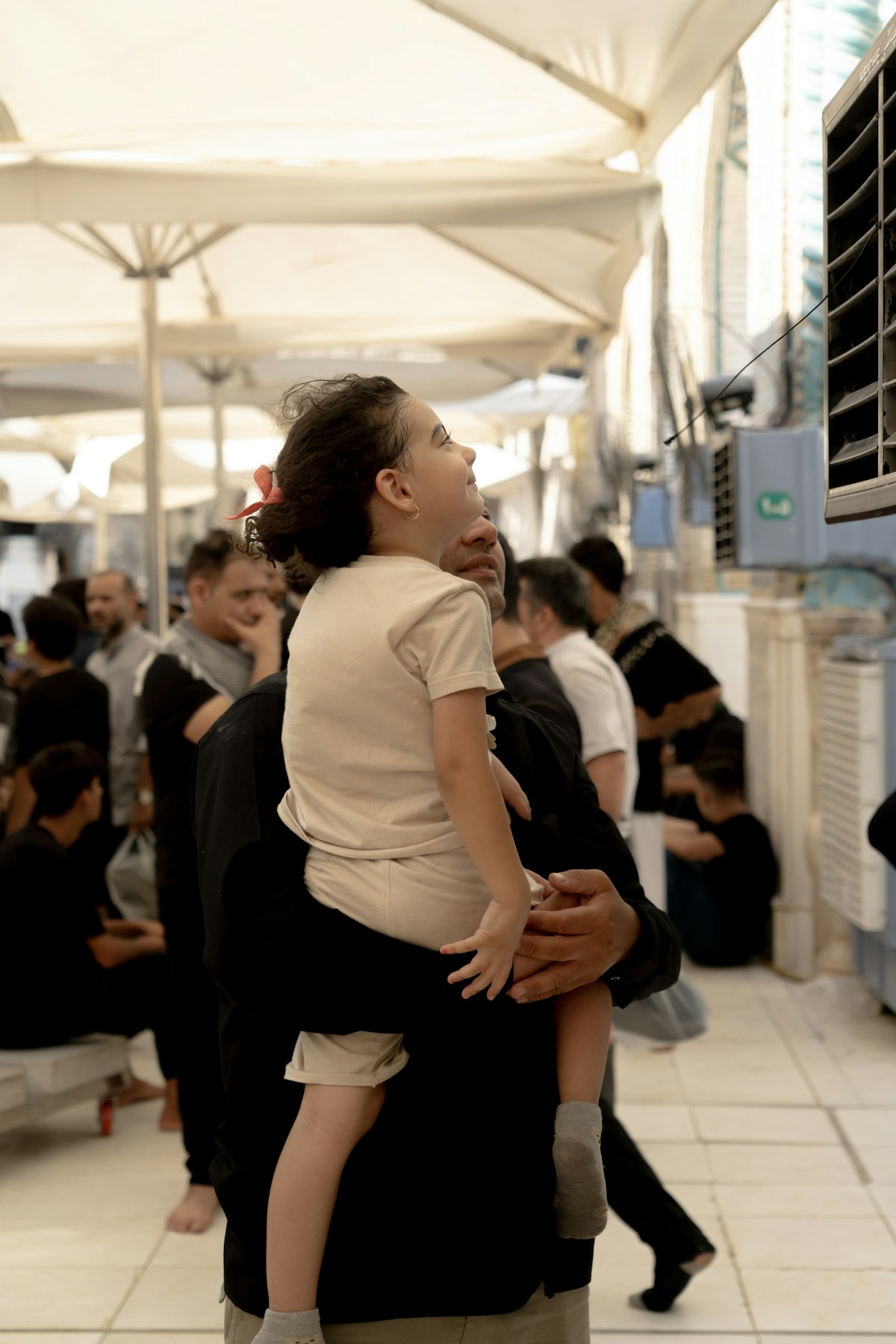
Travelling with one parent is the commonest situation, and the one where the other parent’s consent matters most. Photo: Unsplash.
The welfare duty the officer carries
Under section 55 of the 2009 Borders and Citizenship Act the Home Office must have regard to safeguarding and promoting the welfare of children in the UK, and the visit guidance tells caseworkers: “You must make sure a child’s welfare is taken into account.” For a child not travelling or living with a parent, the officer must be satisfied that the arrangements for travel, reception and care are adequate and that consent has been given. Where details are missing or unclear, or anything raises a welfare concern, further enquiries are made to confirm the host’s identity and address and that the child is expected. An application may be turned down where the arrangements for the child’s welfare are not adequate. This is the one part of visa decision making where the officer is told to look beyond the applicant’s interests.
Whose consent, and in what form
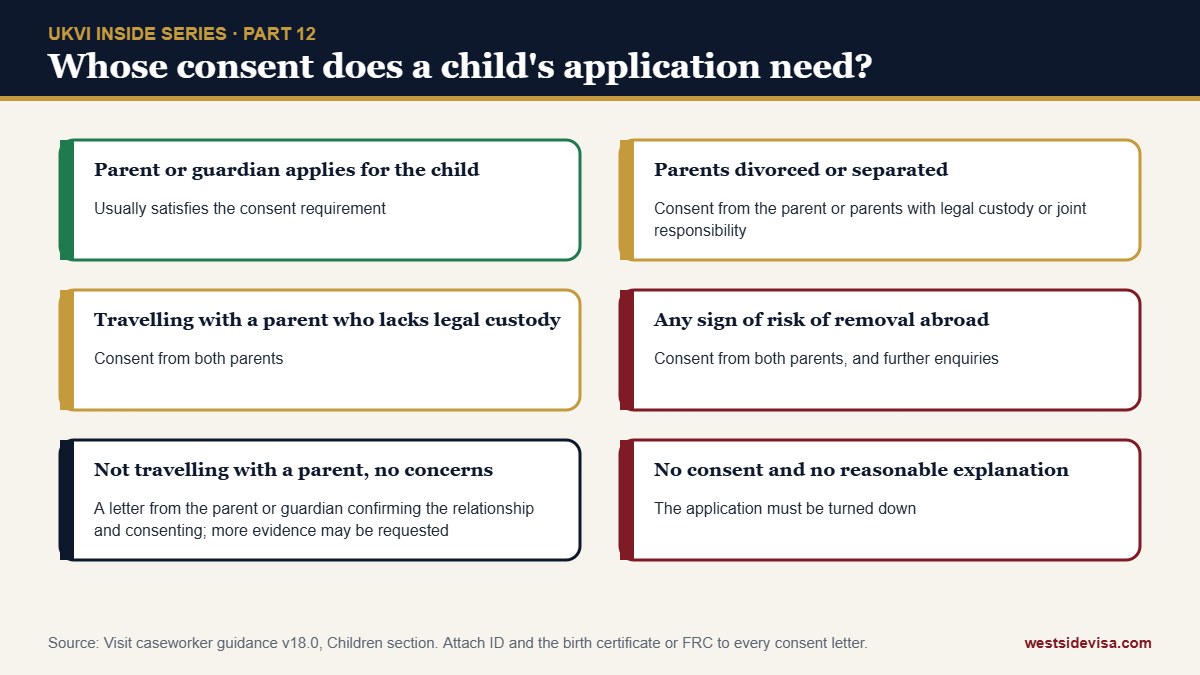
Consent follows custody, not convenience. From the visit guidance, version 18.0.
A parent or guardian makes the application: that usually satisfies the consent requirement.
Divorced or separated parents: consent must come from the parent or parents holding legal custody or joint responsibility.
Travelling with a parent who does not hold legal custody: consent should be sought from both parents.
Any indication of risk that the child could be moved abroad without consent, or is otherwise at risk: both parents.
Not travelling with a parent, no concerns: a letter from the parent or guardian confirming the relationship and consenting to the application is sufficient, with further evidence requested if needed.
No consent and no reasonable explanation: the application must be turned down.
Where someone other than a parent or guardian makes the application, the officer must make enquiries about the accompanying adults and the person giving consent, and any concern about trafficking goes to the modern slavery guidance. For Pakistani families this means the consent letter should name the child, the consenting parent, their relationship, the trip and the adults responsible, with a copy of the consenting parent’s identity document and the child’s birth certificate or family registration certificate.
Accompanied visas: the named adult
For visa nationals, a child’s visit visa is issued as accompanied or unaccompanied. An accompanied visa names the adult or adults the child will travel with, and the border quick guide tells the officer to check “if the applicant is a child with a visa endorsed as accompanied, are they with the specified adult or adults”. A child whose visa names her mother, arriving with an uncle, has a problem at the desk even though both adults hold valid visas. The embassy notice for school groups states the sequencing rule plainly: all accompanying adults must apply first, and the child’s application will fail if the adults have not applied or were not granted.
Unaccompanied children and the host check
The visit quick guide lists children as “Complex, if unaccompanied”, which in Part 2’s terms means the file goes to a more senior officer. Expect checks on the host: identity, address, relationship to the child and evidence that the child is expected. Where the child will stay with a host family or in private foster care for more than 28 days, the private fostering rules for England and Wales, Scotland or Northern Ireland apply and the local authority may need to be notified. A charity or school organising the visit must show it is responsible for the child’s travel and care.
At the border
If there is no parental consent at the border the officer refers to the Border Force children’s guidance; where there are welfare concerns the case goes to local authority children’s services or the police, who advise on the sponsor’s suitability and can take the child into care where there is no responsible sponsor. For an unaccompanied child the officer “may want to ask for evidence about how their visit is to be funded”. Children arriving with a parent are normally dealt with quickly, but the officer sees the whole family’s records and will notice if a parent’s previous application said the children would stay at home.
Not sure how this applies to your case?
Send us your question on WhatsApp. A Westside adviser in DHA Lahore will reply, Monday to Saturday, 10:00 to 18:00.
“Where a child is applying to come to the UK as a visitor or seeking to extend their stay, they are not expected to have funds in their own name.” The child may show access to funds from the parents or a third party, so the parents’ statements, the sponsor’s letter and the host’s undertaking carry the maintenance test. The practical point is consistency: the same parental account that funds the child’s application should appear in the parents’ own applications made the same season.
Since January 2024 most student families cannot travel together; the exceptions are narrow and worth knowing. Photo: Unsplash.
Student dependants after January 2024
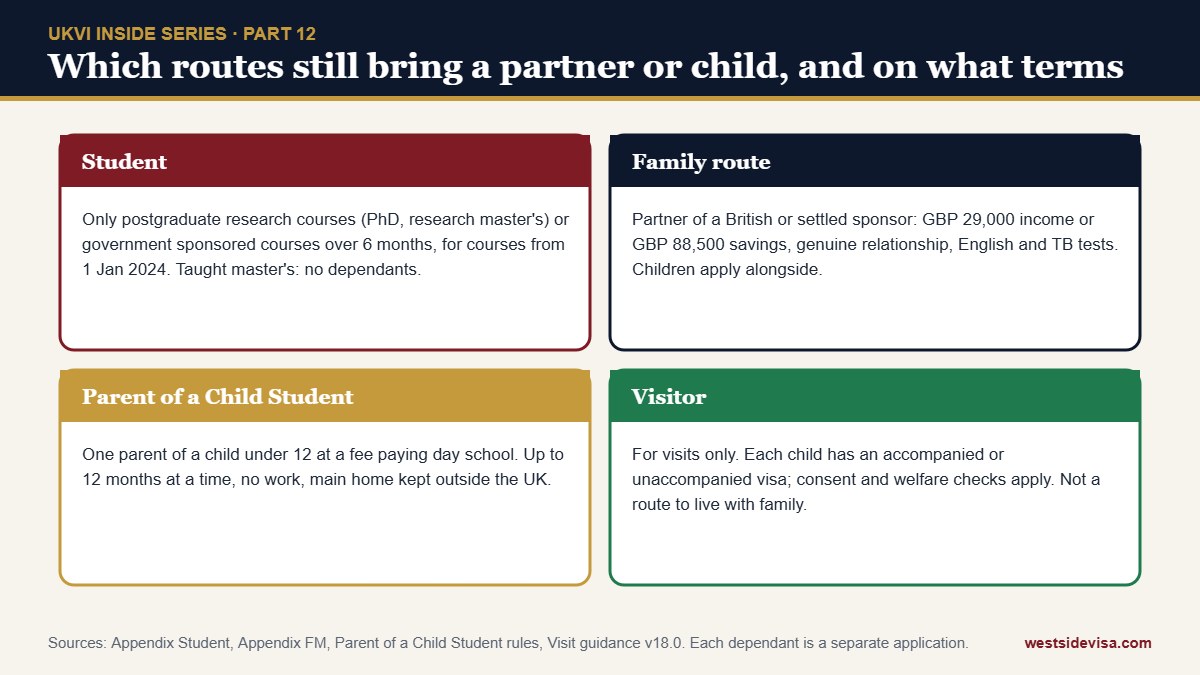
Which routes still bring the family, and on what terms.
For courses starting on or after 1 January 2024, a Student may bring a partner or child only if the course is a postgraduate research programme (a PhD or a research based master’s) or a government sponsored course of more than six months. A taught master’s, however good the university, does not qualify. Each dependant makes a separate application at the full fee and surcharge, enrols biometrics and holds a separate record, and the family’s funds must cover the dependant amounts on top of the student’s. Part 8 explained why universities now screen for this: a dependant application that cannot succeed drags on the sponsor’s statistics.
Parent of a Child Student
For families sending a young child to a UK independent school there is a route of its own. A parent may apply as the Parent of a Child Student where the child is under 12 and attending a fee paying day school, for permission of up to twelve months at a time, renewable while the child remains under 12. The parent may not work, must keep a main home outside the UK and must show funds for both. Only one parent may hold the permission at a time, and the other parent cannot come as the first parent’s dependant. It is the honest route for a mother who wants to be near a seven year old in Year 3, and it is often confused with the visit route, which it is not.
How to prepare a family file
One application per person, submitted in the right order: adults first, then children, with the children’s forms naming the same adults.
Consent in writing from every parent with responsibility, with identity documents and the birth certificate or FRC attached, even when it feels unnecessary.
Match the stories. Who travels, who stays, who pays and where everyone sleeps should read the same across every form in the family.
Check which route actually brings the family. Research student, worker, family route or Parent of a Child Student; the visit route is for visits.
After the grant, one UKVI account per child and the child’s own passport linked to it (Part 7).
Yes. Every child has a separate application, fee, biometric enrolment, person record and, since 2026, a separate UKVI account for the eVisa.
Do young children give fingerprints?
Children under five give a facial image only. From age five, fingerprints and a photograph are taken like an adult’s.
My child’s visa says accompanied by me. Can my brother take him instead?
Not safely. The border officer checks that an accompanied child is with the adult named on the visa. Apply with the correct adult named, or apply for an unaccompanied visa with full host arrangements.
We are separated. Do I need my former husband’s consent for our daughter’s visit visa?
If he holds custody or joint responsibility, yes. If you travel with the child and do not hold legal custody, consent should come from both parents. No consent and no reasonable explanation means the application fails.
Can I bring my wife and children on a UK student visa in 2027?
Only if your course is a postgraduate research programme or a government sponsored course of more than six months. A taught master’s does not allow dependants.
Is there a visa for a parent to live with a young child at a UK school?
Yes, the Parent of a Child Student route, for one parent of a child under 12 at a fee paying day school, for up to twelve months at a time, with no work and a main home kept outside the UK.
Checked on 3 November 2026. General information, not legal advice; custody questions turn on the family’s own documents.
About the author
Mujtaba Maharvi
Mujtaba is the CEO of Westside Visa Consultants. He began his career in 2001 as Executive Secretary to the Consul General of the Republic of Korea in Karachi, co founded Westside in London in 2003, and has since guided more than 1,000 students and families through UK, European, North American and Australian visa decisions from the firm’s offices in DHA Lahore and the UK. He holds postgraduate degrees from the University of Karachi, the University of Padua, Loughborough University and the University of West London, and writes this series from more than twenty years of reading decision letters.
Applying as a family? Get every application right the first time
Westside Visa Consultants prepares family files together, adults and children, in the right order with the right consents. Honest advice from DHA Lahore.
First Floor, 22 A, Sector A, Phase 5, DHA, Lahore · Monday to Saturday, 10:00 to 18:00
This guide is general information, not legal or migration advice. Westside Visa Consultants is an independent private advisory, not affiliated with any government, embassy or visa centre. Always check the official sources before you apply.
Priority buys a place at the front of the queue, not a different officer or a lighter check. Learn how the 5 working day and next working day services work from Pakistan, when the clock starts, why verification and interviews take a file outside the service, the no refund rule and when the extra fee is worth it.
Not every UK visa applicant is interviewed. Here is how UKVI selects who is, how student credibility and visit interviews are run, what is asked, and why the transcript matters more than the conversation.
Moving to the UK is only truly complete when your loved ones are with you. The Dependant visa lets the partner and children of a UK visa holder join them to live, work, and study in the UK.
A UK PhD gives you a world class research degree, generous funding options, and, importantly, a post study advantage that survives the 2027 migration changes: doctoral graduates keep the full three year Graduate Route.
Apply on or before 31 December 2026 and you get 2 years. Apply on or after 1 January 2027 and you get 18 months. The date that matters is the date you submit the application, not the date your course ends.
From 30 November 2026 a UK student must show GBP 1,570 a month in London or GBP 1,203 outside, for up to nine months, plus unpaid fees, held for 28 days. Learn exactly how the officer counts, which accounts count, how a parent’s funds work and the mistakes that fail Pakistani files.
Your university creates your CAS inside the Home Office’s own system, so UKVI reads it before you upload anything. Learn what fields the sponsor fills in, the eight CAS statuses, the sponsor note, the six month limit and how the officer compares the CAS with your form.