
How to Apply for a UK Visitor Visa for Medical Treatment from Pakistan
Seeking world class medical care in the UK? It’s absolutely within reach.



Home / News and Articles / How UKVI works
UKVI inside series · Part 14Students think of the CAS as a reference number they type into the visa form. Inside UKVI it is something else: a database record created by the university on a Home Office system, visible to the caseworker from the moment it is assigned, and often read before your own application is opened. It says what you paid, which documents the university relied on, whether an agent recruited you, and sometimes, in a free text box you never see, what the admissions office thinks you should be asked. This guide follows the CAS from the admissions desk to the officer’s screen.
The Home Office’s own manual says it: “A CAS is not an actual certificate or paper document, but is a virtual document, similar to a database record.” The university creates it inside the Sponsor Management System, SMS, which is a Home Office system the sponsor logs into with a licence. When the record is assigned to you, it becomes visible across UKVI’s systems, including Atlas (Part 1). The CAS statement the university emails you is a printout of some of the fields. The record itself is what the officer reads.
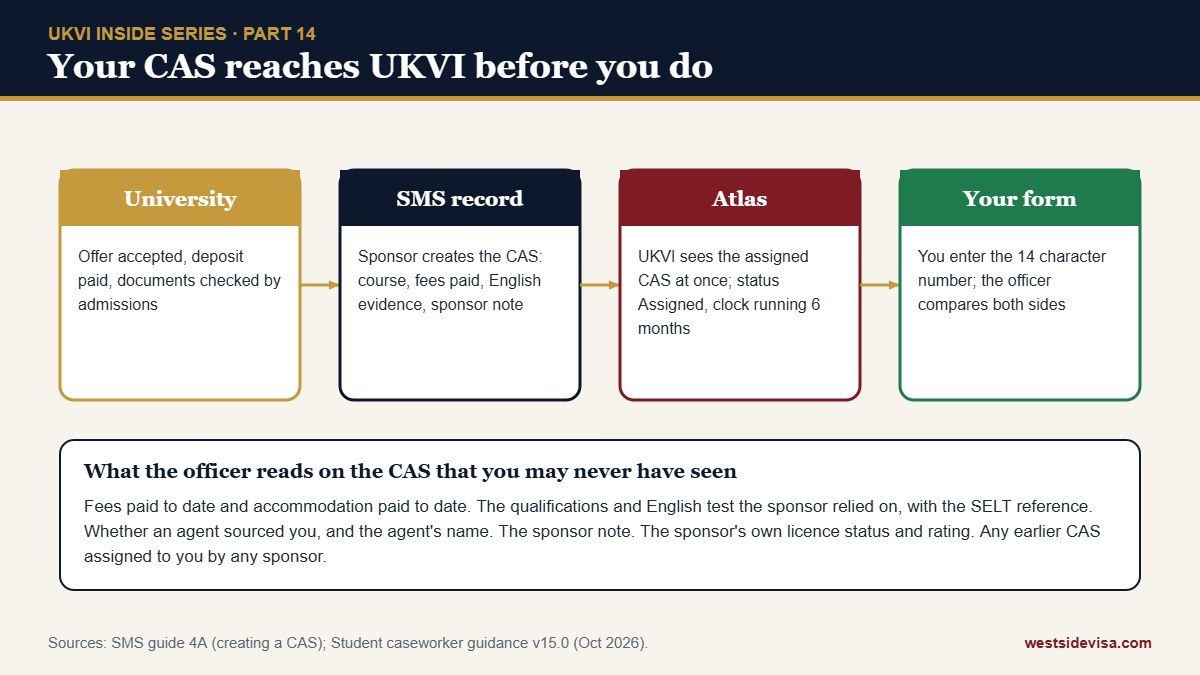
SMS guide 4A lists the fields. Your passport details and nationality. Whether you were “sourced through an agent”, with the agent’s company name, contact name and address. The course title, level, start and end dates, hours a week, and whether it is a continuation of earlier study. Whether ATAS applies. The English language section: whether a SELT was required, the level attained, the four component scores and the test provider, or the reason no test was needed, with a “gifted student” waiver box. Whether you have studied in the UK before, at what level, and a justification text if the new course is not higher. Course fees charged for the first year, scholarship or bursary awarded, fees paid to date, accommodation fees charged and paid. Work placement percentage. And the one field that matters most for what follows: “Evidence used to obtain offer”, where the sponsor must say which qualifications and which English evidence it relied on, quoting the SELT reference number where there is one.
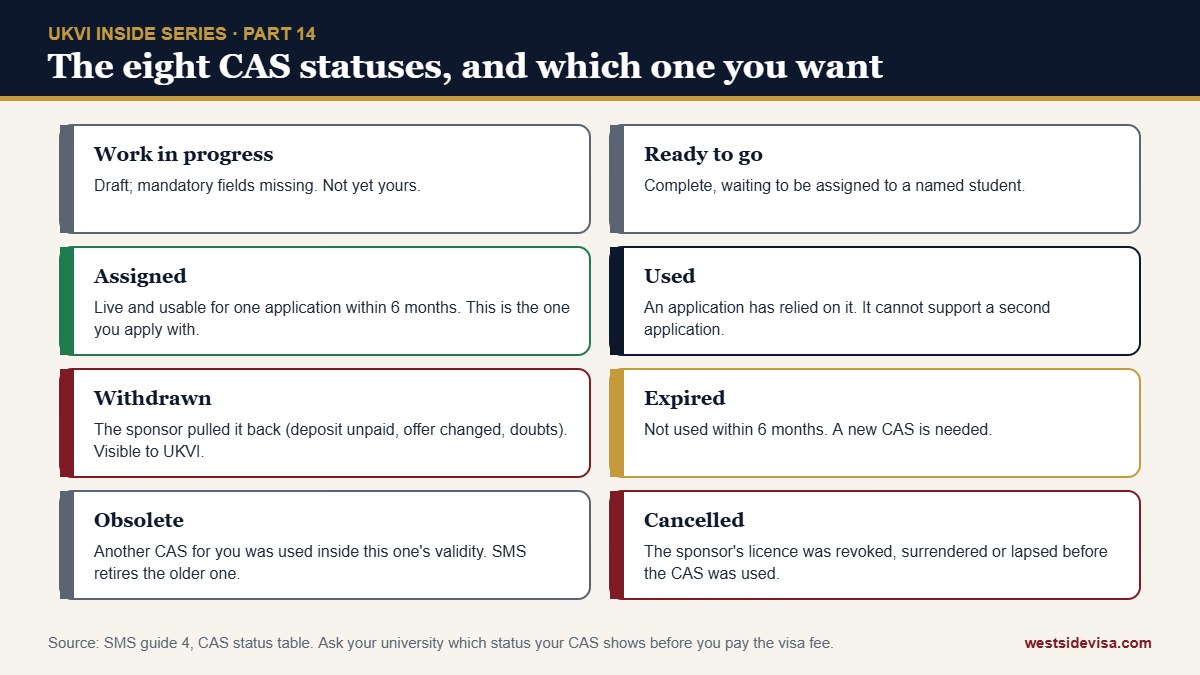
A CAS begins as Work in progress, becomes Ready to go when every mandatory field is filled, and becomes Assigned when the sponsor attaches it to you and spends one unit of its annual allocation. From that date you have six months to apply; the Student guidance tells officers the CAS must “be issued no more than 6 months before the date of application”. Once an application relies on it, it is Used, and a Used CAS “cannot support a second application”, which is why a second attempt after a negative decision needs a fresh CAS from the university, with a fresh judgement by the admissions office about whether to issue one (Part 8). A sponsor may mark a CAS Withdrawn, for an unpaid deposit, a changed offer or doubts about the student, and the withdrawal is visible to the officer. Expired, Obsolete and Cancelled are the system’s own housekeeping, the last of them triggered when a sponsor’s licence ends.
The Student caseworker guidance, version 15.0 of October 2026, instructs: “The caseworker must check whether the CAS submitted with an application is valid.” That means the number matches an Assigned record, the record has not been used in an earlier application, it was assigned within six months, the passport number and personal details on the CAS match the passport and the form, the sponsor holds a current licence for the route, and the course and dates on the CAS are the course and dates you have applied for. Any discrepancy between the application and the CAS is to be checked with the sponsor. Fees: “If the applicant has paid all or part of their course fees this must be confirmed on the CAS”; otherwise you need a sponsor receipt. The money you must show (Part 15) is calculated from the CAS fee fields, not from your offer letter.

The sponsor note is a free text field the university can write at creation or add afterwards. The guidance says “the caseworker must always check the ‘sponsor note’ field on a CAS”. Universities use it for practical things, such as a revised start date, confirmation that a deposit was received after the CAS was assigned, an explanation of a gap in study or of why a course at the same level is justified. Some use it to record that the student passed a pre CAS credibility interview and on what date. You will not normally see the note. If your admissions office offers to add one, say yes to anything that explains a weakness in your file before the officer finds it.
The agent fields exist because the Home Office tracks recruitment channels. Where a sponsor records that you were sourced through an agent, the name goes on the CAS and into the data the Home Office uses to monitor sponsors and the agents they work with. This is not a mark against you. It does mean the officer can see which adviser handled your file, and can connect your application with others from the same source. An adviser whose students produce poor outcomes becomes visible in the data, which is one reason Part 8 advised choosing an adviser as carefully as a university. Westside appears on CAS records as a named representative of the universities we work with, including KEDGE Business School, and we are comfortable with that visibility.
Not sure how this applies to your case?
Send us your question on WhatsApp. A Westside adviser in DHA Lahore will reply, Monday to Saturday, 10:00 to 18:00.
Ask on WhatsAppBecause the sponsor has stated which qualifications and English evidence it relied on, you are bound to produce them. The guidance: applicants “must provide all the documents that the sponsor used to assign the CAS”, unless an exemption applies. The exemptions are the differentiation arrangements for a list of nationalities in Appendix Student ST 22, and sponsorship by a compliant higher education provider that has assessed the qualifications itself. Pakistan is not on the differentiation list, so a Pakistani student at a provider that has not used the HEP assessment route must upload every certificate and transcript named on the CAS, in the form the officer can verify (Part 4). A CAS that names a bachelor’s transcript you cannot produce is a problem the officer will find in minutes.
For an application made from outside the UK, “the CAS will be invalid on the day the sponsor licence is revoked”. A pending application then fails on the CAS requirement, and the fee is not returned. Students already in the UK are treated more gently: the guidance gives 60 days to find a new sponsor or leave before a decision is made on the invalid CAS. This is why Part 8’s Red, Amber and Green ratings matter at the moment you choose where to apply. A sponsor on a Final Warning in 2027 is a sponsor whose CAS could stop being valid between your biometrics and your decision.
Part 15 takes the CAS fee fields into the money a 2027 student file must show, including the figures that change on 30 November 2026.
Yes. The CAS is created on the Home Office’s Sponsor Management System and is visible to UKVI from the moment the university assigns it to you.
You must apply within six months of the date it was assigned. After that it expires and the university must issue a new one.
No. A CAS used in one application is marked Used and cannot support another. You need a fresh CAS, and the university will decide whether to issue it.
It is a free text field the university can add to the CAS record; officers must always read it. Students do not normally see it, but you can ask the admissions office what it says.
Pakistani applicants usually do, because Pakistan is not on the differentiation list. The exception is a compliant higher education provider that has assessed your qualifications itself, in which case the CAS says so.
For an application from outside the UK the CAS becomes invalid on the day the licence is revoked and the application fails. Check the sponsor’s rating and standing before you choose.
Checked on 3 November 2026. General information, not legal advice.

Mujtaba is the CEO of Westside Visa Consultants. He began his career in 2001 as Executive Secretary to the Consul General of the Republic of Korea in Karachi, co founded Westside in London in 2003, and has since guided more than 1,000 students and families through UK, European, North American and Australian visa decisions from the firm’s offices in DHA Lahore and the UK. He holds postgraduate degrees from the University of Karachi, the University of Padua, Loughborough University and the University of West London, and writes this series from more than twenty years of reading decision letters.
Connect with Mujtaba on LinkedIn · About Westside · WhatsApp the office
Confirmed visa changes for Pakistani students, visitors and families, checked against official sources.
Westside reads your CAS statement field by field, matches it to your documents and your form, and tells you what the officer will see. Official admissions representative of KEDGE Business School and partner universities. DHA Lahore, Monday to Saturday.
First Floor, 22 A, Sector A, Phase 5, DHA, Lahore · Monday to Saturday, 10:00 to 18:00
This guide is general information, not legal or migration advice. Westside Visa Consultants is an independent private advisory, not affiliated with any government, embassy or visa centre. Always check the official sources before you apply.




A curated list of the most popular travel packages based on different destinations.
Seeking world class medical care in the UK? It’s absolutely within reach.
Since 25 February 2026 most UK visit visas are eVisas, not stickers. Learn what the grant email means, how to set up and check your UKVI account, what airlines and Border Force see, and how to fix an error before you fly.
Planning to send your child to the UK for a holiday, to visit family, or for a short course?
Australia plans to stop most students bringing family. New Zealand is widening post study work from 16 November. An honest comparison for married Pakistani students.
Dreaming of studying at a world class UK university?
UK visa decision letters are built from templates inside Atlas. Learn the standard of proof, the paragraph codes (V 4.2, ST 5.1, SU 9.1, SUI 10.1), what a letter must contain, and the options for visit, study and family applicants.
From 30 November 2026 a UK student must show GBP 1,570 a month in London or GBP 1,203 outside, for up to nine months, plus unpaid fees, held for 28 days. Learn exactly how the officer counts, which accounts count, how a parent’s funds work and the mistakes that fail Pakistani files.
An administrative review is not an appeal and not a second look at new documents. Learn who reviews a UK visa decision, what counts as a case working error, the 28 day deadline, the GBP 80 fee, the five outcomes and why visit visa applicants have no review at all.