How UKVI Scores Your University: The Compliance Rating That Shapes Your Student Visa Before It Is Read
Your Confirmation of Acceptance for Studies is not a neutral ticket. Behind it sits a sponsor licence, an annual Basic Compliance Assessment and, since 1 June 2026, a Red, Amber or Green rating that is set by the worst of three numbers. Those numbers are built from applicants like you, and they feed back into how your own application is routed and read. This guide explains the system from the university’s side of the desk, and what it means for a Pakistani applicant choosing where to apply for 2027.
By Mujtaba Maharvi, CEO, Westside Visa Consultants · 3 November 2026
Visa outcomesUnder 5%Negative decisions allowed per sponsor per year
Enrolment95% or moreOf visa holders must enrol
Completion85%, then 90%From June 2027
PublishedSponsor registerRatings go public after the first cycle
The licence behind every CAS
A UK university can only sponsor international students because the Home Office has granted it a Student sponsor licence. The licence lets it assign a Confirmation of Acceptance for Studies, the CAS number you enter on your form, through the Sponsorship Management System. Part 2 explained that a CAS is never verified with the university during caseworking; it is checked against the Home Office’s own record. That record also carries the sponsor’s history: how many of its CAS holders were granted visas, how many enrolled, how many finished.
Assigning a CAS carries duties. The compliance guidance says that assigning a CAS “without properly assessing English language ability or academic suitability” is likely to be treated as a serious breach. A university that issues a CAS to a weak applicant is risking its own licence, which is why admissions teams have become stricter about credibility checks of their own before any CAS is issued.
Every graduate counts towards the completion rate the university is judged by. Photo: Unsplash.
The Basic Compliance Assessment
Once a year, tied to the anniversary of the licence, UKVI runs a Basic Compliance Assessment covering the previous twelve months. For assessments on or after 1 June 2026 the sponsor must keep its visa outcome rate (the share of CAS that end in a negative decision) below 5% (it was 10%), an enrolment rate of at least 95% (it was 90%) and a course completion rate of at least 85%, rising to 90% for assessments from 1 June 2027. The enrolment rate is the share of visa holders who actually turned up; the completion rate is the share who finished.
Each of those numbers is made of individual applicants. A Pakistani applicant whose visa is turned down because of an unverifiable bank statement (Part 4) counts against the university that issued the CAS. A student who obtains a visa and never enrols counts twice: once as a non enrolment and once in the intelligence that feeds risk profiles.
Red, Amber, Green: the bands
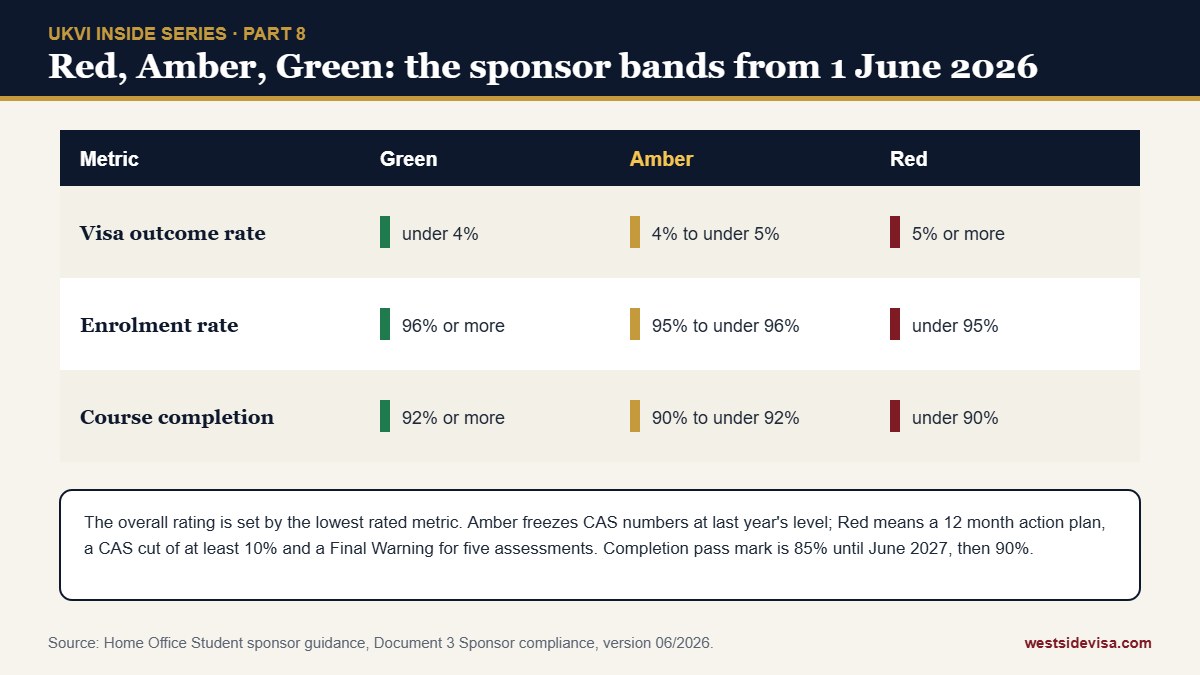
The bands from the Student sponsor compliance guidance, version 06/2026. The worst metric sets the colour.
The June 2026 guidance adds a traffic light on top of the pass marks. Green means a negative outcome rate under 4%, enrolment of 96% or more and completion of 92% or more. Amber is the narrow ledge between: 4% to just under 5%, 95% to just under 96%, 90% to just under 92%. Red is anything worse. The guidance is explicit that “the overall rating is set by the lowest rated metric”, so a university with excellent completion and a 4.5% negative outcome rate is Amber.
What a rating does to a university
Green: no compliance action from the rating itself, although audits and visits remain possible.
Amber: the sponsor may not be allocated more CAS than it used in the previous year until it returns to Green, and it must attend engagement meetings with UKVI, attended at vice chancellor or chief executive level. In practice recruitment is frozen.
Red: an action plan of at least twelve months, a CAS allocation cut of at least 10%, loss of the right to self assess English and to teach remotely, and a “Final Warning” that stays live for the next five assessments. A second Red during that warning starts licence revocation.
Publication: the rating is published on the Register of Student Sponsors after a twenty working day representations period and stays there until the next assessment. Because assessments are spread across the year, the register will only show every sponsor’s colour once the first full cycle completes, around summer 2027.
How this reaches your application
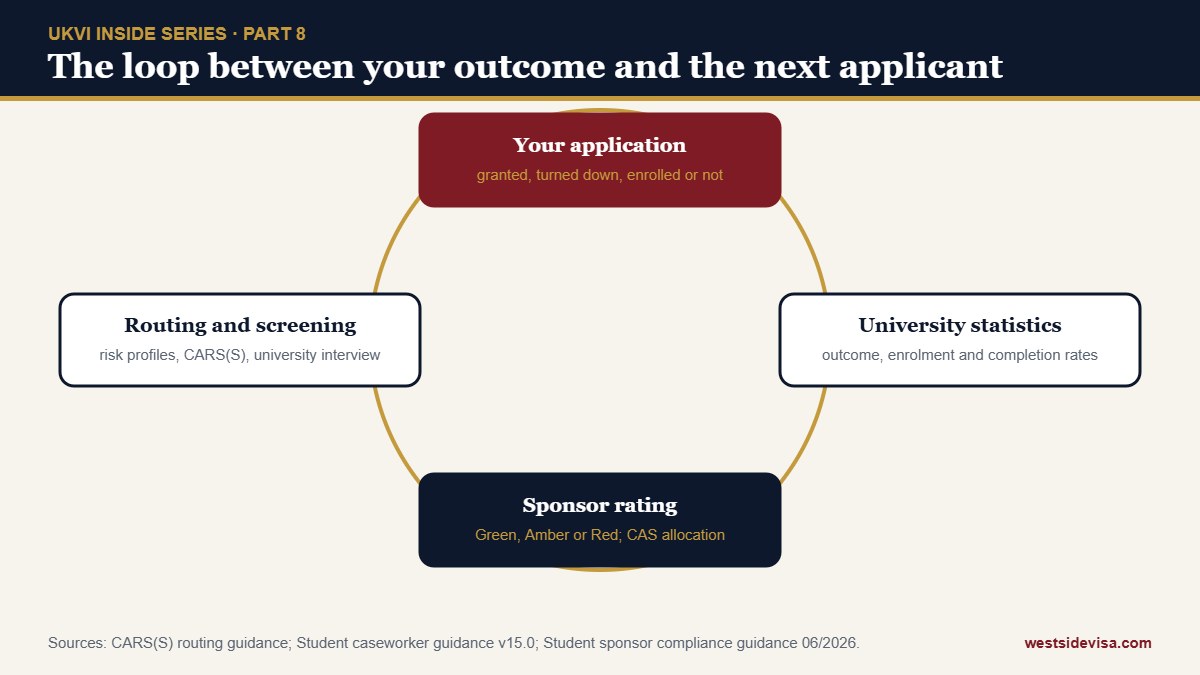
Your outcome becomes the university’s statistic, which becomes the next applicant’s routing. A closed loop.
Three channels connect the sponsor’s numbers to your file. First, Part 5 explained that the study routing tool, CARS(S), uses “sponsor information in the CAS” to match applications against risk profiles, and that risk profiles are built partly from “sponsor cancellations”. A sponsor with a poor record makes a complex routing more likely. Second, the caseworker guidance lists, among the genuineness factors, whether the provider “is under investigation” or is otherwise of concern. Third, the university itself, under pressure to protect its rating, will interview you, verify your funds and sometimes decline to issue a CAS at all. In 2026 the first negative decision on many Pakistani files is made in an admissions office, not by UKVI.
Why this cuts both ways: a Green sponsor is a mild positive signal in routing, but it is also the sponsor that can least afford a weak applicant. Expect a university with a good rating to ask for more evidence, earlier, and to run its own credibility interview before the CAS. Treat that interview with the seriousness of the UKVI one (Part 5); its outcome decides whether UKVI ever sees you.
The admissions and compliance officer is now the first decision maker on a student file. Photo: Unsplash.
Not sure how this applies to your case?
Send us your question on WhatsApp. A Westside adviser in DHA Lahore will reply, Monday to Saturday, 10:00 to 18:00.
Agents, the Agent Quality Framework and “agents of concern”
The caseworker guidance names one more factor that no applicant can see: whether the agent on the file is one “the Home Office has concerns about”. Universities track outcomes by agent, and the 2025 white paper committed sponsors to the Agent Quality Framework, a sector standard for how agents are trained, contracted and monitored. Membership is a floor, not a promise of good conduct, but a university now has every incentive to drop an agent whose students are turned down or fail to enrol, because those students damage its rating. For you, the practical test is simple: ask any adviser which universities they represent directly, and whether their students’ outcomes are tracked by those universities. Westside is an official admissions representative of KEDGE Business School and works with UK institutions on that basis.
What the university must report about you
Sponsorship duties continue after the visa. The compliance guidance lists “failure to report a change in students’ circumstances” as a compliance concern, and says that delayed or unreported information affecting an assessment may be a serious breach. If you do not enrol, stop attending, change course, withdraw or finish early, the university must tell UKVI through the sponsorship system, and that report lands on your Atlas person record (Part 1). A student who obtains a visa and quietly does not turn up has created an entry that every future officer, in the UK and in the four fingerprint sharing countries, can see.
Choosing a sponsor for 2027
Check the Register of Student Sponsors for the institution and, from 2027, its published rating.
Expect and prepare for the university’s own interview and funds check. It is the first gate.
Apply through an adviser the university knows, ideally one it has contracted directly, because the agent on the file is a factor the officer can see.
Choose a course you can complete. Completion is now a scored metric, and the university will assess whether your background supports the course before issuing a CAS.
Once granted, enrol and attend. Non enrolment is reported, recorded, and counted against the next applicant from your city.
Part 9 of this series looks at the other side of the visitor file: how your UK visits are counted, the frequent visitor question and the myth of the 180 day rule.
Questions applicants ask
Can my university lose its licence because of visa outcomes?
Yes. A negative outcome rate of 5% or more, enrolment under 95% or completion under the threshold puts a sponsor in Red, with an action plan, a CAS cut and a Final Warning. A second Red within five assessments starts revocation.
Does a university’s rating affect my own visa decision?
Indirectly. Sponsor information feeds the routing tool and the genuineness factors, and a sponsor under investigation is a named concern in the guidance. More directly, universities under pressure interview and screen applicants harder before issuing a CAS.
Where can I see a university’s rating?
On the Register of Student Sponsors, once published after the sponsor’s first assessment under the June 2026 rules. Most ratings will be visible by summer 2027.
Why did the university interview me before giving a CAS?
Because your outcome counts towards its outcome and enrolment rates, and issuing a CAS without assessing suitability is a breach. Treat the university interview as seriously as a UKVI one.
What happens if I get the visa but do not enrol?
The university must report it. The report sits on your Home Office record, counts against the sponsor, and feeds the risk profiles applied to future applicants.
Does it matter which agent I use?
Yes. The caseworker guidance lists agents the Home Office has concerns about as a genuineness factor, and universities track outcomes by agent under the Agent Quality Framework.
Checked on 3 November 2026. Thresholds are quoted from the June 2026 guidance and may change; confirm against the current Student sponsor guidance. General information, not legal advice.
About the author
Mujtaba Maharvi
Mujtaba is the CEO of Westside Visa Consultants. He began his career in 2001 as Executive Secretary to the Consul General of the Republic of Korea in Karachi, co founded Westside in London in 2003, and has since guided more than 1,000 students and families through UK, European, North American and Australian visa decisions from the firm’s offices in DHA Lahore and the UK. He holds postgraduate degrees from the University of Karachi, the University of Padua, Loughborough University and the University of West London, and writes this series from more than twenty years of reading decision letters.
Choosing a UK university for 2027? Choose with the rating in mind
Westside Visa Consultants works directly with institutions and prepares students for the university interview as well as the visa. Honest advice from DHA Lahore, fees quoted in writing.
First Floor, 22 A, Sector A, Phase 5, DHA, Lahore · Monday to Saturday, 10:00 to 18:00
This guide is general information, not legal or migration advice. Westside Visa Consultants is an independent private advisory, not affiliated with any government, embassy or visa centre. Always check the official sources before you apply.
Everything this series describes, the officer’s notes, interview records, verification results and travel history, sits in a file you can ask to see. Learn the three request types, what each returns, the one month timescale, how to apply from Pakistan and how to read the result before a new application.
Some UK universities have paused Pakistani applicants under stricter Home Office rules. Here is why, and how to choose a university that will issue your CAS for 2027.
Priority buys a place at the front of the queue, not a different officer or a lighter check. Learn how the 5 working day and next working day services work from Pakistan, when the clock starts, why verification and interviews take a file outside the service, the no refund rule and when the extra fee is worth it.
Apply on or before 31 December 2026 and you get 2 years. Apply on or after 1 January 2027 and you get 18 months. The date that matters is the date you submit the application, not the date your course ends.
Thinking of withdrawing a UK visa application? Learn how withdrawal, variation and voiding work under the Home Office rules, what is refunded, when UKVI can decline a withdrawal, and what stays on your record.
Some families are separated by borders but they don’t have to stay that way. The UK Family visa lets a parent or child join their family member who is British or settled in the UK, and build a permanent life together.
You worked hard for your UK degree now stay and turn it into a career. The Graduate Route (post study work visa) lets you live and work in the UK after graduating, with no job offer and no sponsorship needed.