
How to Apply for a UK Spouse Visa from Pakistan
Ready to build your life together in the UK?



Home / News and Articles / How UKVI works
UKVI inside series · Part 7The email says your visa has been granted and, for most applicants from Pakistan since February 2026, nothing is stuck in the passport. There is no sticker to show the airline and no sticker to show the officer at Heathrow. The visa exists as a record linked to your face, your fingerprints and the passport number you registered. This guide explains what that record is, who checks it, what the border officer can see from your file, and the one check you must do on the day the grant arrives.
As Part 1 explained, the decision email is generated by Atlas at a milestone, through GOV.UK Notify, not written by the officer. For a grant it confirms the route, the validity dates and the conditions, and it tells you how to access your eVisa. It does not contain a visa number in the old sense, it is not a travel document, and it is not what the airline will check. Keep it, but do not rely on it at the airport.

The move away from stickers happened in stages. From 15 July 2025, main applicants on the Student, Skilled Worker, Global Talent, Temporary Work and Youth Mobility routes stopped receiving the 90 day entry vignette and received an eVisa only. From 25 February 2026, “most visitors who need a visa will get an eVisa only”, and from the same date carriers began confirming travel permission through “automated digital checks with the Home Office”. Dependants and children on work and study routes were still receiving both a vignette and an eVisa at the time of the 2025 change.
In practice, a Pakistani visitor applying today attends VFS once to enrol biometrics, gets the passport back at that visit, and later receives a grant email. Nothing further is placed in the passport. An older vignette in an expired passport remains valid evidence of the visa; if your passport has changed since, travel with both.
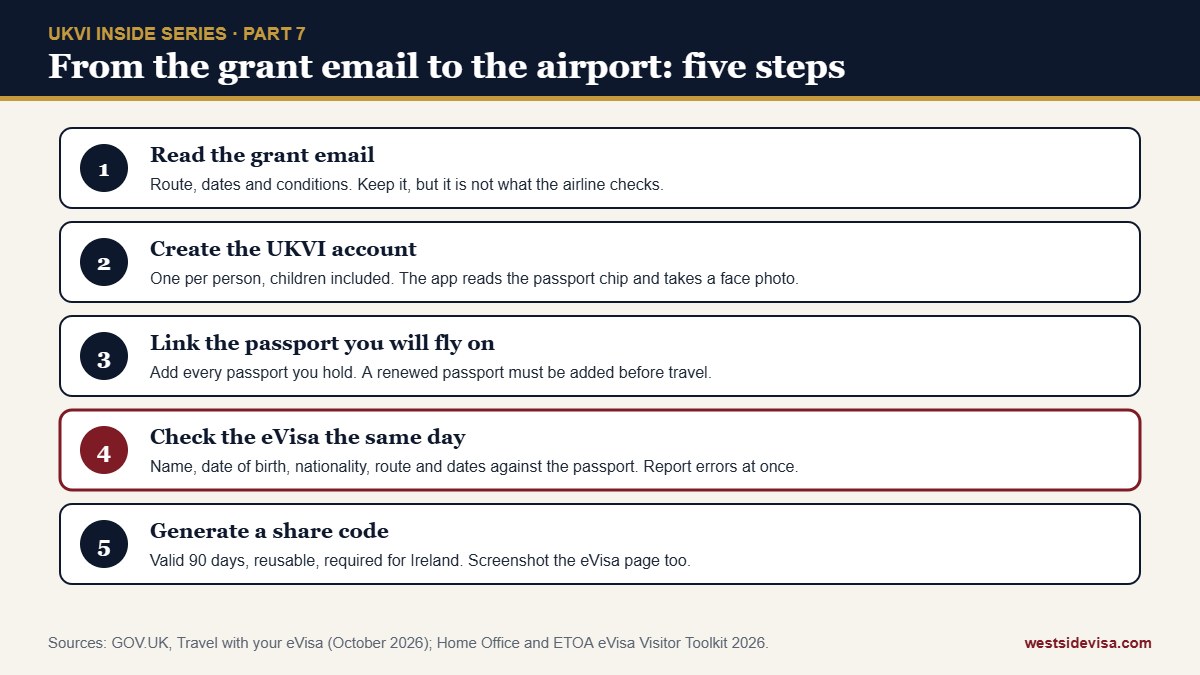
The UKVI account is created at gov.uk/evisa with an email address, a phone number and an identity check through the Home Office ID Check smartphone app, which reads the passport chip and takes a face photo. Three details catch families out:
At check in the carrier sends your passport details to the Home Office and receives a yes or no on whether you hold permission to travel. If the details in your account do not match the passport you present, the automatic check fails, a manual check is attempted through the Border Force carrier support hub, and GOV.UK warns that the carrier may decline to let you travel “if your details are wrong”. A spelling difference between the passport and the account, or a new passport that was never linked, is enough to cause this. It is the single most common eVisa problem we see at Lahore airport.
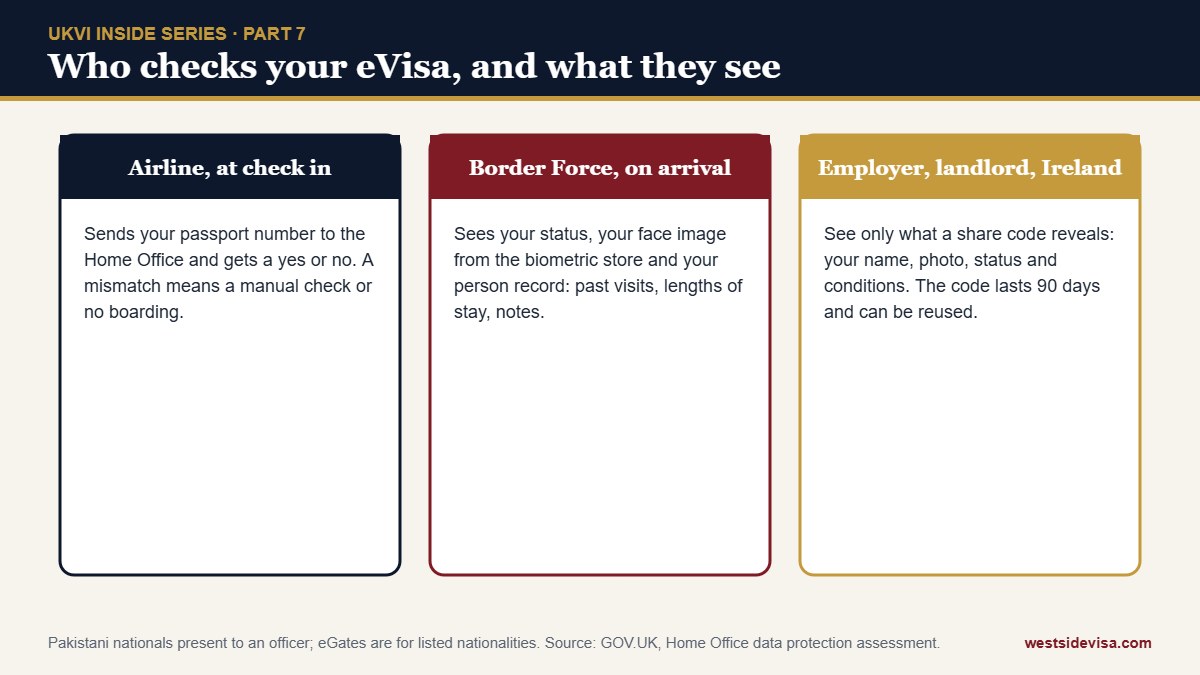
On arrival, your eVisa “is checked when you leave and enter the UK, either by a border control officer or at an eGate”. Pakistani nationals present to an officer. What the officer sees is not just the visa: through the Person Centric Data Platform described in Part 1, they see your status, your face image from the biometric store and, where relevant, your person record, including earlier visits, the length of previous stays and any notes. The officer is not re deciding the visa, but Appendix V still requires a genuine visitor at the point of entry, and the questions at the desk (“how long, where are you staying, who are you visiting”) are checked against what you told the visa officer. Part 9 of this series looks at how your visits are counted.
A visit visa valid for six months, two years or ten years is permission to travel and seek entry. The permission to stay is granted at the border for each visit, normally up to six months, and the officer may give less where the stated purpose needs less. Students and workers receive the permission their eVisa shows, running from the start date on the grant. Check the “valid from” and “valid until” lines on the eVisa itself, not only on the email, because the eVisa is what every later check reads.

Not sure how this applies to your case?
Send us your question on WhatsApp. A Westside adviser in DHA Lahore will reply, Monday to Saturday, 10:00 to 18:00.
Ask on WhatsAppFrom the account’s “view and prove” service you can generate a share code. A travel share code is valid for 90 days, can be used more than once and can be generated before you travel. Carriers normally do not need it because the automatic check comes first, but it is required for onward travel to Ireland and it is what an employer, a landlord or a university asks for in the UK. For a visitor the share code is also the quickest way to show a hotel or a relative’s local authority that you are lawfully present.
Part 1 explained that the eVisa is a live view of Atlas and the biometric store, which is why a wrong name, nationality or date has to be corrected in the caseworking system first. The Home Office’s own assessment says rights requests are actioned “on core systems first, then reflected in View and Prove when status is next requested”. Use the “report an error with your eVisa” form on GOV.UK and allow weeks, not days.
New passports follow two tracks. With a biometric passport you can update the number, expiry date, name or nationality in the account yourself. With a non biometric passport only the number and expiry can be changed online; anything else must be changed by UKVI, which may mean new fingerprints and a photo at a visa application centre. Pakistani machine readable passports issued before the e passport rollout fall into the second group, so plan the update before buying tickets.
Do not travel on an unlinked passport. The eVisa is attached to the identity, but the carrier check runs on the passport number. A renewed passport that was never added to the account produces a failed check at the counter, and the fix cannot be done from the airport queue.
Part 8 of this series explains how UKVI scores your university, and why a sponsor’s compliance rating can decide a student application before it is read.
Since 25 February 2026 most visitors receive an eVisa only. Students and most workers have received eVisas only since 15 July 2025. Dependants on some routes were still receiving a vignette alongside the eVisa.
Normally no. The carrier confirms your permission automatically against your passport details. A share code is useful if the automatic check fails and it is required for travel on to Ireland.
Yes. Every person needs their own account linked to their own passport, although children can use a parent’s email and phone number.
Add the new passport to your UKVI account before travelling. Biometric passports can be updated online; other changes go through UKVI and can take time.
Your eVisa status, your face image from the biometric store and your person record, including previous visits and the length of past stays. They check what you say at the desk against what the visa officer was told.
Report it first. The carrier check runs on the details in the account, and a mismatch can mean you are not allowed to board. Corrections are made in the caseworking system and can take weeks.
Checked on 3 November 2026. The eVisa rollout continues to change; confirm your own category on GOV.UK before travelling. General information, not legal advice.
Mujtaba is the CEO of Westside Visa Consultants. He began his career in 2001 as Executive Secretary to the Consul General of the Republic of Korea in Karachi, co founded Westside in London in 2003, and has since guided more than 1,000 students and families through UK, European, North American and Australian visa decisions from the firm’s offices in DHA Lahore and the UK. He holds postgraduate degrees from the University of Karachi, the University of Padua, Loughborough University and the University of West London, and writes this series from more than twenty years of reading decision letters.
Connect with Mujtaba on LinkedIn · About Westside · WhatsApp the office
Confirmed visa changes for Pakistani students, visitors and families, checked against official sources.
Westside Visa Consultants sets up and checks UKVI accounts and eVisas for the families we file for, and prepares you for the desk. Honest advice from DHA Lahore.
First Floor, 22 A, Sector A, Phase 5, DHA, Lahore · Monday to Saturday, 10:00 to 18:00
This guide is general information, not legal or migration advice. Westside Visa Consultants is an independent private advisory, not affiliated with any government, embassy or visa centre. Always check the official sources before you apply.



A curated list of the most popular travel packages based on different destinations.
Ready to build your life together in the UK?
An administrative review is not an appeal and not a second look at new documents. Learn who reviews a UK visa decision, what counts as a case working error, the 28 day deadline, the GBP 80 fee, the five outcomes and why visit visa applicants have no review at all.
Dreaming of studying at a world class UK university?
A business trip and private medical treatment are both visits, but the officer reads them against a list. Learn the permitted activities, the remote work and intra company rules, how the employer letter is tested, what a UK consultant’s letter must say, the 11 month medical visa and the NHS debt ground.
Planning to send your child to the UK for a holiday, to visit family, or for a short course?
Yes, you really can visit the UK and it’s more achievable than you think.
Choosing where to do your PhD is one of the biggest decisions of your academic life, and the four leading English speaking destinations each offer something different.
From 1 June 2026 every UK university is rated Red, Amber or Green on its visa outcomes. Learn the thresholds, what a rating does to CAS numbers, and why your choice of university and agent now shapes your student visa.