The Long Term UK Visit Visa: How UKVI Decides Who Gets Two, Five or Ten Years, and Why Many Receive Six Months Instead
Parents with children settled in Manchester, exporters with buyers in Birmingham and families who fly to London every summer all ask the same thing in the Lahore office: “Should we apply for the five year visa and stop doing this every time?” It is a fair question with an expensive trap inside it. The long term visa is judged on the same file as the six month visa, but the officer must also be satisfied that you will remain a genuine visitor for years, not weeks. If that extra confidence is missing, the guidance tells the officer to issue a shorter visa, and the higher fee is not returned. This guide explains what the officer weighs, who should apply, who should wait, and how a long visa is lost.
By Mujtaba Maharvi, CEO, Westside Visa Consultants · 18 November 2026
If a shorter visa is issuedNo refundStated on GOV.UK
What a long term visit visa is
GOV.UK puts it in one line: “You can choose to apply for a long term Standard Visitor visa if you visit the UK regularly.” The visa is valid for two, five or ten years, it allows any number of entries, and each stay is still limited to six months. It is the same Standard Visitor route with the same permitted activities described in Part 16; nothing about it allows work, study beyond the visitor limits, or residence. What changes is the length of time the Home Office is trusting you for. A six month visa asks the officer one question: will this person do what they say on this trip and leave? A ten year visa asks whether that will still be true in 2036.
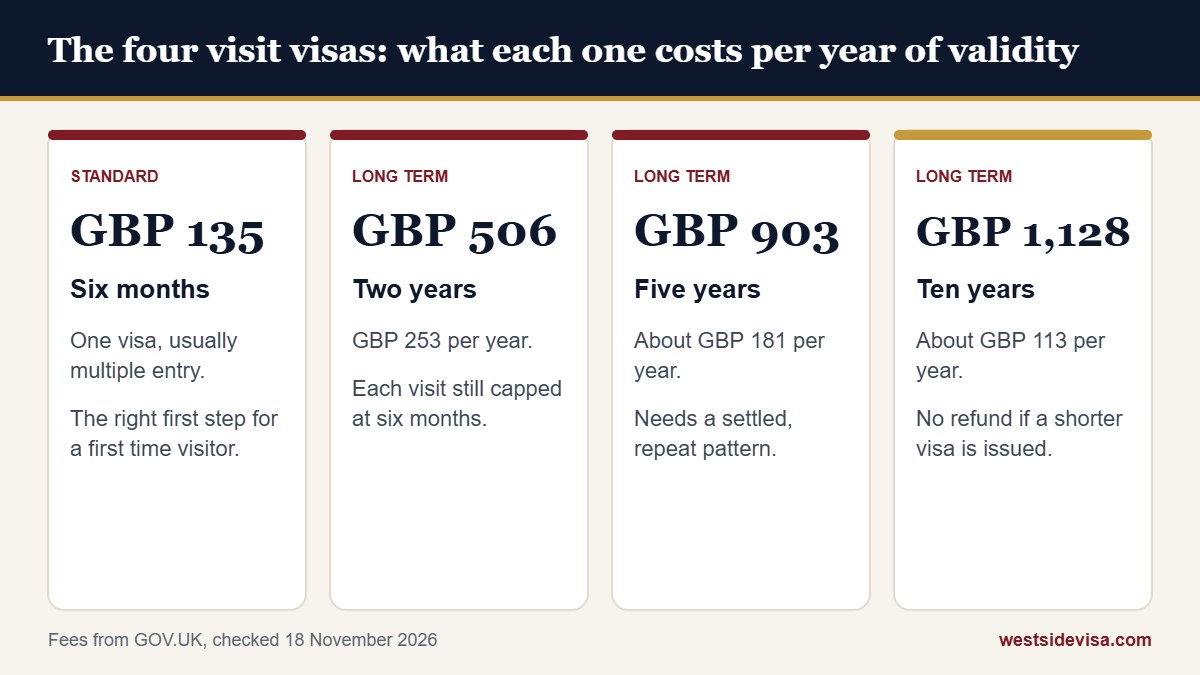
The longer the visa, the lower the cost per year, and the higher the bar. Fees from GOV.UK.
What the officer must be satisfied of
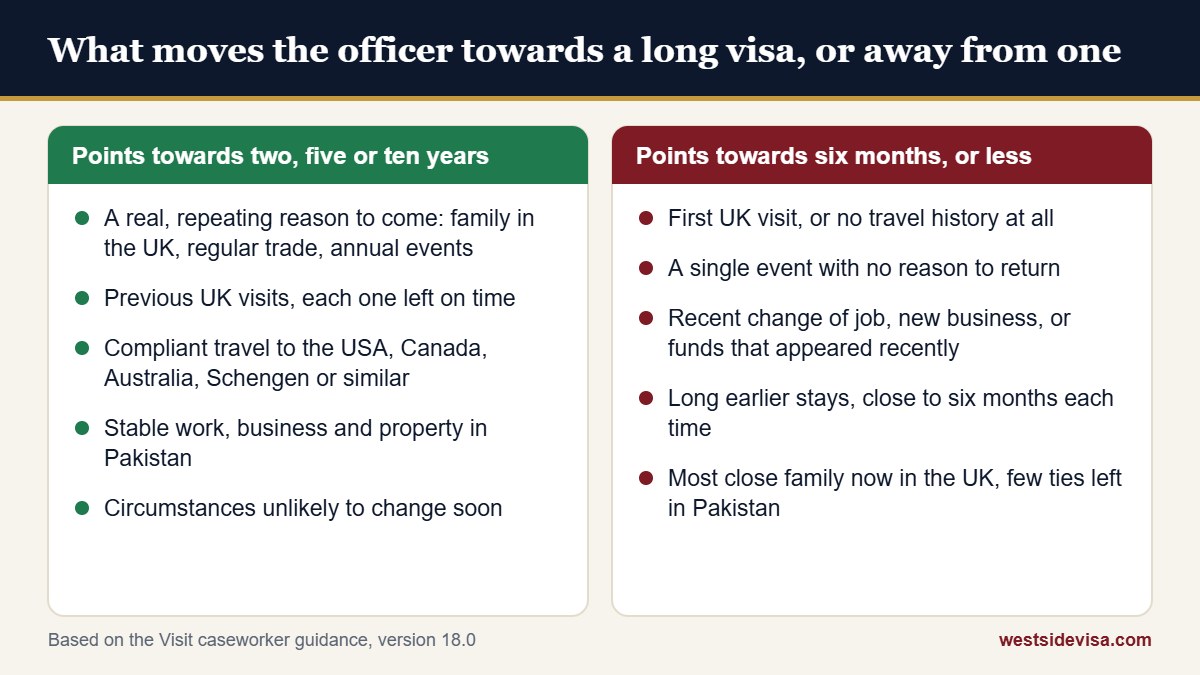
There is no separate set of rules for the long visa. The applicant must meet the genuine visitor requirements like everyone else, and the Visit caseworker guidance (version 18.0, published 8 October 2026) then tells the officer to check “whether the applicant has applied for a multiple entry long term visit visa” and whether there is reason to issue something shorter. In practice the officer reads the same Atlas record described in Part 1, with three questions in mind: is there a frequent and continuing reason to come, is the applicant’s life in Pakistan stable enough that the answers on the form will still hold in several years, and does the travel history show a person who goes home every time? The guidance lists compliant travel to the UK, the USA, Canada, Australia, New Zealand, Ireland and the Schengen countries as something that “may” point towards a genuine visitor, while adding that travel history alone does not decide the case.
The officer is not rewarding wealth. The officer is looking for a pattern that is likely to continue.
Why many applicants receive six months instead
Section 12 of the guidance is where families lose money. It says the officer should normally issue the visa applied for, but may issue a visa of shorter validity where the applicant meets the visitor rules and there are concerns about granting a long one. An Entry Clearance Manager must authorise the decision, and the passport must come back with a covering letter that gives clear reasons. The guidance is equally clear that no full or partial repayment of the fee is made, and GOV.UK tells applicants the same thing: “You will not get a refund of the application fee if you get a shorter visa.” A Lahore businessman who pays GBP 1,128 for ten years and receives six months has paid GBP 993 more than he needed to. That outcome is not a penalty and it does not count against him later, but it is avoidable.
The applicants most often given the shorter visa are first time visitors, people whose circumstances changed recently (a new job, a new company, a recent large deposit of the kind examined in Part 4), and applicants who give one event as the reason for travel. A single wedding in Leicester is a reason for a six month visa. It is not evidence that you will need to come every year.
Regular family visits are the strongest reason for a long visa, once a first visit has been completed and you returned on time. Photo: Unsplash.
The rule for children
A child cannot hold a long term visit visa far into adulthood. The guidance instructs that a child is only granted a long visa valid until six months after the eighteenth birthday, and gives the example of a fourteen year old applying for five or ten years whose visa is capped at that date. GOV.UK adds: “You cannot get a refund on the fee.” For a sixteen year old, a ten year application buys about two and a half years of validity at the ten year price. The two year visa is almost always the correct choice for anyone aged fifteen or over.
Frequent visits, and the line between visiting and living
The long visa creates its own risk. Section 7.4 of the guidance requires the officer, and the Border Force officer at Heathrow on every arrival, to assess whether a person is “in effect, living in the UK through frequent or successive visits”. There is no fixed allowance such as six months in every twelve. The officer looks at how long each stay lasted, how soon you came back, whether you now spend more time in the UK than in Pakistan, whether trips home look like short breaks taken only to return again, and whether there are signs of residence such as registration with a GP or children in UK schools. Grandparents who stay five and a half months, fly to Lahore for three weeks and return are the classic case. Each visit was within the limit, and the pattern is still the problem.
Every arrival on a long term visa is a new assessment at the border. The visa allows you to ask to enter; the pattern of your stays decides the answer. Photo: Unsplash.
Not sure how this applies to your case?
Send us your question on WhatsApp. A Westside adviser in DHA Lahore will reply, Monday to Saturday, 10:00 to 18:00.
GOV.UK warns that the visa may be cancelled if your travel history “shows you are repeatedly living in the UK for extended periods”. Cancellation can also follow a false statement discovered later (the fingerprint sharing described in Part 3 continues for the life of the visa), a change of circumstances that removes the basis of the grant, or work or study outside the visitor rules. What does not cancel a visa is a change of purpose between permitted activities. The guidance accepts that over two, five or ten years the main reason for visiting may change, and gives the example of a visitor whose sporting event is cancelled and who comes for a holiday instead. You may use a visa issued for business to attend a family wedding. You may not use it to help in your brother’s shop.
Who should apply, and who should wait
Apply for two years after one or two UK visits completed on time, with a continuing reason to return and settled work or business in Pakistan.
Apply for five or ten years after a two year visa used properly, or with a long record of compliant travel to the UK and similar countries.
Parents of UK residents: a first application for six months, a second for two years. Keep each stay well under six months and show what brings you home.
Wait: first time travellers, anyone with a decision against them in the last few years (see Part 21), anyone whose job, business or bank balance is new, and anyone aged fifteen to seventeen considering more than two years.
How to prepare
Explain the pattern, not the trip. State in the form why you will need to come repeatedly, and attach evidence: family status in the UK, trade records, earlier visits.
Show every earlier exit. List previous UK and other visits with dates in and out; the form may ask for ten years of travel.
Prove that Pakistan is home in five years’ time: long service, an established business, property, tax returns, dependants here.
Choose the length honestly. Applying one step above your history is reasonable. Three steps above is a donation.
Apply no earlier than three months before travel, and allow the standard three weeks unless the priority service in Part 18 is justified.
Once you hold the visa, keep a record of each stay and keep stays short. The border officer sees the same history you do.
Part 20, next in the series, turns to students: how to check that a university offer and the sponsor behind it are what they claim to be before any money leaves Pakistan.
Questions applicants ask
Does a long term UK visit visa let me stay longer than six months?
No. Each visit is limited to six months whichever visa you hold. The longer visa only removes the need to apply again for each trip.
If I apply for ten years and receive six months, do I get the difference back?
No. GOV.UK states that the application fee is not returned if a shorter visa is issued. The officer must explain the reasons in a covering letter.
Can a first time visitor from Pakistan get a five or ten year visa?
It is possible but uncommon. Without earlier visits the officer has little to show that the pattern will continue, so a six month or two year application is usually the sensible first step.
How many months a year can I spend in the UK on a long term visa?
There is no fixed number. The officer assesses whether you are in effect living in the UK through frequent or successive visits, looking at the length and spacing of your stays and your ties to Pakistan.
Can my long term visit visa be cancelled at the airport?
Yes. A Border Force officer can cancel it if your travel pattern shows you are living in the UK, if a false statement comes to light, or if you intend an activity visitors may not do.
Is a ten year visa worth it for a child?
Rarely. A child’s long term visa is valid only until six months after the eighteenth birthday, and the fee is not reduced.
Checked on 18 November 2026. Fees change, usually each spring; confirm on GOV.UK before you pay. General information, not legal advice.
About the author
Mujtaba Maharvi
Mujtaba is the CEO of Westside Visa Consultants. He began his career in 2001 as Executive Secretary to the Consul General of the Republic of Korea in Karachi, co founded Westside in London in 2003, and has since guided more than 1,000 students and families through UK, European, North American and Australian visa decisions from the firm’s offices in DHA Lahore and the UK. He holds postgraduate degrees from the University of Karachi, the University of Padua, Loughborough University and the University of West London, and writes this series from more than twenty years of reading decision letters.
Thinking about a two, five or ten year UK visit visa?
Bring your passport, your travel history and your last decision letter. We will tell you plainly whether the long visa is realistic this time or whether six months first is the wiser spend.
First Floor, 22 A, Sector A, Phase 5, DHA, Lahore · Monday to Saturday, 10:00 to 18:00
This guide is general information, not legal or migration advice. Westside Visa Consultants is an independent private advisory, not affiliated with any government, embassy or visa centre. Always check the official sources before you apply.
Watch: the long term visit visa in 97 seconds. Part 19 of the UKVI inside series.
A UK spouse or partner application is tested three ways: the sponsor’s income against specified evidence, the relationship against a graded evidence scale, and the whole file against the marriage investigation triggers. Here is how each check works.
Everything you need to visit Canada, the requirements, documents, fees, biometrics, proof of funds and the full application process, explained in plain, simple language.
The complete index to the Westside UKVI inside series: twenty four guides on how a UK visa application is received, checked, verified, decided and recorded, with a reading plan for visitors, students, families and anyone applying again after a negative decision.
An offer letter is not a CAS, and a CAS is only as good as the licence behind it. Learn how to check a UK university on the Home Office register of Student sponsors, what the 2026 compliance ratings mean for Pakistani applicants, what happens to students if a licence is lost, and the checks to make before paying a deposit.
There is no 180 day rule for UK visitors, but UKVI does count your days. Learn how travel history is recorded, what “frequent or successive visits” means, the factors officers weigh, and how long term visa holders stay on the right side.
A business trip and private medical treatment are both visits, but the officer reads them against a list. Learn the permitted activities, the remote work and intra company rules, how the employer letter is tested, what a UK consultant’s letter must say, the 11 month medical visa and the NHS debt ground.
Apply on or before 31 December 2026 and you get 2 years. Apply on or after 1 January 2027 and you get 18 months. The date that matters is the date you submit the application, not the date your course ends.