France Student Visa from Pakistan The Complete 2027/28 Guide
A world class European education at surprisingly affordable public university fees, plus access to 29 Schengen countries no wonder France is booming with Pakistani students. But there’s one step you can’t skip: Campus France.
By the Westside advisers, DHA Lahore · Reviewed September 2026 · 16 min read
Two big changes for 2027/28 applicants. (1) From 1 August 2026 the visa proof of funds is €877.50 a month, up from €615, so a 12 month stay needs about €10,530 in evidence. (2) A decree of May 2026 ended blanket fee waivers at public universities: non EU students now pay €2,902 a year for a licence and €3,950 for a master, plus €105 CVEC. Read what changed in French university fees before you budget.
Here’s something many Pakistani students don’t realise: studying in France can cost far less than the UK, Australia, or Canada. Public French universities charge only a few thousand euros a year, the degrees are world class, and once you’re there, you can travel across 29 Schengen countries. It’s one of the smartest study abroad choices out there if you know how to do it right.
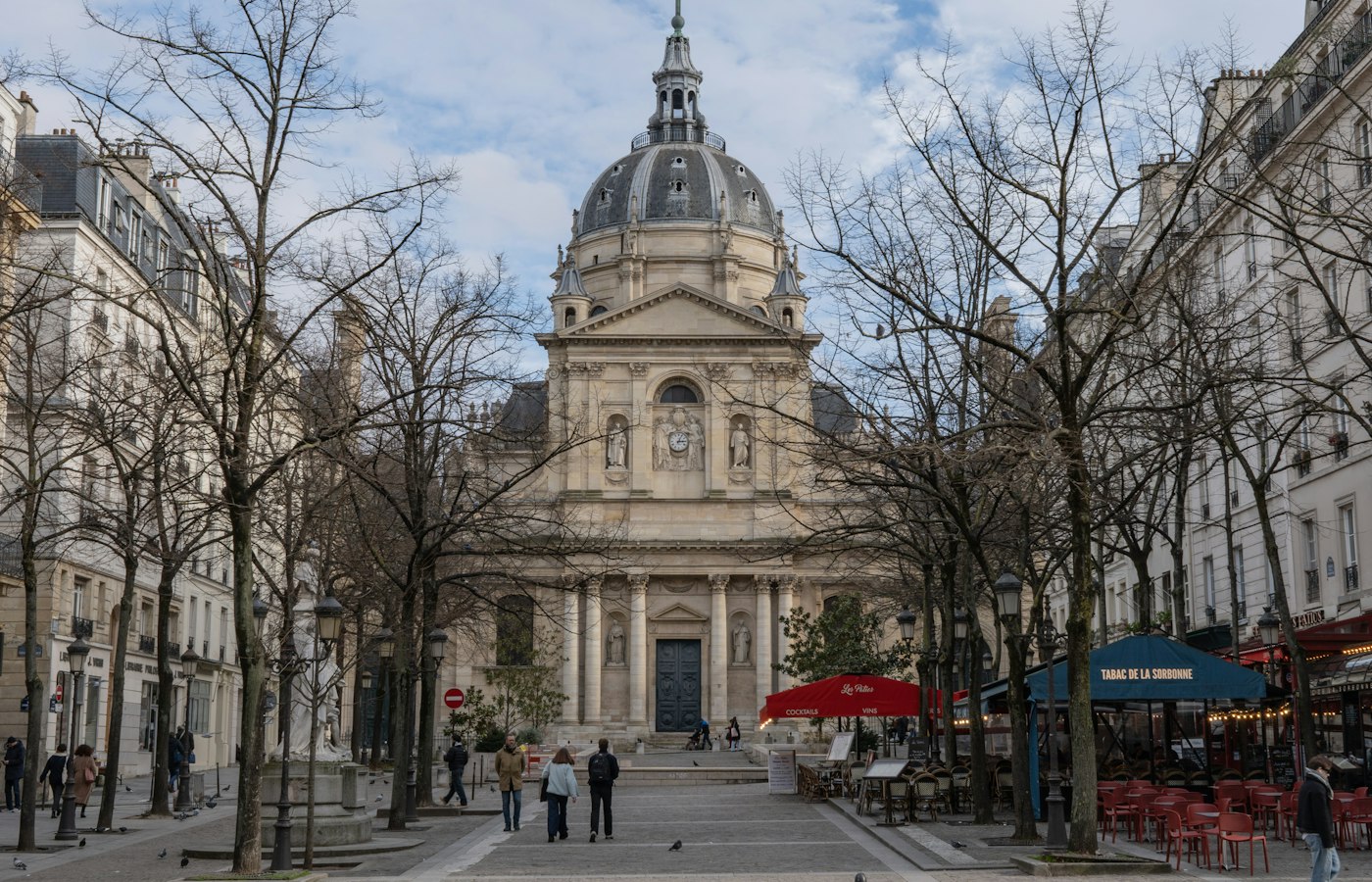
A world class European education, at surprisingly affordable fees.
And that’s the key. France has one step that trips up students who go in blind: the Campus France (Études en France) process, which is mandatory before you can even apply for your visa. Get it right, and your path is smooth. Get it wrong, and you lose months. In this guide, we’ll explain every track (Bachelor, Master, PhD), the full process from start to finish, exact costs, the complete document list, and how to avoid the mistakes that get students rejected. Let’s turn your French dream into a plan.
Who is this guide for?
Pakistani students who want an affordable, high quality European education at Bachelor’s, Master’s, or PhD level with the bonus of Schengen access and part time work rights.
Why Study in France? The Real Advantages
France has quietly become one of the best value study destinations for Pakistani students. Here’s why:
Affordable public universities tuition of €2,902 a year for a licence (bachelor) and €3,950 a year for a master at public universities from 2026/27, plus the €105 CVEC, still far below the UK or Australia. The old figures of €2,770 and €3,770 that many websites quote expired in May 2026.
World class education globally ranked universities and prestigious Grandes Écoles.
1,500+ English taught programs you don’t always need French to study there.
Schengen access your student visa lets you travel across 29 European countries.
Part time work allowed up to 964 hours per year (around 20 hours/week).
Generous scholarships Eiffel Excellence, France Excellence Pakistan, Erasmus Mundus, and more.
Post study opportunities options to stay and gain work experience after graduation.
Your visa appointment comes after a positive Campus France opinion.
Which Student Visa Track Is Right for You?
Your path depends on what and how long you’ll study. There are a few clear tracks:
Bachelor’s (Licence)
For undergraduate study. Apply via Campus France, then the long stay student visa (VLS TS). You can select up to 3 Bachelor’s programs on the EeF platform.
Master’s
The most popular route for Pakistani students. Apply via Campus France (up to 7 Master’s programs), then the VLS TS. Many taught fully in English.
PhD / Research
For doctoral study. PhD applicants usually apply directly (not through the standard Campus France candidature) and often receive a funded doctoral contract.
Short stay study (<90 days)
For short courses, language programs, or summer schools under 3 months. Uses a short stay visa but note it usually can’t be extended into a full degree.
Most Pakistani students
come for a full Bachelor’s or Master’s degree, which means the long stay
VLS TS
visa (a visa that also works as your residence permit for the first year). This guide focuses on that route.
Not sure how this applies to you?Send us your details and a Westside adviser will tell you honestly where you stand. Free 30 minute assessment.
This is the part you absolutely cannot skip. For Pakistani students, the Campus France “Études en France” (EeF) process is compulsory before applying for your visa. It’s a government run system that manages your application and includes an interview.
The compulsory Campus France interview pre checks your file before the visa stage.
Two campaigns which one applies to you?
Candidature campaign if you want to apply to French public universities through the EeF platform. You can select up to 7 Master’s or 3 Bachelor’s programs.
PreConsular campaign if you already have a direct admission from a French institution and just need to complete the EeF process for your visa.
What the process involves
You create an EeF account, complete your profile, upload your documents and Statement of Purpose (SOP), pay the PKR 30,000 EeF fee (non refundable, paid to Alliance Française Karachi within a week of Campus France asking for it), and then attend a compulsory academic interview at the nearest Alliance Française in Islamabad, Lahore, or Karachi. Bring all your original documents. This interview assesses your study project and pre checks your file before it reaches the visa section.
Deadlines matter a lot:
The Campus France campaign has strict deadlines each year (files and payment must be completed by set dates). For the 2027 Candidature campaign, the EeF platform opened on 1 October 2026, applications close on 18 November 2026 and the PKR 30,000 fee must be paid by 30 November 2026, by bank transfer or deposit to Alliance Française Karachi using the details Campus France Pakistan sends you. University results are due by 30 April 2027 and your final choice by 30 May 2027. Miss them and you wait a whole year. Start several months before your intended intake.
Arrive with your documents and housing plan ready.
Eligibility & Requirements The Quick Checklist
To qualify for a France student visa, you’ll generally need:
Academic qualifications Matric & Intermediate for Bachelor’s; a Bachelor’s degree for Master’s; a Master’s for PhD.
Admission / acceptance from a recognised French institution (via Campus France).
Language proof IELTS/TOEFL for English taught programs, or DELF/DALF/TCF for French taught (some accept an MOI letter or internal test).
Proof of funds €877.50 per month for applications made from 1 August 2026 (about €10,530 for a 12 month stay; the old €615 figure no longer applies).
Health insurance valid coverage for your stay.
Clean record no serious criminal history.
Genuine student intent a clear, honest study plan.
Documents You’ll Need
Your application is only as strong as your documents. Typically you’ll need:
A missing document or last minute finances cause needless stress prepare early.
Valid passport (and any old passports).
Academic documents Matric, Intermediate, degree & transcripts, attested by IBCC and HEC.
Admission / acceptance letter from your French institution.
Statement of Purpose (SOP) explaining your study goals (French translation often preferred).
Language certificate IELTS/TOEFL or DELF/TCF (or MOI letter where accepted).
Proof of funds bank statements, sponsor letter, or scholarship award.
Accommodation proof university housing, rental, or host confirmation.
Travel & health insurance.
Passport photos and the completed France Visas form.
Campus France (EeF) certificate and payment receipt.
Attest early:
Get your academic documents attested by
IBCC and HEC
in Pakistan well ahead of time. This is a common last minute bottleneck that delays students sort it out early.
Student life in France starts the day you land.
Proof of Funds Get This Exactly Right
Financial proof is one of the most important and most common failure points of any student visa. For France, you must show you can support yourself.
Genuine, consistent bank statements are key: about €10,530 for a 12 month stay at the new €877.50 monthly rate.
The amount€877.50 per month, roughly €10,530 for a 12 month stay (about PKR 3.4 million at current rates). This new rate applies to visa applications made on or after 1 August 2026 and replaces the old €615 figure.
The sources personal/family bank statements, a sponsor, a scholarship, or a blocked account.
Consistency is key steady balances held over time look far stronger than a sudden large deposit.
Correct format & dating, recent statements, on bank letterhead, clearly showing the balance.
The #1 financial mistake sudden deposits:
A large sum that suddenly appears in your account right before applying is a major red flag. Visa officers want
genuine, consistent finances
not money that looks arranged just to pass the visa. Keep your statements steady, and if you have a big legitimate deposit, document its source clearly (property sale, business income, etc.).
The Step by Step Application Process
Here’s your complete journey from Pakistan, in order:
Choose your program & check the intake Decide your level (Bachelor/Master/PhD) and shortlist programs. Note the Campus France deadlines and start several months ahead.
Register on Campus France (EeF) Create your Études en France account, complete your profile, upload documents and your SOP, and choose your programs (Candidature) or link your admission (PreConsular).
Pay the fee & attend the interview Pay the PKR 30,000 EeF fee, then attend your compulsory academic interview at Alliance Française (Islamabad, Lahore, or Karachi) with all originals.
Receive your admission Universities review your file and issue decisions through the platform. Accept your offer and get your official admission letter.
Apply for the VLS TS visa on France Visas Complete your visa application on France Visas, then book your appointment at the visa centre (VFS) and submit your documents and biometrics. The visa fee is €50 for students who come through Études en France (€99 for other long stay visas), and you pay a further e stamp of about €75 when you validate the visa online after arrival.
Travel & validate your visa (OFII) Once approved, travel to France. Within your first 3 months, validate your VLS TS online (via the OFII/ANEF portal) so it acts as your residence permit for the year.
Timeline tip:
The Campus France stage comes first and has its own interview and validation, so begin several months before your intake. After your visa appointment, processing usually takes around 2 to 6 weeks (longer in peak season).
Costs, Fees & Work Rights
France Student Visa Key Facts (2027/28)
Campus France (EeF) fee
PKR 30,000 (non refundable)
Visa fee (VLS TS)
€50 for Études en France applicants (€99 standard)
Proof of funds
€877.50/month from 1 Aug 2026 (about €10,530 for 12 months)
Public university tuition
€2,902 (licence) / €3,950 (master) per year + €105 CVEC
Grande École / private
~€8,000 to €20,000 per year
Living costs
€877.50/month minimum (€1,000 to €1,200 in Paris)
Part time work
Up to 964 hours/year (~20 hrs/week)
Processing (after appointment)
Around 2 to 6 weeks
Interview
Compulsory (Campus France, Alliance Française)
Main intakes
Fall (Sep to Oct, largest) & Spring (Jan to Mar)
Post study work
APS up to 12 months to find a job (after Master’s)
Work while you study:
Student visa holders can work up to 964 hours per year (about 20 hours a week), which helps cover living costs. During holidays, you can work more within that annual limit. PhD/research students often have broader work rights.
Intakes & Timeline When to Start
Études en France calendar for the September 2027 intake (Campus France Pakistan)
Candidature campaign opens
1 October 2026
Candidature campaign closes
18 November 2026 (firm)
Universities reply by
30 April 2027
Final programme choice by
31 May 2027
Pre consular campaign (you already hold an admission)
Spring 2027 entry by 30 December 2026; autumn 2027 deadline expected around late August 2027
Interview venues
Alliance Française Islamabad, Lahore or Karachi
Two doors, not one. The candidature campaign is for students applying to public universities through the platform. Most of the students Westside places go through the direct admission door instead: you apply to a grande école or private school directly (their campaigns run from October 2026 to about June 2027), get your admission letter, and then use the shorter pre consular Études en France procedure for the visa. Missed the 18 November deadline? The direct route is still open. See our France programme finder for 200 plus English taught programmes with fees and application routes.
Timing is everything with France, because the mandatory Campus France stage takes months before your visa. France has two main intakes:
Fall intake (September to October) the largest, with the most programs and places. This is the main intake most Pakistani students target.
Spring intake (January to March) smaller, with fewer programs available.
Start early this is critical:
The Campus France (EeF) process alone takes about 2 to 3 months (account, documents, interview), and the campaign has firm deadlines. For a September (Fall) start, you should begin the Campus France process by around
January
, and ideally start planning 4 to 5 months (or more) ahead. Missing a deadline means waiting a whole year.
Not sure how this applies to your case?
Send us your question on WhatsApp. A Westside adviser in DHA Lahore will reply, Monday to Saturday, 10:00 to 18:00.
One of the biggest myths is that you must speak French to study in France. Not true here’s the reality:
English taught programs France has over 1,500 programs taught fully in English, especially at Master’s level. For these you’ll usually need IELTS (around 6.0 to 6.5+) or TOEFL though many universities accept an MOI (Medium of Instruction) letter or their own internal English test instead.
French taught programs for these you’ll need French proficiency, usually DELF/DALF or TCF (around B2). These often have lower or no tuition at public universities.
Learn some French anyway even in an English program, basic French helps hugely with daily life, part time work, and settling in.
No IELTS? Often no problem:
Because many French universities accept an MOI letter or internal test, plenty of Pakistani students study in France without ever taking IELTS. We’ll help you find programs that match your language profile.
Accommodation & Living in France
Sorting your accommodation is a key part of both your visa file and your comfort. Your main options:
CROUS student residences subsidised government student housing (limited places, competitive, and eligibility rules apply to international students).
Private studios & shared apartments more available but pricier, especially in Paris. Sharing keeps costs down.
Temporary housing first many students book short term accommodation for arrival, then find a longer lease once settled.
For renting privately, you may be asked for a guarantor. The government backed Visale scheme can act as a free guarantor for eligible students. Note that housing aid (CAF) rules for non EU students changed from July 2026 and generally now require a qualifying French social criteria scholarship so don’t count on CAF unless you qualify.
Budget realistically:
Living costs vary a lot by city Paris is expensive, while smaller cities like Toulouse, Lyon, or Lille are far more affordable. Budget at least €877.50 a month for living (the visa minimum from August 2026), and realistically €1,000 to €1,200 in Paris. A furnished studio can require a large upfront amount, so plan ahead.
Scholarships to Lower Your Costs
France is generous with scholarships, and several are open to Pakistani students. Popular options include:
Eiffel Excellence Scholarship prestigious government scholarship for Master’s and PhD students.
France Excellence Pakistan a French Embassy scholarship program for Pakistani students.
Erasmus Mundus Joint Master’s EU funded, often fully covering tuition and living.
Grande École / university scholarships institutional awards covering 30 to full of tuition.
Apply early & realistically:
Scholarships are competitive and have their own deadlines (often earlier than admissions). A strong academic record and a clear study plan help. We can guide you on which scholarships fit your profile.
Life After Graduation Post Study Work (APS)
Here’s a big reason France is such a smart choice: it offers a genuine post study future. After completing your degree (especially a Master’s), you can apply for the APS (Autorisation Provisoire de Séjour) a temporary residence permit that lets you stay in France to look for a job or start a business.
Job search stay the APS lets you remain in France after your studies to find work in your field.
Convert to a work permit if you secure a qualifying job (typically paying at least 1.5× the French minimum wage), you can move onto a work permit or Talent Passport.
A pathway to staying this is how many students turn a French degree into a European career.
Plan for the future:
Apply for the APS
before
your student permit expires. A French degree plus post study work experience opens strong doors in France and across Europe.
Renewing Your Student Permit
Your VLS TS visa covers your first year. For longer programs, before it expires you apply at your local préfecture for a multi year student residence permit (carte de séjour pluriannuelle étudiant), which can cover the rest of your course.
Apply early usually 2 to 4 months before your current permit expires.
Typical documents valid passport, current permit with OFII validation, proof of enrolment for the next year, financial proof (€877.50/month), and proof of accommodation.
Keep validating remember to complete your OFII validation in your first 3 months, as you’ll need it for renewals, housing, and banking.
Common Reasons for Rejection and How to Beat Them First
The encouraging truth: most France student rejections come from avoidable mistakes, not from being ineligible. Fix these before you apply:
Weak or inconsistent finances
Insufficient funds, a sudden large deposit, or the wrong format/dating are among the top rejection reasons.
Fix it first: Show genuine, consistent funds (about €10,530 for 12 months at €877.50 a month) held over time, correctly formatted, with any large deposit’s source documented.
Weak or unclear study plan
A vague SOP or an unconvincing academic project where your past studies don’t connect to your chosen program, raises doubts.
Fix it first: Write a clear, honest SOP showing why this program, why France, and how it fits your career. Prepare well for the Campus France interview.
Incomplete or unattested documents
A missing paper, or academic documents not attested by IBCC/HEC, can sink an otherwise strong file.
Fix it first: Use a complete checklist, attest documents early, and double check everything before submitting.
Doubts about return intent
If the officer isn’t convinced you’re a genuine student who will respect the visa’s purpose, they may reject.
Fix it first: Present genuine student intent and show your ties to Pakistan (family, future plans) that support your return.
Missing Campus France deadlines
Late EeF submission or payment means your file isn’t considered a whole year lost.
Fix it first: Start early, track every Campus France deadline, and complete your file and payment well before the cut off.
How Westside Visa Turns Your Application Into a Success Story
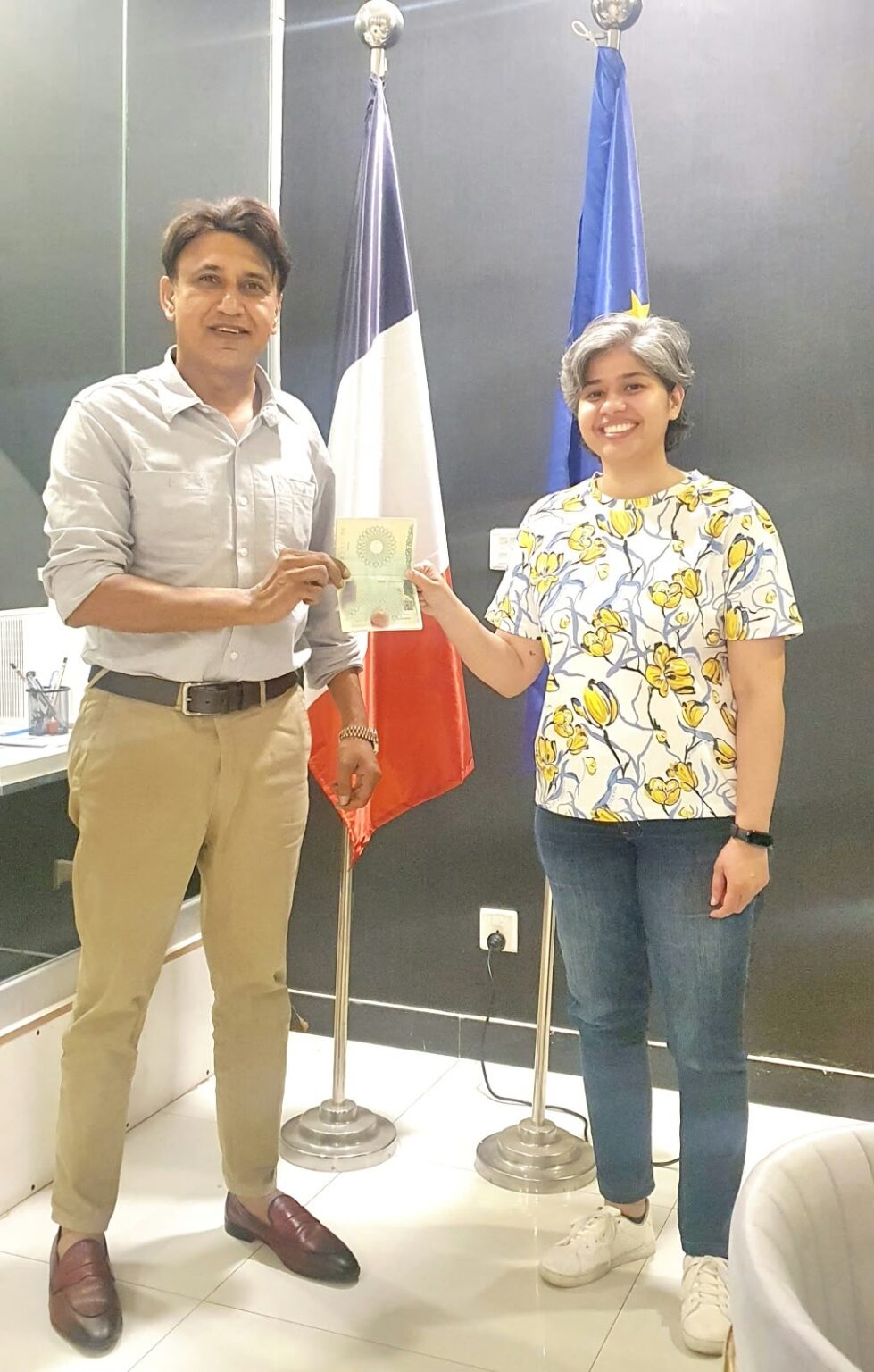
With the right guidance, your French study journey starts strong.
Here’s the honest truth: no one can “promise” a visa, the decision always rests with the French authorities. But you can make your application as strong as possible, and avoid the mistakes that cost students a year. And that’s exactly where we come in.
At Westside Visa, our consultants in DHA Lahore help Pakistani students reach France with clean, credible applications. We help you:
Choose the right program & track, Bachelor, Master, or PhD, matched to your profile.
Master the Campus France process the EeF file, deadlines, and interview preparation.
Build a strong, honest document file complete, attested, correctly formatted.
Get your finances right genuine, consistent, well documented funds.
Present genuine student intent, a clear SOP and study plan.
Spot and fix red flags before you submit not after a costly rejection.
And if you’ve already been rejected, don’t lose hope we’re expert at reading a rejection, fixing the real problem, and rebuilding a stronger application. Many of our success stories started with a “no”. Think of us as your teammate honest, experienced, and fully on your side, all the way to France.
France 2027 intake series from Westside Visa Consultants
An affordable, world class European education is within your reach. Westside Visa guides you through Campus France, your visa, and every step, with honest, expert advice you can trust.
Is Campus France mandatory for Pakistani students? +
Yes. For Pakistani students, the Campus France “Études en France” (EeF) process is compulsory before applying for a student visa. It includes uploading your documents, paying the PKR 30,000 fee, and attending an academic interview at Alliance Française in Islamabad, Lahore, or Karachi.
Do I need IELTS to study in France? +
Not always. For English taught programs you’ll usually need IELTS or TOEFL, but many universities accept alternatives like an MOI (Medium of Instruction) letter or their own internal test. For French taught programs, you’ll need French proficiency (DELF/DALF/TCF). France has over 1,500 English taught programs.
How much money do I need to show? +
You must show €877.50 per month for applications made from 1 August 2026, roughly €10,530 for a 12 month stay (about PKR 3.4 million at current rates). The old figure of €615 no longer applies. Funds can come from bank statements, a sponsor, or a scholarship. Steady, consistent balances look far stronger than a last minute deposit.
How much does it cost to study in France? +
Public French universities charge €2,902 per year for a licence and €3,950 per year for a master for non EU students from 2026/27 (plus the €105 CVEC), and blanket fee waivers ended in May 2026, while Grandes Écoles and private institutions charge around €8,000 to €20,000. This makes France one of the most affordable quality study destinations in Europe. The Campus France fee is PKR 30,000 and the visa fee is €50 for Études en France applicants.
Can I work while studying in France? +
Yes. Student visa holders can work up to 964 hours per year (about 20 hours per week), which helps cover living costs. During university holidays you can work more within that annual limit. PhD/research students often have broader work rights.
How long does the whole process take? +
Because the Campus France stage comes first (with its own interview and deadlines), you should start several months before your intake. After your visa appointment, processing usually takes around 2 to 6 weeks, sometimes longer in peak season.
Does Westside Visa help with France applications? +
Yes from choosing your program and mastering the Campus France process to building a clean document file and getting your finances right. We can’t promise a visa (no honest consultant can), but we make sure your application is as strong as possible. Contact us to get started.
This guide is general information from Westside Visa Consultants, not legal advice. Visa rules change often, so always confirm the latest position on the official government website before you apply.
Good news for Pakistani students: France is one of the most affordable top study destinations in the world, thanks to heavily subsidised public university fees. But smart budgeting still matters.
Family belongs together. If you or your spouse is building a life in France, French law gives you real routes to reunite whether you’re joining a French citizen or a family member already settled there.
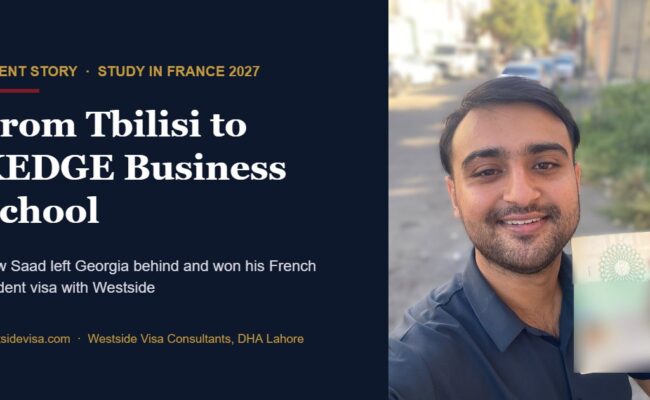
Saad was living in Tbilisi and felt stuck. Westside handled his KEDGE Business School admission and French student visa from Lahore. Why France beats Georgia for 2027.
Want to live in France for more than 90 days without working as a retiree, a financially independent person, or a second home owner? The Long Stay Visitor Visa (VLS TS visiteur) is your route.
Westside Visa Consultants has placed Pakistani students in France every year since 2021, through the Etudes en France procedure and through direct admission.
One visa, 29 European countries. A France Schengen visa opens the door to Paris, and to Germany, Italy, Spain, and beyond. But with Pakistan facing one of the world’s highest rejection rates, how you apply matters more than ever.