



France Scholarships for Pakistani Students The Complete 2026 Guide
Studying in France is already affordable, but scholarships can make it even cheaper, or in some cases nearly free.




One of the biggest myths about studying abroad is that IELTS is compulsory. The truth?
If you’ve been putting off your dream of studying in France because you’re worried about IELTS this guide is for you. Here’s the reality that many students don’t know: France is one of the most flexible study destinations when it comes to English tests. Thousands of international students study there every year without ever sitting an IELTS exam. The key is knowing which route fits your profile.

In this guide, we’ll walk you through every way to study in France without IELTS, the requirements for each, what you’ll need for French taught programs, how it affects your visa, and the mistakes to avoid so you can move forward with confidence. Let’s clear up the confusion.
Who is this guide for?
Pakistani students who want to study in France but don’t have IELTS (or want to avoid it) for Bachelor’s, Master’s, or beyond.
Let’s bust the myth right away: IELTS is not always mandatory for France. Many French universities and schools accept alternative proof of your English ability. Whether you need IELTS depends entirely on the specific university and program you choose.
The bottom line:
Studying in France without IELTS is genuinely feasible for many students. The trick is matching your profile to universities and programs whose requirements you can meet which is exactly where good guidance helps.
Here are the main ways Pakistani students get admission without an IELTS score:
| 1 | MOI (Medium of Instruction) letter | A certificate from your previous institution confirming your studies were taught in English. The most common route. |
| 2 | Other English tests | Many universities accept TOEFL, PTE, Duolingo (DET), or Cambridge instead of IELTS. |
| 3 | University internal test / interview | Some universities assess your English through their own test or a video interview. |
| 4 | English medium academic record | Strong English marks in your 10th, 12th, or Bachelor’s can support your application. |
| 5 | French taught program | Study in French instead you’ll need DELF/TCF French proficiency, not IELTS. |
Not sure how this applies to you?Send us your details and a Westside adviser will tell you honestly where you stand. Free 30 minute assessment.
Ask on WhatsApp
For most Pakistani students, the MOI (Medium of Instruction) letter is the easiest route. It’s an official letter from your previous school, college, or university confirming that your education was delivered in English.
MOI isn’t accepted everywhere:
Some universities accept MOI freely; others prefer a formal test; and top business schools often require IELTS or an equivalent regardless. Always confirm the specific program’s policy before relying on MOI this is a key place where a wrong assumption costs you.

If a program does want a formal English test but not specifically IELTS, you often have choices. Commonly accepted alternatives include:
More options than you think:
If IELTS specifically isn’t for you, an alternative test may fit better. We can help you find programs that accept the test (or proof) you already have or can easily get.

Here’s a route many students overlook: if you study in French rather than English, IELTS is completely irrelevant. Instead, you’ll need to prove your French proficiency.
Think ahead:
Even if you study in English, learning some French makes your student life (and part time work) much easier. And a French taught program can open up more affordable, less competitive options.

One honest caution: France’s top business schools (the Grandes Écoles) are generally stricter about language than public universities. If your goal is a prestigious MBA or Master’s in Management, be aware:
Don’t assume for business schools:
The “no IELTS” flexibility is strongest at public universities. For elite business schools, check each program carefully and plan for IELTS or an equivalent if needed.
Not sure how this applies to your case?
Send us your question on WhatsApp. A Westside adviser in DHA Lahore will reply, Monday to Saturday, 10:00 to 18:00.
Ask on WhatsAppAn important point that confuses many students: the French student visa itself doesn’t have a separate IELTS requirement. The visa process focuses on your university admission and your Campus France attestation.
Remember Campus France:
Whether or not you take IELTS, the Campus France (Études en France) process is still mandatory for France, including the compulsory interview. See our
full France student visa guide
for the complete process.
For a no IELTS application, your typical documents include:

Make your SOP work hard:
When you don’t have IELTS, your Statement of Purpose is a great place to clearly explain your English medium background and why you’ll thrive in an English taught program. A strong SOP genuinely helps.
The process is the same, minus the IELTS:
Studying without IELTS doesn’t change the overall France journey Campus France, admission, and the VLS TS visa all still apply. You’re simply using a different form of English proof.
Going the no IELTS route has its own pitfalls. Avoid these before you apply:
| Assuming MOI is accepted everywhere | Applying to a program that actually requires IELTS, assuming MOI will do, leads to rejection at admission or visa stage. | Fix it first: Confirm each program’s exact language policy before applying. Target universities that clearly accept your form of proof. |
| Weak English shown at interview | Even without IELTS, poor communication in the Campus France or visa interview raises doubts about coping with the program. | Fix it first: Prepare well, practise speaking clearly about your course and goals, and show you can genuinely study in English. |
| A weak or generic SOP | Without a test score, a vague Statement of Purpose fails to reassure the university about your English readiness. | Fix it first: Write a strong, specific SOP that clearly explains your English medium background and your fit for the program. |
| Weak finances or inconsistent funds | Regardless of IELTS, insufficient or sudden funds is a top rejection reason for any France student visa. | Fix it first: Show genuine, consistent bank statements meeting the required amount no last minute deposits. |
| Incomplete or unattested documents | Missing attestations, translations, or a missing MOI letter causes delays and rejections. | Fix it first: Get transcripts attested (IBCC/HEC), translate documents properly, and secure your MOI letter early. |

Here’s the honest truth: no one can “promise” admission or a visa, the decisions rest with the universities and French authorities. But the no IELTS route is all about matching the right profile to the right program, and that’s exactly where we come in.
At Westside Visa, our consultants in DHA Lahore help Pakistani students study in France without IELTS through strong, well matched applications. We help you:
And if you’ve already been rejected, don’t lose hope we’re expert at reading a rejection, fixing the real issue (often the wrong program choice or weak proof), and rebuilding a stronger application. Many of our success stories started with a “no”. Think of us as your teammate honest, experienced, and fully on your side.
Ready to plan your studies in France? Start here:
Your French education is closer than you think the right route and the right universities make all the difference. Westside Visa guides you through every step, with honest, expert advice you can trust.
Book Your Free Consultation Message on WhatsApp
+92 322 5061166 info@westsidevisa.com First Floor 22 A, Sector A Phase 5 DHA, Lahore
Yes. Many French universities accept alternatives to IELTS such as an MOI letter, other English tests (TOEFL, PTE, Duolingo, Cambridge), a university’s internal test or interview, or your English medium academic record. French taught programs need French proficiency (DELF/TCF) instead. Always check each program’s specific policy.
MOI stands for Medium of Instruction. It’s an official letter from your previous school, college, or university confirming that your studies were taught in English. Many French universities accept it instead of IELTS, usually when your prior education was substantially (often around 75%+) in English.
No, the visa itself doesn’t have a separate IELTS requirement. It focuses on your university admission and Campus France attestation. However, you still need genuine admission (which is where language proof matters), and your communication may be assessed during the Campus France interview.
Often, yes. France’s top business schools (Grandes Écoles) are generally stricter and may require IELTS 7.0+ or an equivalent, plus GMAT/GRE for MBAs. Some waive the test for fully English taught prior degrees, but not as a blanket rule. Public universities are usually more flexible.
Then IELTS is irrelevant you’ll need French proficiency instead, usually DELF/DALF or TCF at around B2 level. Some universities offer a 1 year intensive French preparatory year if your French isn’t yet at the required level. French taught public programs are often very affordable.
Not if you have valid alternative proof and genuine admission. That said, a decent IELTS score can strengthen your file and your credibility, even when it’s optional. The bigger factors for visa success are genuine admission, a strong profile, and consistent finances.
Yes from assessing your profile and finding universities that accept your proof to securing your MOI letter, writing a strong SOP, and guiding Campus France and the visa. We can’t promise admission or a visa (no honest consultant can), but we make your application as strong as possible. Contact us to get started.
Westside Visa News brings the week’s official changes for Pakistani students and families, in plain language, every Monday.
Visit us at First Floor, 22 A, Sector A, Phase 5, DHA Lahore, Monday to Saturday, 10:00 to 18:00, or message us any time.
This guide is general information from Westside Visa Consultants, not legal advice. Visa rules change often, so always confirm the latest position on the official government website before you apply.



A curated list of the most popular travel packages based on different destinations.
Studying in France is already affordable, but scholarships can make it even cheaper, or in some cases nearly free.
The Campus France interview is the make or break moment of your France study journey, no interview, no visa. But here’s the good news: it’s not designed to fail you. It’s there to confirm you’re a genuine, well prepared student.
One visa, 29 European countries. A France Schengen visa opens the door to Paris, and to Germany, Italy, Spain, and beyond. But with Pakistan facing one of the world’s highest rejection rates, how you apply matters more than ever.
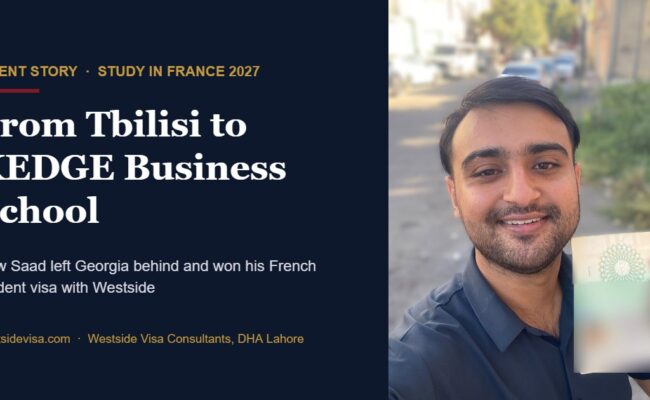
Saad was living in Tbilisi and felt stuck. Westside handled his KEDGE Business School admission and French student visa from Lahore. Why France beats Georgia for 2027.
A world class European education at surprisingly affordable public university fees, plus access to 29 Schengen countries no wonder France is booming with Pakistani students. But there’s one step you can’t skip: Campus France.
For Pakistani students, Campus France is not optional, it’s the mandatory first gate to studying in France. Get it right and everything else flows smoothly; get it wrong and your visa never even gets processed.
A France visa rejection stings but it’s not the end of the road. There’s no automatic ban and no mandatory waiting period. What matters is understanding exactly why you were rejected, fixing the real issue, and coming back stronger.
Westside Visa Consultants has placed Pakistani students in France every year since 2021, through the Etudes en France procedure and through direct admission.