
French University Fees for Pakistani Students in 2027: What Changed in May 2026
Westside Visa Consultants has placed Pakistani students in France every year since 2021, through the Etudes en France procedure and through direct admission.




The Campus France interview is the make or break moment of your France study journey, no interview, no visa. But here’s the good news: it’s not designed to fail you. It’s there to confirm you’re a genuine, well prepared student.
Imagine you’ve done everything right, great admission, funds ready, documents in order, and then it all comes down to a 20 to 40 minute conversation. That’s the Campus France interview, and for Pakistani students it’s one of the most decisive steps in the whole France study visa process. The interviewer’s job isn’t to trip you up; it’s to confirm you’re a genuine student with a clear plan. Prepare well, and this becomes your chance to shine.

In this guide, we’ll walk through exactly what the interview is, the two intakes and their timing, the five areas questions come from, real questions with model answers, and the exact mistakes that sink interviews, so yours doesn’t. Let’s get you ready.
Who is this guide for?
Pakistani students preparing for the Campus France (Études en France) pre consular interview as part of their France student visa application.
Every student applying for a French student visa through Campus France must complete a pre consular interview. It’s not optional, and it’s a genuine turning point in your application.
An important mindset shift:
The interview is not a test designed to fail you. For genuine, well documented applicants, the France student visa success rate is generally high. The interview simply confirms you’re real, prepared, and serious. Walk in seeing it as your opportunity, not a threat.
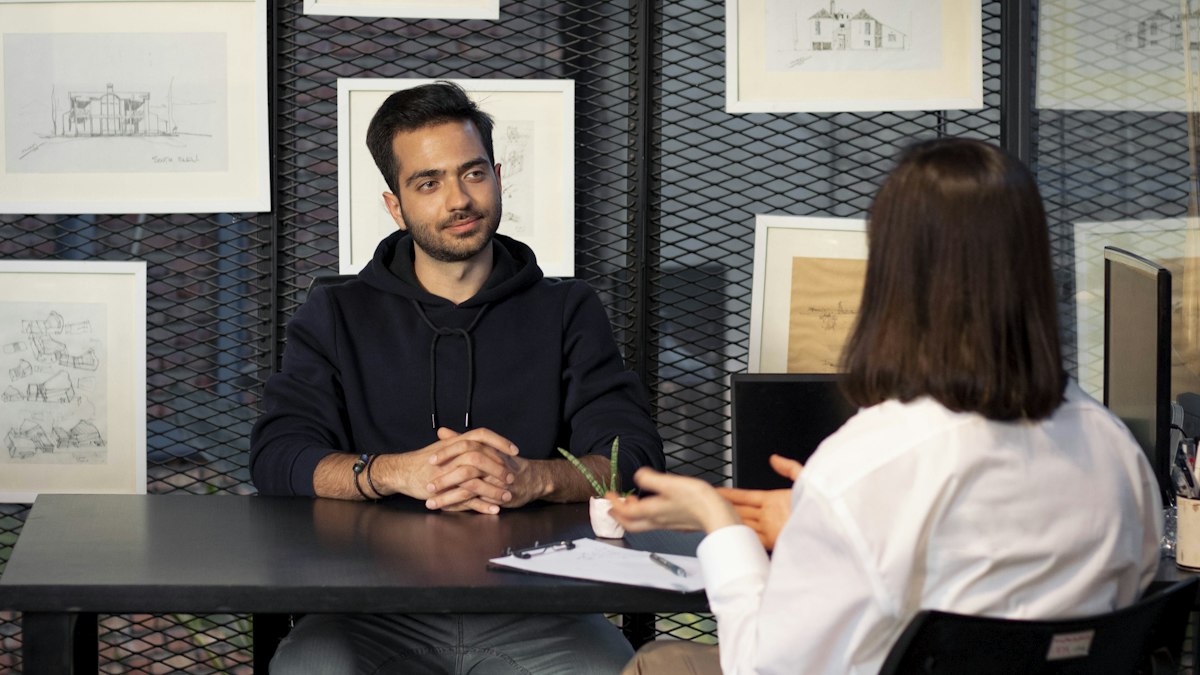
Here’s what many students don’t realise. After your interview, the Campus France officer writes a report called an “avis” (advisory opinion) that goes to the French consulate.
This is why preparation is everything:
Because a weak interview leads to a weak avis, and a weak avis is very hard to recover from, your interview performance can quietly decide your visa. Treat it with the seriousness it deserves, and prepare properly.
Not sure how this applies to you?Send us your details and a Westside adviser will tell you honestly where you stand. Free 30 minute assessment.
Ask on WhatsApp
Your interview timing depends on your intake, so let’s get this clear. France has two academic intakes, and choosing the right one matters:
September, October (the main intake)
January, March (the smaller intake)
When to start:
Begin your Campus France process about four to five months before your intake, and submit your EeF file around 60 days before the intake date on your admission letter. Early applicants get better program choices and smoother interview scheduling.
January intake, extra care:
Because the Spring intake is smaller and less common, interviewers may ask more about
why
you chose it. Be ready to explain your timing clearly and confidently, and make sure your SOP does the same.

Interview questions may feel random, but they almost always fall into five clear areas. Master these five and nothing can surprise you:
| 1. Motivation for France | Why France, why this course, and why now. Your genuine reasons for choosing to study there. | |
| 2. Program & university | Your knowledge of the course, modules, university, and city. Prove you researched properly. | |
| 3. Career plan | How this degree fits your future goals, and how it connects back to opportunities. | |
| 4. Finances | Who funds your studies, how much you have, and that you can support yourself. | |
| 5. Ties to Pakistan | Your intent and plans after studies, showing genuine reasons and connections to home. |

Here are common Campus France questions Pakistani students face, with the approach behind a strong answer. Don’t memorise scripts, understand the intent, then answer honestly in your own words.
Q
Tell me about yourself.
Approach: A crisp 60 second intro, your name, academic background, current qualification, and the course you’re heading to. Confident and to the point.
Q
Why do you want to study in France?
Approach: Give genuine, specific reasons, France’s strength in your field, affordable quality public education, the reputation of your university. Avoid generic lines anyone could say.
Q
Why this course and this university specifically?
Approach: Show you researched. Mention specific modules, the program structure, faculty or facilities, and how it fits your background and goals. This proves genuine intent.
Q
Why did you choose the January (or September) intake?
Approach: Explain your timing logically, when your admission came through, your preparation, and how it fits your plan. For January especially, justify it clearly and confidently.
Q
How will you fund your studies?
Approach: Be clear and precise, who your sponsor is, the total funds available, and that you can comfortably cover tuition and living costs. Your answer must match your financial documents exactly.
Q
What are your plans after completing your studies?
Approach: Show a genuine, forward looking plan, how your French degree opens real opportunities and connects to your goals and ties to Pakistan. Be honest and specific.
Q
Do you know anyone in France? Do you speak French?
Approach: Answer honestly. If your course is in English, explain that clearly; if you’ve started learning French, mention it positively. Never exaggerate or invent.


If you take just one principle from this guide, make it this: your spoken answers must perfectly match your written documents. Consistency is the secret behind every successful interview.
The one line test:
Before your interview, ask yourself, “Does everything I’m going to say match everything I’ve written?” If the answer is yes, you’re ready. Everything connects. Nothing contradicts.
Not sure how this applies to your case?
Send us your question on WhatsApp. A Westside adviser in DHA Lahore will reply, Monday to Saturday, 10:00 to 18:00.
Ask on WhatsAppConfidence comes from preparation. Follow this simple plan and you’ll walk in ready:
Walk in fully prepared with everything the officer might ask to see:
Presentation counts:
Arrive early, dress smartly, keep your documents organised, and be polite and calm. First impressions shape the interviewer’s view before you even answer a question.
| Mandatory? | Yes, no interview, no visa |
| Duration | 20 to 40 minutes |
| Where | Campus France office (ISB/LHR/KHI) or Embassy service |
| Interviewer | Campus France staff (not the visa officer) |
| Result | An “avis” (advisory opinion) sent to the consulate |
| Final decision | Made by the consulate |
| Question areas | Motivation, program, career, finances, ties to Pakistan |
| Intakes | Fall (Sep to Oct, main) & Spring (Jan to Mar) |
| When to start | 4 to 5 months before intake |
| File submission | ~60 days before intake date |
| Golden rule | Everything connects, nothing contradicts |
Most interview problems come down to these avoidable mistakes. Fix them before you sit down:
| Answers that contradict your documents | The biggest killer. If your spoken answers don’t match your SOP or finances, the officer doubts everything. | Fix it first: Re read every document and make sure your answers line up perfectly. Everything connects, nothing contradicts. |
| Not knowing your own course | Being unable to name modules or explain why you chose the program signals a non genuine student. | Fix it first: Research your course deeply, know the modules, structure, and why it fits your background and goals. |
| Vague answers about money | Not knowing your own funds, sponsor, or costs is a major red flag about your ability to cope. | Fix it first: Know your exact numbers, who funds you, how much, and that it covers tuition and living, matching your documents. |
| A weak or generic motivation | “France has good education” tells the officer nothing. Generic answers suggest you haven’t thought it through. | Fix it first: Prepare specific, genuine reasons tied to your field, your university, and your goals. |
| Memorised, robotic answers | Reciting a script sounds rehearsed and unconvincing, and falls apart the moment a follow up question comes. | Fix it first: Understand the intent behind each question and answer naturally in your own words, not from memory. |
| Exaggerating or being dishonest | Inventing connections, overstating French skills, or bending facts is easily spotted and destroys credibility. | Fix it first: Always be honest. A genuine, modest answer beats a confident exaggeration every single time. |

Here’s the honest truth: the interview rewards students who are genuinely prepared, who know their file, their course, and their numbers, and who can speak about them naturally and consistently. That preparation is a skill, and it’s exactly what we help you build. That’s where we come in.
At Westside Visa, our consultants in DHA Lahore prepare Pakistani students for the Campus France interview from start to finish. We help you:
Whether it’s your first attempt or you’re recovering from a tough interview, we help you walk in calm, confident, and ready. Think of us as your teammate, honest, experienced, and fully on your side.
Prepare your full France application here:
The interview is your moment to prove you’re a genuine, prepared student, and preparation makes all the difference. Westside Visa coaches you through every step, with honest, expert advice you can trust.
Book Your Free Consultation Message on WhatsApp
+92 322 5061166 info@westsidevisa.com First Floor 22 A, Sector A Phase 5 DHA, Lahore
Yes. Every student applying for a French student visa through Campus France must complete the pre consular interview. It’s not optional, no interview, no visa. It takes place at your nearest Campus France office (Islamabad, Lahore, or Karachi) or the Embassy’s Cultural & Cooperation Service.
It usually lasts 20 to 40 minutes (longer for complex profiles like career changers or those with study gaps). Its purpose is to assess your educational project and pre check your file. The interviewer is a Campus France staff member, not the visa officer, and they write an “avis” (advisory opinion) for the consulate.
No. The final visa decision is made by the French consulate, not the interviewer. However, the interviewer’s “avis” strongly influences the outcome, a favourable avis supports your case, while an unfavourable one is very difficult to overcome. That’s why preparing well is so important.
The Fall (September to October) intake is the largest, with the most programs and places, and is the best default for most students. The Spring (January to March) intake is smaller with fewer programs and needs a stronger explanation of your timing. Both are valid for a visa if your file and study plan are strong. Start your process 4 to 5 months before your intake.
Questions come from five areas: your motivation for studying in France, your knowledge of your program and university, your career plan, your finances, and your ties to Pakistan. Common questions include “Why France?”, “Why this course?”, “How will you fund your studies?”, and “What are your plans after graduation?”
Consistency. Your spoken answers must match your written documents exactly, your SOP, your finances, your study plan. The golden rule is “everything connects, nothing contradicts”. A single mismatch between what you say and what you’ve submitted can raise serious doubts.
Yes we run realistic mock Campus France interviews, prepare you across all five question areas, help you build a consistent story, and give honest feedback so you walk in confident. We can’t promise a visa (no honest consultant can), but we make sure you’re as prepared as possible. Contact us to get started.
Westside Visa News brings the week’s official changes for Pakistani students and families, in plain language, every Monday.
Visit us at First Floor, 22 A, Sector A, Phase 5, DHA Lahore, Monday to Saturday, 10:00 to 18:00, or message us any time.
This guide is general information from Westside Visa Consultants, not legal advice. Visa rules change often, so always confirm the latest position on the official government website before you apply.


A curated list of the most popular travel packages based on different destinations.
Westside Visa Consultants has placed Pakistani students in France every year since 2021, through the Etudes en France procedure and through direct admission.
Here’s the hard truth every Pakistani applicant needs to hear: weak or unclear proof of funds is the number one reason France visas get rejected. The good news?
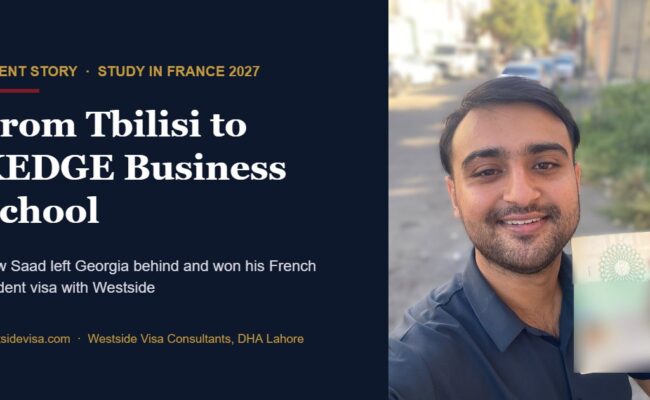
Saad was living in Tbilisi and felt stuck. Westside handled his KEDGE Business School admission and French student visa from Lahore. Why France beats Georgia for 2027.
For Pakistani students, Campus France is not optional, it’s the mandatory first gate to studying in France. Get it right and everything else flows smoothly; get it wrong and your visa never even gets processed.
Studying in France is already affordable, but scholarships can make it even cheaper, or in some cases nearly free.
Family belongs together. If you or your spouse is building a life in France, French law gives you real routes to reunite whether you’re joining a French citizen or a family member already settled there.
One of the biggest myths about studying abroad is that IELTS is compulsory. The truth?
One visa, 29 European countries. A France Schengen visa opens the door to Paris, and to Germany, Italy, Spain, and beyond. But with Pakistan facing one of the world’s highest rejection rates, how you apply matters more than ever.