Australia Student Visa for Pakistani Students 2026/27: Evidence Level 3, the Genuine Student Test, AUD 29,710 in Funds and How to Get Priority Processing
Australia wants more international students in 2026, but the door for Pakistani applicants is narrower than it looks.
By the Westside advisers, DHA Lahore · Reviewed September 2026 · 11 min read
Update, 24 September 2026: family members. On 17 September 2026 the Australian government announced that most international students and graduate (subclass 485) visa holders will no longer be able to bring a partner or children. PhD students, Pacific and ASEAN nationals, and family members already in Australia are exempt. No start date has been announced yet. Students will also only be able to change course up the qualification scale.
Australia raised its 2026 planning level to 295,000 new international students, while tightening evidence rules for Pakistan.
Who is this for?
Pakistani students and parents planning the February or July 2027 intakes in Australia, and anyone rejected on Genuine Student or financial grounds who wants to understand why before reapplying.
Westside Visa Consultants has been advising Pakistani families on Australia since the subclass 500 replaced the old student visa categories, and 2026 is the year the rules have tightened most. The Australia student visa for Pakistani students now turns on three things: the evidence level, the Genuine Student answers, and your provider’s place in the processing queue. Read this before you pay a deposit.
Australia student visa for Pakistani students: what changed for 2026/27
AUD 2,500
Visa application charge
From 1 July 2026, non refundable
AUD 29,710
Living costs to evidence
Plus first year fees and travel
Level 3
Pakistan evidence level
Since 8 January 2026
Visa application charge: AUD 2,500 from 1 July 2026 (it was AUD 2,000), non refundable, per Study Australia. Dependants pay additional charges.
Pakistan is Evidence Level 3 since the 8 January 2026 update. Every applicant must upload English test results and full financial evidence with the application. No streamlined route.
Ministerial Direction 115 replaced MD111 on 14 November 2025 and governs processing order for all of 2026. Your university’s position against its allocation decides how quick your file moves.
National Planning Level: 295,000 new overseas student commencements for 2026, 25,000 more than 2025, and no provider receives fewer places than it had in 2025 (Study Australia, Agent Hub).
Temporary Graduate visa (485): age limit 35 for bachelor’s and coursework master’s graduates, IELTS 6.5, charge AUD 5,750 from 1 July 2026.
Your English score must match your course and visa rules.
What it costs: the numbers in Australian dollars and rupees
The Department of Home Affairs requires evidence of funds for the first 12 months in Australia. The current figures are:
Note: the partner and child amounts below apply under the current rules. Once the announced family restriction starts, most students outside PhD programmes will not be able to include family members.
Item
Amount (AUD)
About PKR (at 200 per AUD)
Living costs, primary applicant, 12 months
29,710
5.9 million
First year tuition (example, master’s at a Group of Eight university)
35,000 to 50,000
7 to 10 million
Return travel (typical allowance)
2,500
500,000
Visa application charge
2,500
500,000
Overseas Student Health Cover, single, per year (budget)
600 to 800
120,000 to 160,000
Spouse or de facto partner, living costs
10,394
2.1 million
Each dependent child, living costs
4,449
890,000
School fees per school age child, per year
13,502
2.7 million
For a single applicant on a AUD 35,000 course, the funds to evidence are therefore about AUD 67,000, roughly PKR 13.4 million, before OSHC and the visa charge. The rupee figures move with the exchange rate; the Department converts at the rate on the day it assesses the file, so keep a margin.
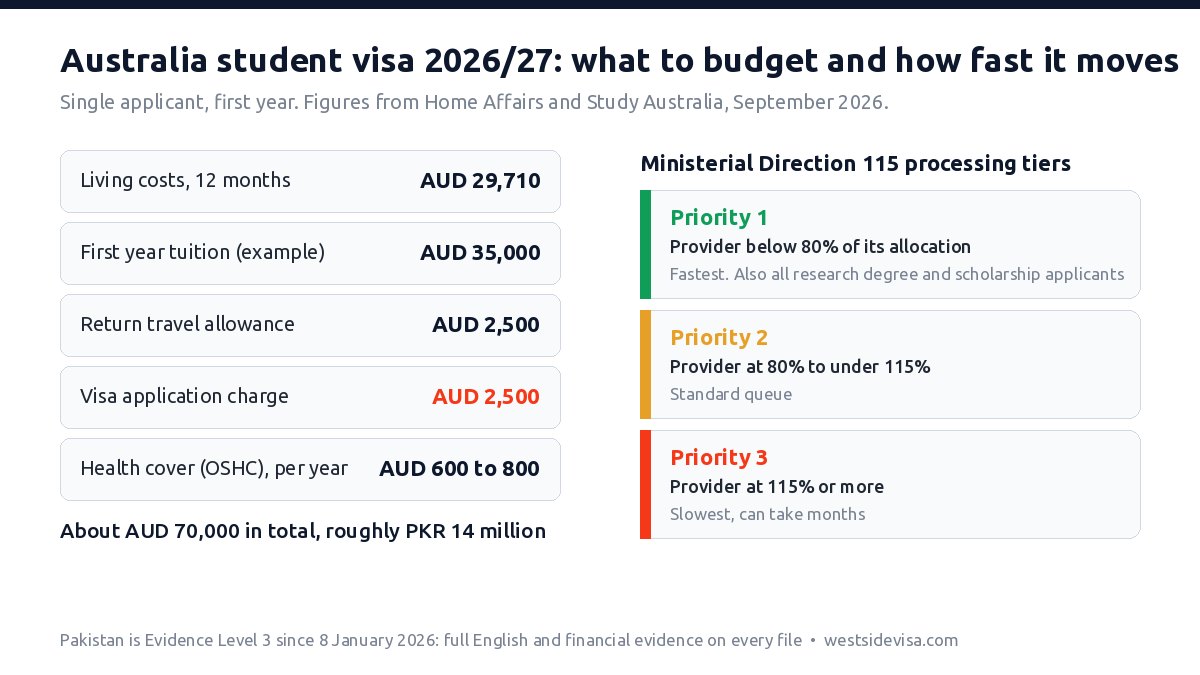
What a single applicant budgets for the first year, and the three processing tiers under Ministerial Direction 115.
Two things Pakistani families often miss. First, the AUD 29,710 is a living cost figure set by the Department, not an estimate of what you will spend; Sydney and Melbourne cost more than that in practice. Second, the funds must be genuinely available to you. Money that appears in an account weeks before lodgement without a documented source is the single most common reason for rejection under the Genuine Student test.
Acceptable financial evidence
Money deposits with a financial institution, in your name or a parent’s or spouse’s name, with a history that shows where the money came from.
A loan from a bank or licensed financial institution, with the loan agreement and evidence the funds have been disbursed or are available.
A government loan or a scholarship or sponsorship letter.
The annual income route: instead of savings, evidence that your parent or spouse earned above the Department’s income threshold in the previous financial year, through tax returns or official income documents. Check the current threshold on the Home Affairs subclass 500 page before relying on it, as it is adjusted periodically.
Property valuations, prize bonds, gold and informal family loans are not accepted as capacity, though property income can help explain the source of savings. If you are comparing destinations, our UK student visa financial requirements guide shows how the UK’s 28 day rule differs from Australia’s genuine access test.
Not sure how this applies to you?Send us your details and a Westside adviser will tell you honestly where you stand. Free 30 minute assessment.
Evidence Level 3: what it means for a Pakistani file
Australia rates each country and each education provider on a three level scale. The combination decides how much evidence you must lodge. Pakistan moved to Evidence Level 3 on 8 January 2026, alongside several other South Asian countries. In practice:
English evidence with the applicationYou must submit an accepted English test result with the application (in centre test, taken within the last two years for the student visa).
Full financial evidence, whatever the provider’s ratingTwelve months of living costs, first year fees and travel, documented with source of funds.
Closer scrutinyCase officers examine the source of funds, employment history and study gaps in more detail, and a request for further information is common.
This is not a ban and it is not a quota on Pakistanis. It is a higher evidence bar. Well prepared files still succeed; thin files are rejected quickly.
Regional cities can offer lower costs and good universities.
The Genuine Student requirement: how it is actually decided
Since March 2024 the Genuine Temporary Entrant statement has been replaced by the Genuine Student requirement. Instead of a free essay, the online form asks targeted questions, and a case officer scores your answers against your documents. The four areas are:
Your current circumstances: ties to Pakistan, family, employment, assets, and the reasons you want to study abroad now.
Why this course and this provider: how the course fits your academic record and career plan, why Australia over Pakistan or other countries, and what you know about the institution.
How the course benefits you: the specific roles, salary bands or licences the qualification leads to, in Pakistan or wherever you plan to work.
Anything else relevant: previous rejections, study gaps, a change of field, or a return to study after years of work.
From our files, the answers that pass share three features: they are specific (named employers, named courses, real salary figures), they are consistent with every document in the file, and they do not sound like a template. A Pakistani applicant with a BBA and four years at a bank who wants a Master of Business Analytics at a university that runs an industry placement is a coherent story. The same applicant applying for a Diploma of Hospitality is not, and the rejection letter will say so.
You may say you want to stay.
Australian policy still allows you to say you would like to work after graduation; that is what the Temporary Graduate visa is for. What the officer must not conclude is that the course is a vehicle rather than the purpose.
English: what score you need
Situation
IELTS Academic (in centre)
Direct entry to a degree, student visa minimum
6.0 overall
Packaged with at least 10 weeks of ELICOS English
5.5 overall
Packaged with at least 20 weeks of ELICOS
5.0 overall
Temporary Graduate visa (485) after study
6.5 overall, no band below 5.5
Universities usually ask for more than the visa minimum (6.5 overall with 6.0 in each band is common for master’s). PTE Academic and TOEFL iBT in centre are accepted at equivalent scores. Home edition or online tests are not accepted for the visa. If you are planning for the 485 later, aim for 6.5 now rather than sitting the test again in Australia. Our Lahore office runs IELTS preparation for Academic and UKVI formats.
Show genuine study plans that fit your background.
Ministerial Direction 115: how to get into the quick lane
Since 14 November 2025, student visa applications are processed in an order set by Ministerial Direction 115. The Department gives each education provider an indicative allocation of new overseas student commencements for the year. Where your provider stands against that allocation decides your tier:
Priority 1: the provider’s pipeline of new commencements is below 80 percent of its allocation. Quickest processing.
Priority 2: the provider is at 80 percent or more but below 115 percent. Standard processing.
Priority 3: the provider is at 115 percent or more. Slowest processing, and these files can sit for months.
Some applications are Priority 1 regardless of the provider: school students, standalone ELICOS students, postgraduate research (master’s by research and PhD) applicants, government scholarship holders, and students from Pacific nations and Timor Leste. This is one reason we keep pointing research candidates at Australia; see our PhD in Australia guide and the four country PhD comparison.
Ask the question in writing.
Ask the university’s international office which priority tier its applications currently fall in. A good university that has already filled 115 percent of its allocation by June may be a slower visa than a comparable university that is still recruiting. Apply early in the cycle, when most providers are still in Priority 1 or 2. For the February 2027 intake that means lodging by October 2026.
Rejections: what the early 2026 figures say
Home Affairs data for February 2026 showed a 32.5 percent rejection rate for offshore higher education student visas, the highest monthly figure in more than 20 years, with much higher rates for some South Asian countries and fraud identified in roughly 40 percent of rejections. The pattern in rejected Pakistani files we have reviewed:
Unexplained funds. Large deposits shortly before lodgement, or savings that do not match the family’s declared income.
A course that does not fit the applicant. Downgrading from a bachelor’s to a diploma, or switching field with no explanation.
Template Genuine Student answers that repeat the university’s website and say nothing about the applicant.
Gaps and inconsistencies between the CV, the academic transcripts, the employment letters and the online form.
Document problems: unverifiable employment letters, edited bank statements, or an English test from a home edition.
Choosing a Priority 3 provider late in the year and then having the CoE lapse while the file waits.
A rejection on the Genuine Student ground is recorded and must be declared in every future application to Australia and to most other countries. A weak first application costs more than the AUD 2,500 charge.
Work rights during and after study
Student visa holders can work up to 48 hours per fortnight while the course is in session and unlimited hours during scheduled breaks. Master’s by research and PhD students have no cap once the course starts. Dependants of postgraduate students have full work rights; dependants of bachelor’s students are limited to 48 hours per fortnight.
Temporary Graduate visa (subclass 485), Post Higher Education Work stream, 2026
Bachelor’s or coursework master’s
2 years
Research master’s or doctorate
3 years
Age at application
35 or under (exceptions for some doctoral graduates)
English
IELTS 6.5 overall, no band below 5.5
Australian study requirement
At least 92 weeks, apply within 6 months of completion
Charge
AUD 5,750 from 1 July 2026
Compare this with the UK, where the post study period is being cut to 18 months from January 2027; our Graduate visa deadline guide has the details.
Step by step: the Australia student visa timeline from Pakistan
12 months before the intakeChoose the course and provider with the Genuine Student test in mind, sit IELTS Academic in a test centre, and start assembling financial evidence with a documented source.
9 to 10 months beforeApply to the university with transcripts, a statement of purpose and references. Receive the Letter of Offer.
7 to 8 months beforeAccept the offer, pay the deposit, arrange Overseas Student Health Cover for the full visa period, and receive the Confirmation of Enrolment (CoE).
6 months beforeLodge the subclass 500 application online through ImmiAccount with the CoE, OSHC, English result, financial evidence and the Genuine Student answers. Pay AUD 2,500. Complete biometrics at the VFS centre in Lahore, Islamabad or Karachi and the health examination at a panel clinic.
Waiting periodUnder Priority 1 many complete applications are decided within weeks; Priority 2 and 3 files take longer, and a request for further information restarts the clock. Do not book flights before the grant.
GrantCheck the conditions on the grant notice (8105 work limit, 8202 course attendance, 8501 health cover) and enter Australia before the course start date on the CoE.
How Westside prepares an Australia file
We start with the course choice, because the Genuine Student test is decided there, and we tell families honestly when a course will not be believed. We then map the financial evidence backwards from the AUD figure to the family’s actual income and savings history, prepare the Genuine Student answers with the applicant rather than for them, and check every document against every other before lodgement. Our fee is quoted in writing before you commit, and we never promise an outcome; the decision belongs to the Department. Start on our Study in Australia page or message us on WhatsApp.
Frequently asked questions
How much does the Australia student visa cost from Pakistan in 2026? +
The visa application charge is AUD 2,500 (about PKR 500,000) from 1 July 2026, plus Overseas Student Health Cover, the health examination, biometrics and the English test. Dependants pay additional charges.
How much bank balance do I need for an Australia student visa? +
You must show AUD 29,710 for 12 months of living costs plus your first year tuition and return travel. A single applicant on a AUD 35,000 course needs about AUD 67,000, roughly PKR 13.4 million at current rates, with a documented source.
Is Pakistan a high risk country for the Australia student visa? +
Pakistan has been at Evidence Level 3 since 8 January 2026, the highest evidence tier. It means full English and financial evidence must be lodged with every application and files are examined more closely. It is not a bar to a well prepared application.
What IELTS score do I need? +
The visa minimum is IELTS Academic 6.0 overall for direct entry, or 5.5 with at least 10 weeks of packaged English. Universities usually require 6.5. The test must be taken in a test centre, not online.
What is the Genuine Student requirement? +
A set of targeted questions in the visa form about your circumstances, why you chose the course and provider, how it benefits you, and anything else relevant. The officer scores the answers against your documents. Specific, consistent, personal answers pass; template answers do not.
Can I bring my spouse and children? +
Yes, as dependants on the same application or later, with extra living cost evidence (AUD 10,394 for a partner, AUD 4,449 per child, plus AUD 13,502 school fees per school age child) and additional visa charges. Partners of postgraduate students have full work rights.
How long does the visa take? +
It depends on your provider’s tier under Ministerial Direction 115. Priority 1 files are often decided within weeks; Priority 2 and 3 files can take months. Lodging early in the year, before providers reach their allocations, is the best protection.
Can I stay and work after graduating? +
The Temporary Graduate visa (485) gives 2 years after a bachelor’s or coursework master’s and 3 years after a research degree, if you are 35 or under, hold IELTS 6.5 and apply within six months of finishing. The charge is AUD 5,750.
This guide is general information from Westside Visa Consultants, not legal advice. Visa rules change often, so always confirm the latest position on the official government website before you apply.
A PhD in Australia offers a rare trio: the RTP scholarship (full tuition plus a tax free stipend), a four year post study work visa for doctoral graduates, and 20 skilled migration points toward permanent residency.
Since 2 October 2026 most new Australian Student visa applicants cannot bring a partner or children. Who is exempt and the options for married Pakistani students.
Australia plans to stop most students bringing family. New Zealand is widening post study work from 16 November. An honest comparison for married Pakistani students.
Choosing where to do your PhD is one of the biggest decisions of your academic life, and the four leading English speaking destinations each offer something different.