Should You Rush Your UK Student Visa Before 30 November? Our Advice for Pakistani Students
Rushing to beat the UK’s 30 November funds rise could cost more than it saves. How Pakistani students should time the money, the CAS and the application.




Home / News and Articles / Canada
Our analysis · Plan published 5 November 2026Canada has published its student numbers for the next three years, and they are almost the same as before. For a family in Lahore or Karachi, the useful news is not the number. Canada is running well below its target, so the ceiling is not what will decide your file. Here is what the plan says, how it reaches a Pakistani applicant, how we read it, and what we would do now.
On 5 November 2026, with its federal budget, Canada published its Levels Plan for 2027 to 2029. This is the yearly plan that sets how many people the country intends to admit. The headline numbers are these.
| New arrivals and admissions | 2026 plan | 2027 | 2028 | 2029 |
|---|---|---|---|---|
| New international students | 155,000 | 150,000 | 150,000 | 150,000 |
| All new temporary residents (students and workers) | 385,000 | 370,000 | 370,000 | 370,000 |
| Permanent residents | 380,000 | 380,000 | 380,000 | 380,000 |
The 2028 and 2029 figures are notional, and Canada will confirm or adjust them by 1 November of the year before. The 150,000 for 2027 is also no surprise: it is the same figure Canada pencilled in a year ago, and its own page marks it as consistent with last year’s plan. These targets count new arrivals only. Study permit extensions, changes of status inside Canada and visitors are outside them.
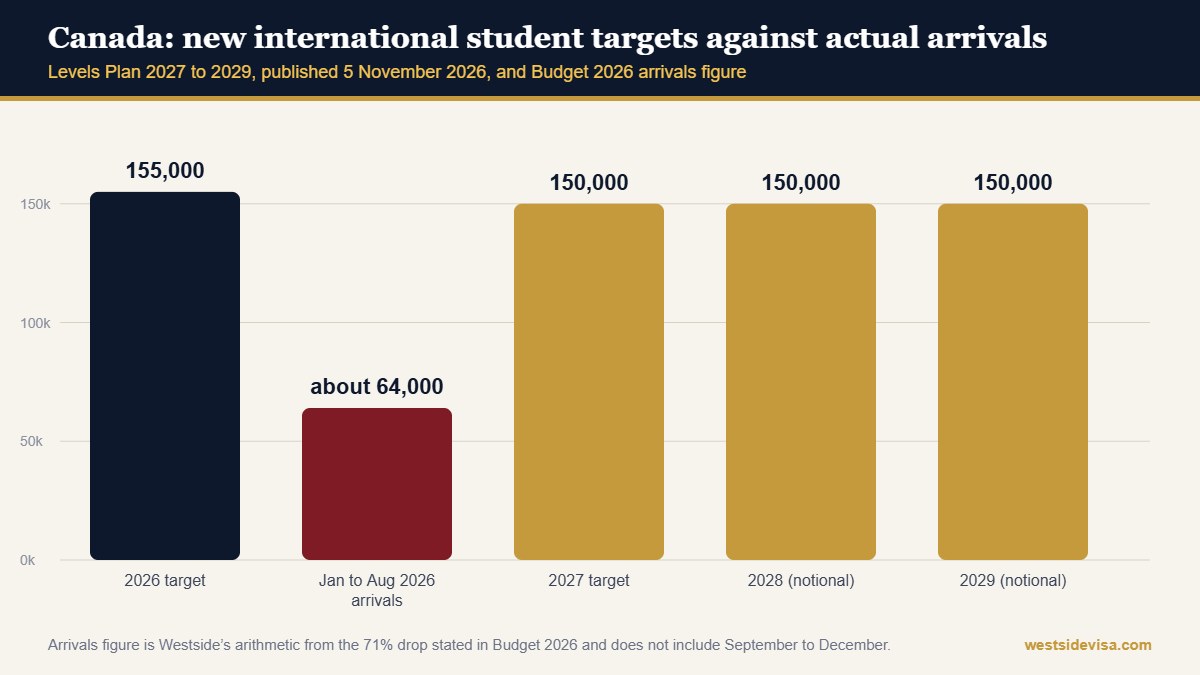
The budget also gives the backdrop. New international student arrivals from January to August 2026 were 71% lower than in the same months of 2024, a drop of 156,440. By our arithmetic, that leaves about 64,000 arrivals in those eight months, against a target of 155,000 for the whole year.
Two other measures have drawn attention. Up to 200,000 people already in Canada may move to permanent residence in 2027, half of them workers and half in a humanitarian group. And Canada expects the wait for spouse and partner sponsorship outside Quebec to move closer to 12 months, within a yearly target of 66,000 spouses, partners and children.

This is a global target with no country list. Nothing in the plan names Pakistan, for better or worse, and we found no notice about it from the Canadian High Commission or the visa centre, and no coverage in Pakistani press, when we checked on 6 November. Four things make it land differently here.
The master’s route already sits outside the provincial letter. Since 1 January 2026, students on a master’s or doctoral degree at a public institution have not needed a provincial or territorial attestation letter (PAL or TAL). Quebec has its own requirements. For the many Pakistani applicants who already hold a bachelor’s degree, this matters more than the 150,000 headline. IRCC planned for 49,000 permits in this group in 2026.
Other programmes still depend on numbers not yet published. Bachelor’s, diploma and certificate applicants at most institutions still need a PAL. Canada’s 2027 provincial allocations were not out when we wrote this. Last year’s notice appeared on 25 November, so a student choosing a college diploma today does not yet know how much room the province will have.
Files from Pakistan are moving quicker than many families assume. CIC News reported on 4 November, from IRCC data, that study permits from Pakistan were taking about 5 weeks, against 8 for India and 11 for Nigeria. Visitor visas from Pakistan were about 58 days. These are estimates and they move weekly. In September, the study permit figure was about 7 weeks.
A married student has a route here that has closed elsewhere. The spouse of a student on a master’s of 16 months or longer, or a doctoral programme, can still apply for an open work permit. That is now a real difference between Canada and its competitors, as the table below shows.
The number is a ceiling, and Canada is well under it. We hear families say “the cap is full” or “Canada has closed”. The figures do not support either. ICEF Monitor, writing before the August figures were out, estimated that arrivals for 2026 may not exceed 90,000 against the 155,000 target. Cutting that target to 150,000 changes very little for someone applying in 2027.
The test is the decision on your own file. ICEF Monitor reports an average approval rate of 47% for new study permits from January to May 2026, across all countries, up from 36% a year earlier. We have not found a 2026 figure for Pakistan, and we will not guess one. But if arrivals are so far below target while so many applications are turned down, then numbers are not the obstacle. A credible study plan, a clear funds history and a sensible choice of programme are what will count. The same ICEF report says master’s and doctoral students made up 21% of new permits from January to June, up from 12%. Canada is already shifting toward those students.
A flat target is not an open door. Canada still wants temporary residents down to 5% of the population by the end of 2027, and The Hub reports they stood at 6.7% on 1 July. IRCC said a year ago that further reductions were needed to get there. We would expect careful scrutiny of study permit files to continue, not ease, whatever the headline number says.
Do not build a plan on the 200,000 places. We expect these to be sold to Pakistani families as a new way into permanent residence. They are not. They are a one time measure for 2027, for people already in Canada. The regular target stays flat at 380,000, and Canada says permanent admissions will stay below 1% of the population beyond 2027. A student arriving in September 2027 would finish after this measure has ended. Choose Canada for the degree and the work rights after it, not for a promise of permanent residence that nobody can make you.
What we would tell a client today: if you hold a good bachelor’s degree and can fund a master’s at a public university, Canada has become one of the clearer choices for 2027, and more so if you are married. If you are looking at a private college diploma because it looks cheaper, we would slow down. That is where the provincial letter, the work rights and the decision itself all become harder.
Few Pakistani families are looking at Canada alone. Here is how a taught master’s compares on the points they ask us about most.
| Taught master’s | Canada (public university, 16 months or longer) | Australia | UK |
|---|---|---|---|
| Partner | Spouse can apply for an open work permit | Most new applicants cannot bring family since 2 October 2026, and family cannot be added to a 485 later since 13 November | Dependants only for research and government sponsored students |
| Work after study | Post Graduation Work Permit; language level CLB 7 in all four skills; no field of study rule for master’s graduates | 485 visa, 2 years for a coursework master’s; IELTS 6.5 with 5.5 in each band; age 35 or under | Graduate visa falls to 18 months for applications from 1 January 2027 |
| Living funds to show | CAD 23,448 for one person, plus tuition and travel | AUD 29,710, plus first year fees and travel; tighter evidence under consultation | £14,130 London or £10,827 elsewhere from 30 November, plus unpaid fees |
| Direction of travel | Target flat to 2029, but temporary population still being reduced | Consultation on the Genuine Student test and funds closes 23 November | Home Office statistics due 26 November, including where Pakistan stands |
Each country’s rules have conditions the table cannot hold. Read our guides on Australia’s new 485 family rules, the UK Graduate visa and New Zealand’s graduate diploma route before deciding.
Not sure how this applies to your case?
Send us your question on WhatsApp. A Westside adviser in DHA Lahore will reply, Monday to Saturday, 10:00 to 18:00.
Ask on WhatsApp
The plan published on 5 November 2026 sets a target of up to 150,000 new international students in 2027, and the same notional figure for 2028 and 2029. The 2026 target is 155,000. Extensions and changes of status inside Canada are not counted.
There is no separate number for Pakistan. New arrivals from January to August 2026 were 71% below 2024 and well short of the yearly target, so the overall target is not the main obstacle. The decision on your own application matters more.
Not for a degree granting master’s or doctoral programme at a public institution. Other programmes generally still need a PAL or TAL, and Quebec has its own requirements. The 2027 provincial allocations had not been published on 16 November 2026.
Your spouse may apply for an open work permit if you are on a master’s of 16 months or longer, a doctoral programme, or a listed professional degree or eligible programme, and you hold a valid study permit.
That measure is a one time step in 2027 for people already in Canada. It is not a route for someone applying from Pakistan for a future study permit.
About 5 weeks, according to IRCC data reported by CIC News on 4 November 2026. Estimates change every week and are not a promise, so check the official tool before fixing dates.
Checked on 6 November 2026 and rechecked on 16 November 2026. The figure of about 64,000 and the analysis are Westside’s own. Australian and UK figures are from Home Affairs and gov.uk as recorded in our earlier guides; check the current pages before you apply. General information, not legal advice.
Mujtaba is the CEO of Westside Visa Consultants. He began his career in 2001 as Executive Secretary to the Consul General of the Republic of Korea in Karachi, co founded Westside in London in 2003, and has since guided more than 1,000 students and families through UK, European, North American and Australian visa decisions from the firm’s offices in DHA Lahore and the UK. He holds postgraduate degrees from the University of Karachi, the University of Padua, Loughborough University and the University of West London.
Connect with Mujtaba on LinkedIn · About Westside · WhatsApp the office
Confirmed visa changes for Pakistani students, visitors and families, checked against official sources.
Send us your degree, your budget and whether you will travel as a couple, and we will tell you honestly which programme type fits and what the file needs.
First Floor, 22 A, Sector A, Phase 5, DHA, Lahore · Monday to Saturday, 10:00 to 18:00
This guide is general information, not legal or migration advice. Westside Visa Consultants is an independent private advisory, not affiliated with any government, embassy or visa centre. Always check the official sources before you apply.
A curated list of the most popular travel packages based on different destinations.

Rushing to beat the UK’s 30 November funds rise could cost more than it saves. How Pakistani students should time the money, the CAS and the application.
Studying medicine in France is affordable and world class, but it’s also one of the most demanding paths a Pakistani student can choose. Entry runs through the competitive PASS/L.
Dreaming of studying at a world class UK university?
Here’s a fact most people learn the hard way: broken document attestation is the number one reason Bulgaria visa applications from Pakistan get rejected.
France is home to some of the world’s best universities, with 38 institutions in the QS 2027/2028 rankings and several in the global top 100. But a ranking alone won’t tell you where you belong.
If you’ve searched for a quicker Canadian visa, you’ve probably seen the term “CAN+”. It sounds like a special visa, but it isn’t. CAN+ is a quicker processing program that can speed up your regular Canada visitor visa, if you qualify.
A medical emergency is one of life’s most stressful moments, and if the treatment you need is in Canada, the pressure of paperwork can feel overwhelming.
You must show your outstanding first year tuition plus £1,529 a month for London or £1,171 a month outside London, for up to 9 months.