Australia’s Student Dependant Ban: What Married Pakistani Students Should Do Now
Since 2 October 2026 most new Australian Student visa applicants cannot bring a partner or children. Who is exempt and the options for married Pakistani students.




Home / News and Articles / Australia
Our analysis · Proposal, not yet a rule · Submissions close 23 NovemberAustralia’s Department of Home Affairs is consulting on how student visa applicants prove their money. Nothing has been decided, and today’s rules still apply. But one possible step is aimed at applicants from Evidence Level 3 countries, the group sector checks place Pakistan in, and its timing matters: a family lodging in May 2027 would need a money trail that starts this month. Here is what is proposed, why it lands differently in Lahore or Karachi, how we read it, and what we would do now.
On 30 October 2026 the Department of Home Affairs published a consultation paper, “Strengthening the Genuine Student requirement and financial capacity framework”. It covers three things: possible updates to Ministerial Direction 106, which guides the Genuine Student assessment; ways to strengthen financial capacity rules; and a possible interim measure for primary applicants. The department is plain about its status: “No decisions have been made on the proposals outlined in the discussion paper.” Submissions close at 12:00 pm AEDT on Monday 23 November 2026, and no start date is given for anything.
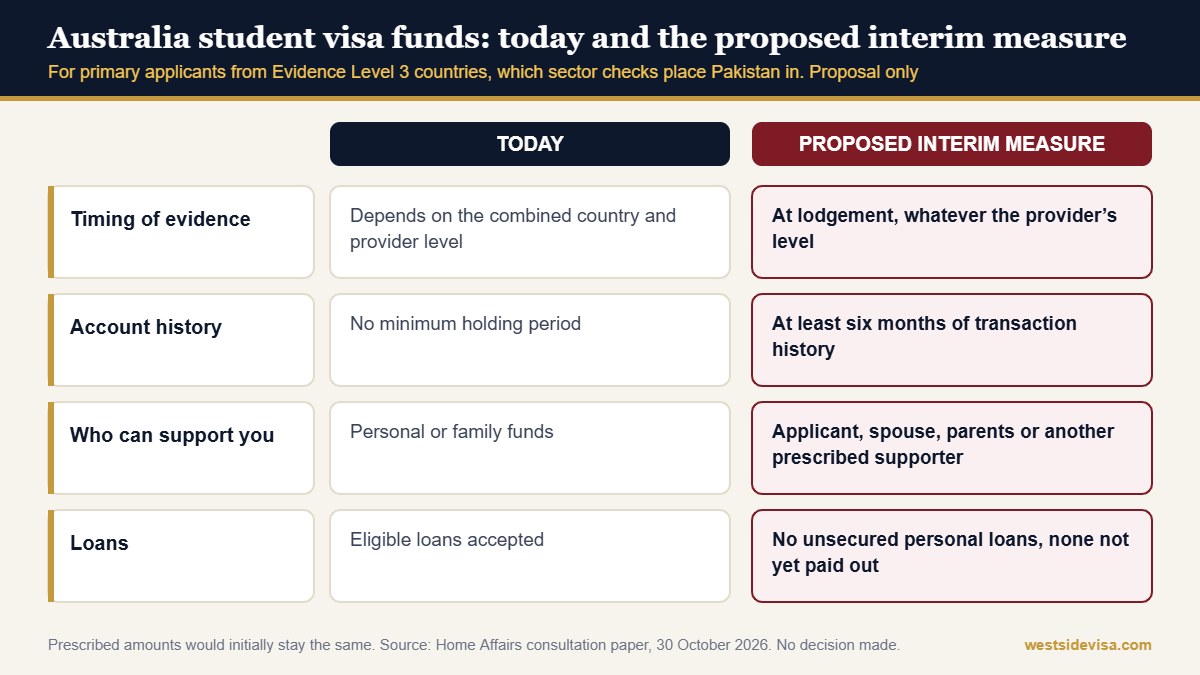
The interim measure is the part to watch. As written in the paper, for primary applicants from Evidence Level 3 countries:
The paper also proposes that possible future earnings in Australia cannot count towards the funds, that formulaic Genuine Student statements give way to revised application questions, and that credible transnational education can count in an applicant’s favour.

The paper names no countries, and Home Affairs does not publish its list of country levels. Pakistan has been placed at Evidence Level 3 since the 8 January 2026 update, and again after the 30 September 2026 update, according to sector sources who check the department’s Document Checklist Tool. So this is not a rule written about Pakistan. It is a rule for a group Pakistan sits in, alongside India, Nepal and others. Four things make it bite harder here.
The provider route would stop helping. The paper describes today’s position: “The combined country and provider Evidence Level determines whether evidence is required at lodgement or only if requested.” Sector guides read that as streamlined evidence for a Level 3 passport at a Level 1 provider, and regular evidence at Level 2 or 3 providers. The interim measure would remove that difference for primary applicants from Level 3 countries. A Pakistani student choosing a Level 1 university would prepare the same financial file as anyone else.
Family funding here is often wider than the paper’s list. The paper says today’s pathways “permit personal or family funds”. In practice a Pakistani student’s costs are often pooled across a family: a brother abroad, an uncle, a family business. The named supporters are the applicant, spouse and parents, plus “another prescribed supporter”, which the paper does not define. Until it does, we would not build a file on anyone else’s account.
Six months of history favours money that already sits still. Today, “No specific account or minimum holding period applies”. A salaried parent with steady savings would notice little. A family that keeps its wealth in property or a business, and turns it into cash shortly before applying, would have much more to explain. The paper does not say how a recent, well documented property sale would be treated, so that is a question to watch rather than a settled answer.
The stakes are already high. The PIE News reported that 37% of offshore higher education applications from Pakistan were turned down from January to March 2026, lower than Nepal (69%), Bangladesh (45%), India (42%) and Sri Lanka (41%). The visa charge alone is AUD 2,500, about PKR 500,000, and it is not refundable. A Pakistani practitioner told The PIE in August that universities already ask for different financial evidence under the same framework. The High Commission in Islamabad had no notice on this consultation when we checked on 4 November, so families will hear about it first from universities and consultants.
This is a change in what is being tested. Look at the last ten months: Pakistan at Evidence Level 3 in January, the visa charge up to AUD 2,500 in July, family members and most onshore applications restricted from 2 October, the 485 family rules from 13 November, and now this. Each step moves the real decision earlier, and away from what happens after a student arrives. The money question is moving the same way: from “do you have it?” to “how long has it been yours, and can someone else verify that?”
It is not only a squeeze. Assistant Minister Julian Hill told the ABC, “I want grant rates to improve and greater certainty for everyone”, and the paper says it aims to reduce avoidable rejections. A clear rule could help a well prepared Pakistani family more than today’s uneven practice does. He was also open about the cost, saying this holds “even if this means raising the financial standards and a smaller pool of prospective students”. We take him at his word on both.
We would plan around the interim measure, not the deposit models. This is our judgment, not a government statement. The paper says the Australian account model needs further legal, banking and systems work, while the interim measure keeps today’s amounts and is described as a separate, earlier step. That makes it the more likely to arrive first. It is still a proposal, could change after 23 November, or could be dropped. But preparing for it costs a family very little, and being caught without it could cost an intake.
Do not assume one country’s rule carries over. The UK asks for funds held for 28 consecutive days. Australia may ask for six months of history. A family comparing the two should plan the money for each separately, and pick the destination the family’s real finances can support.
What we would tell a client today: no need to change destination, and no need to move money in a hurry. A rushed transfer is the very thing this proposal would make harder to explain. Start the paper trail now, in the right names, and treat Australia as a plan that needs more lead time than it did in 2025.
Separately, the paper sets out four longer term options. All are at discussion stage, with no dates. Under the first three, the money would sit in an eligible Australian account in the applicant’s own name before lodging. The paper also floats verified overseas accounts as a transitional step. It does not address how Pakistani families would move funds abroad before a visa is granted, which we think is the first question to be answered for this market.
| Option | What must be held | For how long |
|---|---|---|
| 1. Managed 50% model | Half of tuition and prescribed living costs for the whole course | At least one month, released on a set schedule |
| 2. Flexible 50% model | The same half | At least three months, no required release schedule |
| 3. First year assurance | All tuition and prescribed living costs for the first 12 months | At least three months |
| 4. Recognised education finance | Costs met through recognised institutions, personal funds or a mix | Australian account preferred where practicable |
A worked illustration shows why the course length matters. We assume AUD 40,000 a year in tuition (our example, not an official figure), the current living figure of AUD 29,710 a year, and about PKR 200 to the Australian dollar.
| Course length | Options 1 and 2 (half of the whole course) | Option 3 (first 12 months) |
|---|---|---|
| 18 months | AUD 52,283, about PKR 10.5 million | AUD 69,710, about PKR 13.9 million |
| 2 years | AUD 69,710, about PKR 13.9 million | AUD 69,710, about PKR 13.9 million |
| 3 years | AUD 104,565, about PKR 20.9 million | AUD 69,710, about PKR 13.9 million |
For a two year master’s the sums match, so the real difference is how long the money is locked and who controls its release. A three year bachelor’s would be far more demanding under the 50% models. That is one reason a family should not assume “50%” means the cheaper option. Today’s requirement, for comparison, is 12 months of tuition, living, travel and family costs, or the annual income route.
Not sure how this applies to your case?
Send us your question on WhatsApp. A Westside adviser in DHA Lahore will reply, Monday to Saturday, 10:00 to 18:00.
Ask on WhatsAppWe will update this article when Home Affairs announces a decision, and any change will appear on our Visa News page.

Not yet. Home Affairs is consulting until 23 November 2026 and says no decisions have been made. Today’s rules still apply, and no start date has been given for any change.
Sector sources using the Document Checklist Tool place Pakistan at Evidence Level 3, unchanged after the 30 September 2026 update. Home Affairs does not publish the list, so confirm your passport and provider in the tool before you apply.
Not under the interim measure as described, which would initially keep today’s amounts. The longer term options could require more money at the point of lodging, depending on the option and the length of the course. None of these has been decided.
Today’s pathways permit family funds. The interim measure would generally limit reliance to the applicant, spouse, parents or another prescribed supporter, and that last group is not defined. We would use your own or your parents’ accounts where possible.
If adopted as written, yes. The interim measure applies to primary applicants from Evidence Level 3 countries regardless of the provider’s Evidence Level.
Only if your file is genuinely ready. No start date or transitional rule has been published, and a rushed application carries its own risk. Build your history now and lodge when the course, money and documents are in order.
Checked on 4 November 2026 and rechecked on 16 November 2026. The analysis and the worked illustration are Westside’s own. This is a proposal and may change; confirm the current rules with the Department of Home Affairs before you apply. General information, not legal advice.
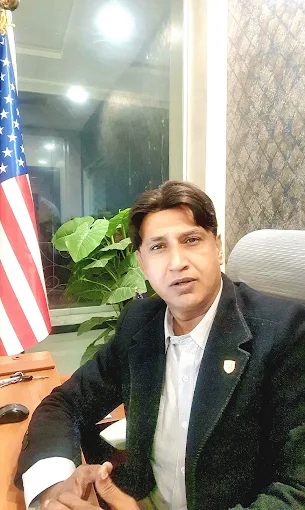
Mujtaba is the CEO of Westside Visa Consultants. He began his career in 2001 as Executive Secretary to the Consul General of the Republic of Korea in Karachi, co founded Westside in London in 2003, and has since guided more than 1,000 students and families through UK, European, North American and Australian visa decisions from the firm’s offices in DHA Lahore and the UK. He holds postgraduate degrees from the University of Karachi, the University of Padua, Loughborough University and the University of West London.
Connect with Mujtaba on LinkedIn · About Westside · WhatsApp the office
Confirmed visa changes for Pakistani students, visitors and families, checked against official sources.
Send us your funding plan, whose accounts the money sits in and your intended lodging month, and we will tell you honestly where it needs work.
First Floor, 22 A, Sector A, Phase 5, DHA, Lahore · Monday to Saturday, 10:00 to 18:00
This guide is general information, not legal or migration advice. Westside Visa Consultants is an independent private advisory, not affiliated with any government, embassy or visa centre. Always check the official sources before you apply.


A curated list of the most popular travel packages based on different destinations.
Since 2 October 2026 most new Australian Student visa applicants cannot bring a partner or children. Who is exempt and the options for married Pakistani students.
No employer. No job offer. No labor certification. If you are a skilled professional in Pakistan or the United States, the EB 2 National Interest Waiver may be your quickest, most independent path to a US green card.
Here’s the hard truth every Pakistani applicant needs to hear: weak or unclear proof of funds is the number one reason France visas get rejected. The good news?
Canada has set up to 150,000 new students a year to 2029. Our reading for Pakistani applicants: who it helps, what still decides a file, and what to do now.
Want an affordable EU degree without the sky high tuition or brutal competition of Western Europe?
Here’s a fact most people learn the hard way: broken document attestation is the number one reason Bulgaria visa applications from Pakistan get rejected.
A visa rejection feels like the end of the road but very often, it isn’t.
Every parent shares one dream: to keep the family together. So when a US citizen parent must live apart from their child, the distance can feel unbearable. Fortunately, the United States offers a direct answer.