A US Court Keeps “Duration of Status” for Students: What the 16 November Ruling Means for Pakistanis Studying in America
On Monday 16 November 2026 a federal judge in Boston struck down the US government’s rule that would have ended “Duration of Status” for F1 students and replaced it with a fixed stay of up to four years. The rule never came into force, and now it has been set aside altogether. For the more than 13,000 Pakistani students in the United States, and for families planning a US degree in 2027, the familiar rules stay in place, at least for now. Here is what happened, why it matters, how we read it, and what to do.
By Mujtaba Maharvi, CEO, Westside Visa Consultants · 20 November 2026
Ruling16 November 2026US District Court, Massachusetts
Four year capVacatedThe rule never took effect
What applies nowDuration of StatusExtensions through your university
Final?Can be appealedNo appeal confirmed by 20 November
What happened
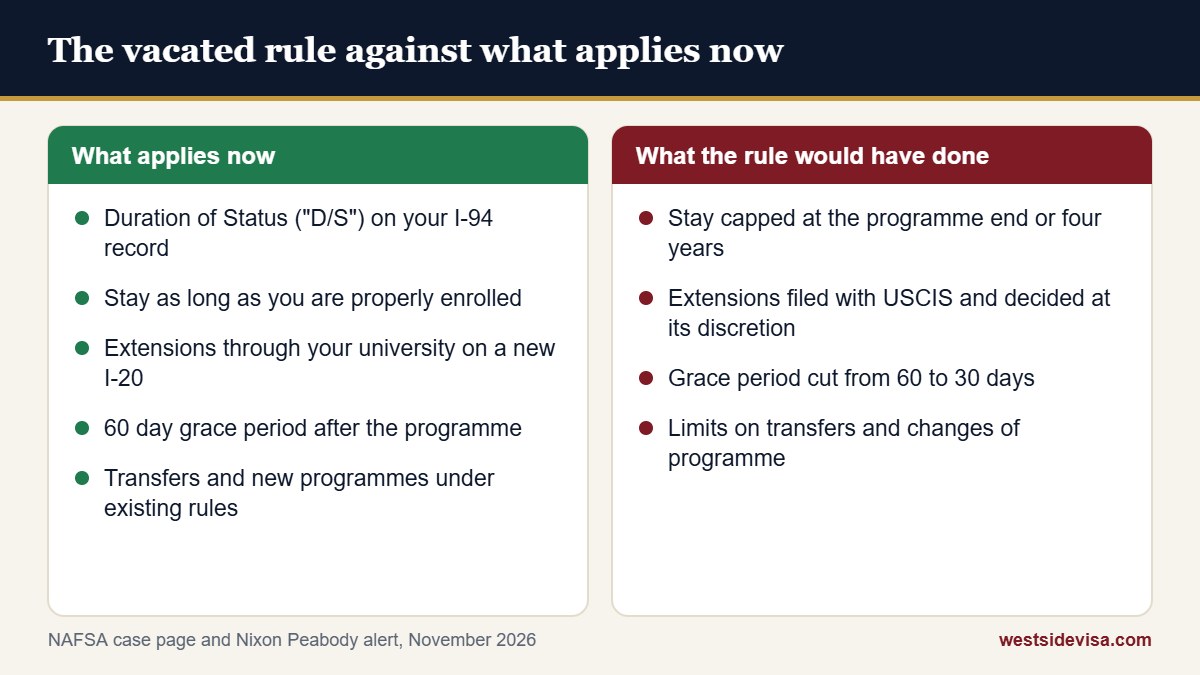
Duration of Status, shown as “D/S” on your I-94 record, lets a student stay for as long as they are properly enrolled, with any extension handled by the university on a new I-20. A rule published on 17 July 2026 would have replaced that with a fixed admission period. According to NAFSA, students would have been admitted only until the programme end date, and for not more than four years; extensions would have gone to USCIS for a discretionary decision; changes of programme and transfers would have been restricted; and the grace period after an F1 programme would have fallen from 60 days to 30.
The rule was due to start on 15 September 2026. On 14 September the US District Court for the District of Massachusetts postponed it nationwide, and the government appealed. On 16 November Judge F. Dennis Saylor IV granted summary judgment to the challengers, a coalition led by the Presidents’ Alliance and NAFSA, and vacated the rule under the Administrative Procedure Act. A law firm alert describes it as vacated in its entirety, for all students and not only the organisations that sued.
What this does not change. The ruling is about how long you may stay once admitted. It does not change how the US Embassy in Islamabad or the Consulate in Karachi decides an F1 visa, the interview, the social media checks, or the funds you must show.
The left column is the law today. The right column never took effect.
Why it matters for a Pakistani student
Pakistan sits fully inside the group the rule covered. It had no country list; it applied to every F1 and J1 holder. The Open Doors fact sheet counts 13,165 Pakistani students in the United States in 2024/25, of whom 5,816 were graduate students.
PhD students had the most to lose. A doctorate in the US commonly takes five to six years. Under a four year cap, every Pakistani PhD student would have needed a discretionary extension from USCIS in the middle of the degree, with fees, waiting time and no certainty.
Students who change direction keep their options. Moving from one university to another, or adding a second master’s, stays under the existing rules.
Families keep one fewer cost to plan for. There is no extension filing to budget for, and the 60 day grace period after graduation remains.
For students already in the US, nothing needs to be filed because of this ruling. Photo: Unsplash.
Our reading of it
This is a strong ruling, but not the last word. The rule was vacated after a final decision, not merely paused. The government may still appeal and ask for the ruling to be put on hold; as of 20 November we found no confirmed appeal.
The direction of US policy has not changed. Over 2026 the government has added social media checks, tried to cap stays and tried to narrow work during study. A day after this ruling, another judge in the same court paused the August limits on internships, which we cover in a separate article. The courts have stopped two measures; they have not reversed the trend.
What we would tell a client today: if the US is the right country for your subject and your budget, this ruling removes one reason to hesitate. It is not a reason on its own to choose the US over the UK, Canada or Australia.
Choose the degree for the degree. Court rulings can move in both directions. Photo: Unsplash.
Not sure how this applies to your case?
Send us your question on WhatsApp. A Westside adviser in DHA Lahore will reply, Monday to Saturday, 10:00 to 18:00.
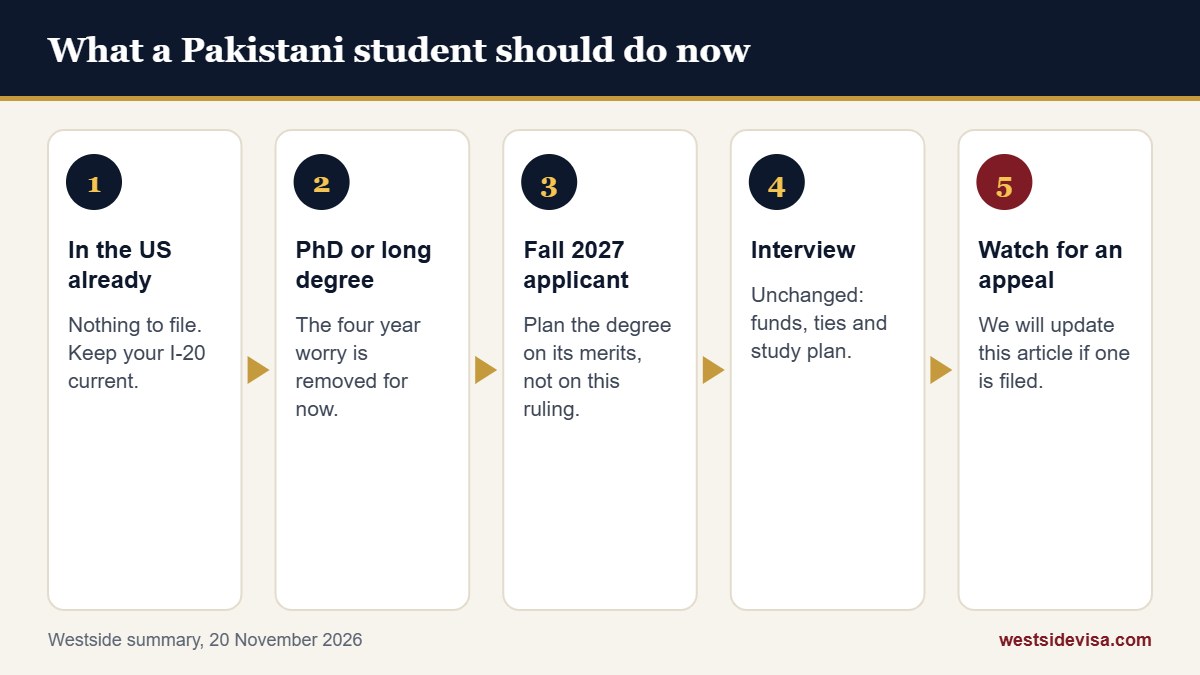
Most students need to do nothing except stay informed.
Already in the US: nothing to file. Keep your I-20 dates accurate and stay in touch with your university’s international office.
PhD and long programmes: extensions remain with your university, as before.
Applying for Fall 2027: prepare funds, ties to Pakistan and a clear study plan. Our F1 student visa guide covers the documents.
Do not rely on headlines. If the government appeals and wins a pause, the position could change. We will update this article and our Visa News page.
Questions applicants ask
What did the US court decide on 16 November 2026?
It vacated the rule that would have replaced Duration of Status with a fixed stay of up to four years for F1 and J1 holders. The rule never took effect.
Do Pakistani students in the US need to do anything now?
No. Duration of Status continues, and extensions are still handled by your university on a new I-20.
Can the government appeal?
Yes. It may appeal and ask for the ruling to be put on hold. No appeal had been confirmed when we checked on 20 November 2026.
Does the ruling make an F1 visa easier to get from Pakistan?
No. It concerns the length of stay after admission. The interview, documents and funds are unchanged.
What would the four year cap have meant for a PhD student?
A discretionary extension application to USCIS in the middle of the degree, with a fee and no certainty of approval.
Is the grace period still 60 days?
Yes. The cut to 30 days was part of the vacated rule.
Checked on 20 November 2026. We read the plaintiffs’ case page and a law firm alert, not the court order itself. Confirm your own position with your university before acting. General information, not legal advice.
About the author
Mujtaba Maharvi
Mujtaba is the CEO of Westside Visa Consultants. He began his career in 2001 as Executive Secretary to the Consul General of the Republic of Korea in Karachi, co founded Westside in London in 2003, and has since guided more than 1,000 students and families through UK, European, North American and Australian visa decisions from the firm’s offices in DHA Lahore and the UK. He holds postgraduate degrees from the University of Karachi, the University of Padua, Loughborough University and the University of West London.
Bring your offers and your budget. We will tell you what the two court rulings change for your plan, what they do not, and how to prepare for the interview in Islamabad or Karachi.
First Floor, 22 A, Sector A, Phase 5, DHA, Lahore · Monday to Saturday, 10:00 to 18:00
This guide is general information, not legal or migration advice. Westside Visa Consultants is an independent private advisory, not affiliated with any government, embassy or visa centre. Always check the official sources before you apply.
Campus France Pakistan has extended the Études en France deadline for September 2027 from 18 November to 15 December 2026, with the PKR 30,000 fee due by 20 December. See the full updated timeline, who gains from the extra four weeks, what cannot be changed after you submit, and a week by week plan.
Canada has cut the number of new international students hard since 2024. But the door has not closed evenly. Master’s and PhD students now get an easier path, while college diplomas face the steepest cuts.
A world class European education at surprisingly affordable public university fees, plus access to 29 Schengen countries no wonder France is booming with Pakistani students. But there’s one step you can’t skip: Campus France.
A UK PhD gives you a world class research degree, generous funding options, and, importantly, a post study advantage that survives the 2027 migration changes: doctoral graduates keep the full three year Graduate Route.
France has two very different worlds of higher education: public universities and Grandes Écoles. One is affordable and admits on your academic file; the other is elite, selective, and built on powerful networks.
Here’s a fact most people learn the hard way: broken document attestation is the number one reason Bulgaria visa applications from Pakistan get rejected.
Rushing to beat the UK’s 30 November funds rise could cost more than it saves. How Pakistani students should time the money, the CAS and the application.