Why a US Visit Visa Is Turned Down Under Section 214(b), and When to Apply Again: A Guide for Pakistani Applicants
Most US visit visas that are turned down in Pakistan are turned down under one line of law: section 214(b). It is not a ban and it is not a judgment on your character. This guide reads the officer’s own manual to show what the decision means and when a new application is worth making.
By Mujtaba Maharvi, CEO, Westside Visa Consultants · 24 November 2026
Legal basisSection 214(b)Every applicant is presumed to intend to stay
AppealNoneBut the decision is not permanent
Apply againAny timeWith a significant change in circumstances
FeeNot refundedA new form, fee and interview each time
What section 214(b) says
Section 214(b) sits in the main US visa statute, known by its initials as the INA. It starts from a presumption: every applicant for a visitor visa is treated as someone who intends to stay in the United States, until they show otherwise. The officer does not have to prove that you will overstay. You carry the burden of showing that you will not (Foreign Affairs Manual, 9 FAM 302.1 and 9 FAM 401.1).
The State Department puts it in two parts on its public page: the applicant either did not show that they qualify for the visa category, or did not overcome the presumption by showing strong ties to their home country.
A 214(b) letter names the section of law. It does not list what was missing.
How the officer sees it: the question at the window is not whether you are a good person. It is whether, on what you wrote and said, the officer is satisfied today that this is a temporary visit.
It is not only about ties
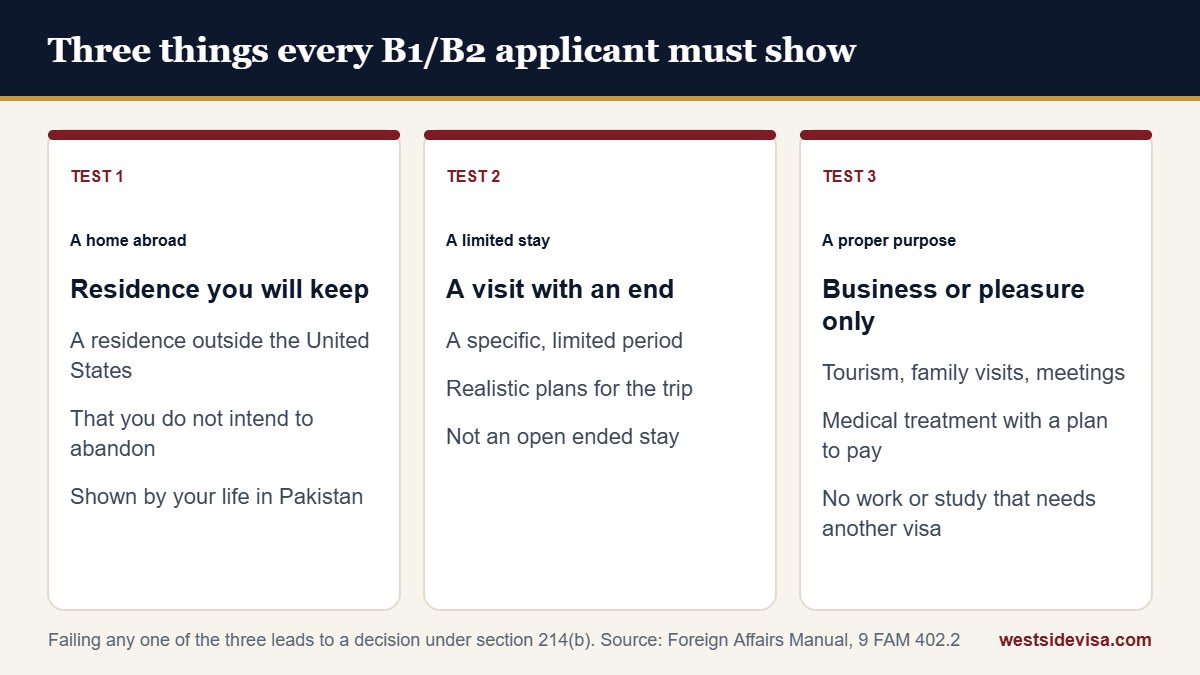
Many applicants are told that 214(b) means “weak ties”. The manual says otherwise. It states plainly that 214(b) does not simply mean an applicant must have ties: failing any requirement of the visitor category leads to the same decision (9 FAM 302.1).
Three requirements, one decision. A vague purpose can fail the test as surely as weak ties.
So a salaried professional with property in Lahore can still be turned down if the trip itself does not make sense: no clear dates, a stay far longer than the stated purpose needs, or a purpose that sounds like work or study.
What counts as ties
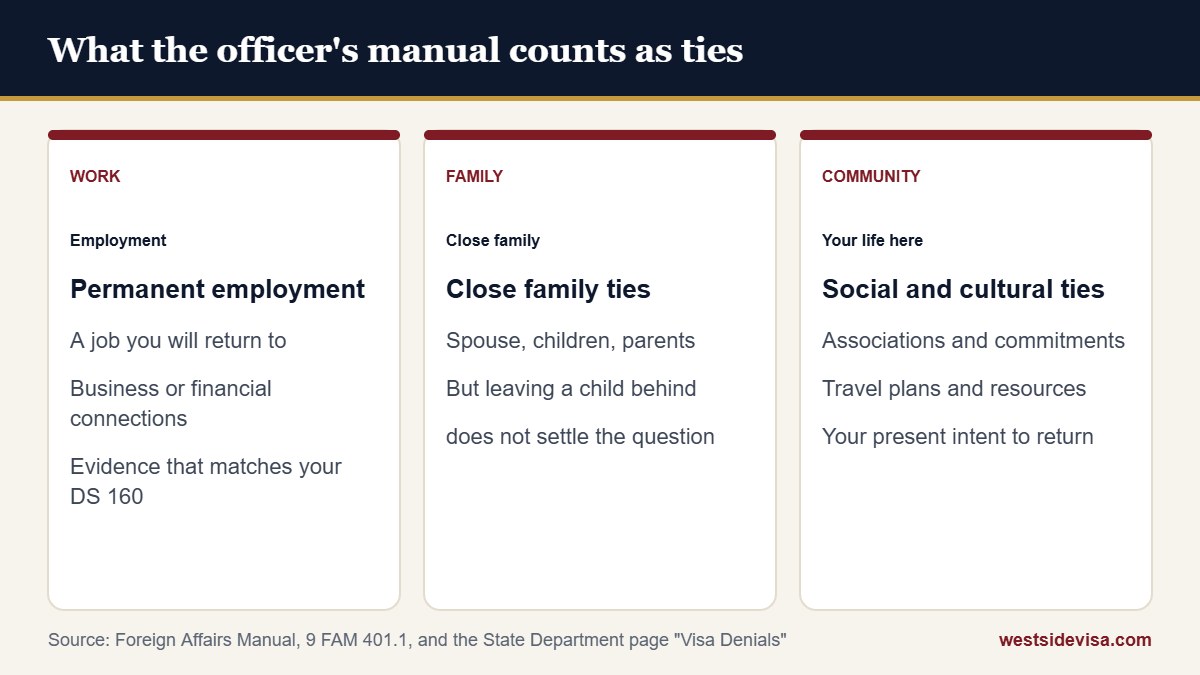
The manual asks for “a strong inducement to return” and lists what can show it: permanent employment, business or financial connections, close family ties, and social or cultural associations (9 FAM 401.1). The State Department’s public page adds that officers also look at your travel plans and financial resources.
Ties are wider than a bank balance or a property paper.
Four points in the manual matter to Pakistani families in particular:
Present intent controls. The officer looks at your intention to return now. A suspicion that life may be better in America is not, on its own, enough to turn you down (9 FAM 401.1).
Leaving a child behind does not settle it. The manual says an applicant cannot remove the officer’s doubts by offering to leave a child at home (9 FAM 402.2).
A pending family petition is not an automatic bar. A visitor visa may still be issued to someone with a pending immigrant petition, if they otherwise qualify (9 FAM 401.1). In practice the officer will want a clear, believable reason for a short visit now.
A profile is not a reason. The manual tells officers that an applicant’s demographic profile is not a ground for turning a visa down (9 FAM 403.10).
What happens at the window, and after
The officer must explain the decision and give you a written notice that cites the section of law (9 FAM 403.10). The letter is a standard one. It will not list the document or answer that decided your case.
There is no appeal. The State Department’s page says so directly.
It is not permanent. A 214(b) decision applies to that application on that day (9 FAM 302.1).
The fee is not refunded. It pays for processing, whatever the result.
A supervisor can review. Supervisors may reopen a decision they believe was made in error, but an applicant cannot request this as a right (9 FAM 403.10).
Do not confuse it with 221(g). A 221(g) notice means the officer needs more documents or more checks before deciding. The State Department page gives one year to supply what was asked. A 214(b) decision is final for that application.
When to apply again
You may apply again at any time. Each new application needs a new DS 160 form, a new fee and a new interview, and it is handled as a new case (9 FAM 403.10). The State Department’s advice is to apply again when there are significant changes in your circumstances.
The useful question is not how long to wait, but what has changed.
The rest of this section is our view, from files we have reviewed.
Changes that usually matter: a new or more senior job with a salary record behind it, a business that now has tax returns, a completed degree, recent travel to other countries with return on time, or a trip with a clearer and shorter purpose. Corrections matter too: if the first DS 160 was filled in carelessly or by someone else, an accurate form is itself a change, provided you can explain the difference honestly.
Changes that rarely matter on their own: a bigger bank balance that arrived last month, a new invitation letter saying the same thing, or a different interview date.
What we would tell a client today: do not apply again the following week with the same file. Write down every question you were asked and what you answered, compare it with your DS 160, and find the gap. If nothing has changed and nothing was wrong, wait until something real has.
Not sure how this applies to your case?
Send us your question on WhatsApp. A Westside adviser in DHA Lahore will reply, Monday to Saturday, 10:00 to 18:00.
A 214(b) decision passes with time and circumstance. A false document does not. Under section 212(a)(6)(C)(i) of the same statute, a person who seeks a visa by fraud or by wilfully misrepresenting a material fact becomes inadmissible to the United States, and that finding does not lapse the way a 214(b) decision does.
After a 214(b) decision, never buy a job letter, borrow money to dress up a statement, hide the earlier decision, or change your story to fit what you think the officer wants. Every earlier DS 160 stays on record and the next officer reads it first.
Checklist before you apply again
Can you state the purpose of the trip in one sentence, with dates?
Does the length of stay match that purpose?
Does every answer on the new DS 160 agree with your documents and with what you will say?
If an answer differs from last time, can you explain why, truthfully?
What has changed since the last decision, and can you show it on paper?
Who is paying, and does that make sense for your income?
Have you declared the earlier decision?
Questions applicants ask
Is a 214(b) decision a ban on travelling to the United States?
No. The officer’s manual says a 214(b) decision is not permanent. It applies to that application. You can apply again.
How long must I wait before applying again?
There is no waiting period. The State Department advises applying again when there are significant changes in your circumstances, with a new form, fee and interview.
Can I appeal a 214(b) decision?
No. The State Department states there is no appeal process. A supervisor may review a decision believed to be made in error, but you cannot require it.
Will an invitation or sponsor letter from a relative in America fix it?
Not by itself. The test is about you: your residence abroad, a limited stay and a proper purpose. A letter can explain the visit, but it does not replace your own ties.
My brother has filed a family petition for me. Will I always be turned down for a visit visa?
Not automatically. The manual says a visitor visa may be issued to a person with a pending immigrant petition if they otherwise qualify. Expect the officer to test the reason for a short visit closely.
Is the visa fee refunded?
No. The fee covers processing of the application and is not refunded.
Checked on 24 November 2026. Chapter numbers refer to the Foreign Affairs Manual as read on that date; the manual is revised often. General information, not legal advice.
About the author
Mujtaba Maharvi
Mujtaba Maharvi is the CEO of Westside Visa Consultants. He began his career in 2001 at the Consulate General of the Republic of Korea in Karachi and co founded Westside in the UK after his graduation from the University of West London. Since then he has guided more than 1,000 students and families through their visa files from Pakistan.
First Floor, 22 A, Sector A, Phase 5, DHA, Lahore · Monday to Saturday, 10:00 to 18:00
This guide is general information, not legal or migration advice. Westside Visa Consultants is an independent private advisory, not affiliated with any government, embassy or visa centre. Always check the official sources before you apply.
Watch: section 214(b) and when to apply again, in 62 seconds.
Every parent shares one dream: to keep the family together. So when a US citizen parent must live apart from their child, the distance can feel unbearable. Fortunately, the United States offers a direct answer.
There is no waiting period before a new UK visit or student application, but the officer opens the old file beside the new one. Learn what is compared line by line, how to answer each reason in the decision letter, what a covering letter can and cannot do, and the cases where waiting three or six months is the stronger choice.
Your Schengen visa gets you on the plane, but the border is where your trip is really checked. Since April 2026 Europe records every short stay visitor’s fingerprints and photo in a new digital system called EES.
You married the person you love. Yet between you and your life together in America stands one final test: proof. The US Embassy in Islamabad does not doubt love; it demands evidence.
Family means everything. For many Pakistanis who become US citizens, one dream stays close to the heart: to bring a brother or sister to live beside them in the United States.
Our parents give us everything. So when we finally settle in America, one wish grows stronger than any other: to bring them close and care for them at last. Thankfully, the United States honours that bond.
Already in the UK as a visitor and wondering if you can stay longer or switch to another visa? The honest answer is: it’s possible in some cases, but far more limited than most people think.
A medical emergency changes everything in an instant. One day your family plans quietly, and the next you race against time. Maybe a loved one in the United States has fallen critically ill.