Attestation From Home: Why the Foreign Ministry’s Digital Attestation System Matters to Pakistani Students and Families
Since 12 October 2026 the Ministry of Foreign Affairs has offered document attestation online, with an electronic certificate sent by email. We welcome it, and we set out what is confirmed, what is still to be published and what applicants should do now.
By Mujtaba Maharvi, CEO, Westside Visa Consultants · 24 November 2026
CertificateBy emailAfter the process and fee are complete
Still to be publishedFees and timingsAlso how a receiver verifies the certificate
In short, if you need a document attested: apply on the Ministry’s own portal with your own email and CNIC, pay only on the portal, keep the emailed certificate and the payment record, and ask the receiving university, embassy or employer in writing whether it accepts the electronic certificate. Never hand your portal login to anyone who offers to “do it for you”.
What is on the record
These points come from the Ministry’s circular No. Dir (CA&OP)/2026-Attest of 14 October 2026, addressed to the officers of the Ministry. We read the circular as published by Minute Mirror on 15 October 2026, and checked it against the reports in Business Recorder and ProPakistani of the same day.
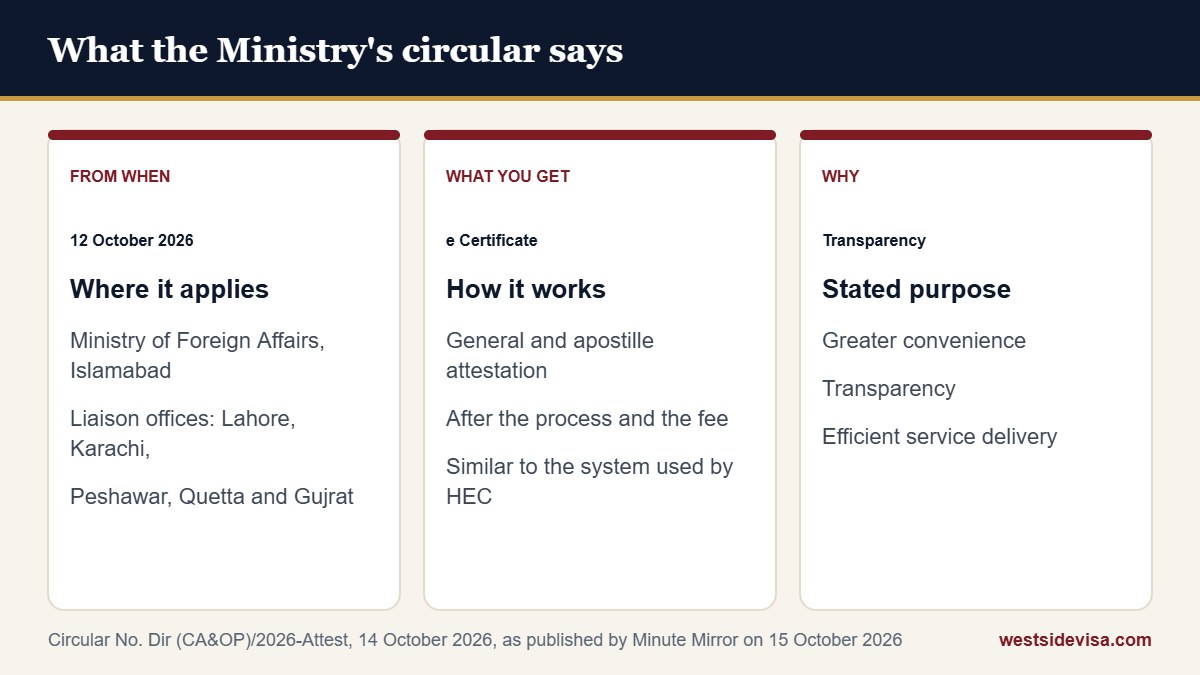
The Ministry of Foreign Affairs introduced a Digital Attestation System, effective 12 October 2026.
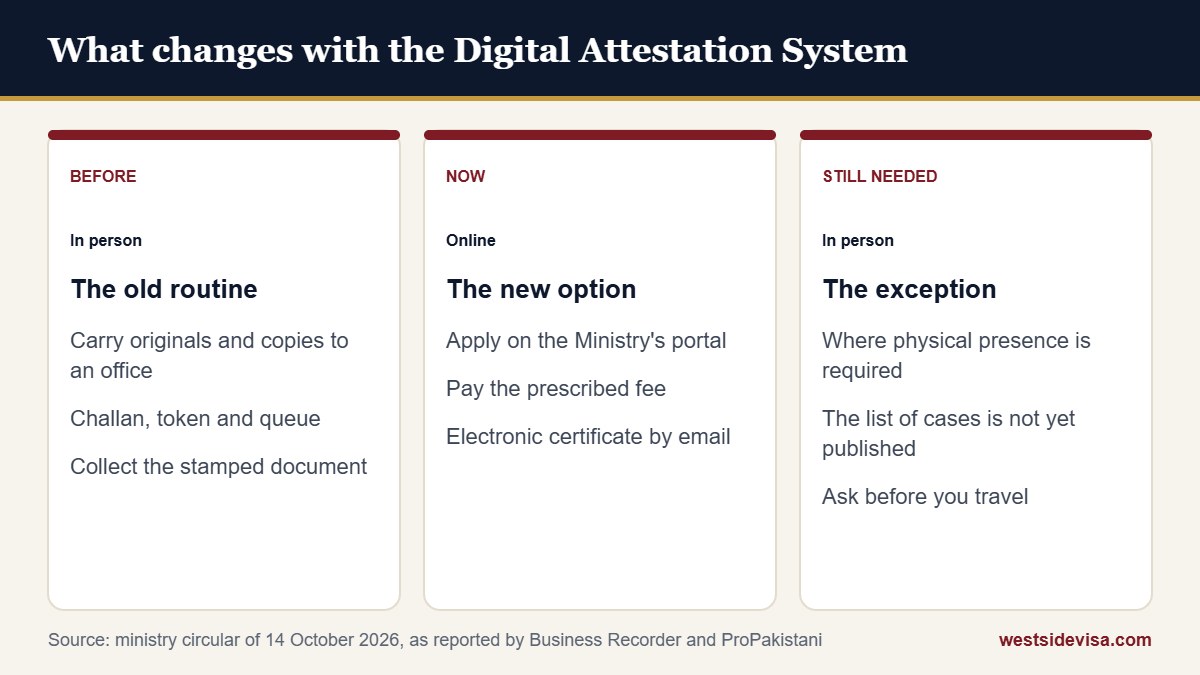
Applicants for general or apostille attestation can complete the process on the portal, pay the prescribed fee and receive an electronic certificate by email.
It covers the headquarters in Islamabad and the liaison offices in Lahore, Karachi, Peshawar, Quetta and Gujrat.
Applicants need not visit in person, except where physical presence is required. Officers were told to encourage electronic submission.
What changes: the online option sits beside the in person route, it does not remove it.
The published fees for the in person route. The Ministry’s consular page, read on 24 November 2026, lists apostille fees of Rs 3,000 for personal or educational documents, Rs 4,500 for legal documents and Rs 12,000 for commercial documents, in place since 8 July 2024, and says no fee is charged for general attestation. It does not say whether the portal charges the same amounts.
Not yet published, as far as we could find on 24 November 2026: the fees charged on the portal, processing times, how a receiving embassy or university verifies the electronic certificate, and how the system works for Pakistanis abroad. The Ministry’s apostille page still describes the in person steps.
The circular in three points. We summarise it here instead of reproducing the document.
What the portal itself shows. Its sign in page, which we opened on 24 November 2026, is titled the General Attestation and Apostille Portal of the Ministry of Foreign Affairs. It says applicants can apply for, manage and track attestation and apostille applications, with apostille offered for Hague Convention member countries, and it names the National Information Technology Board as its developer. We did not create an account, so the steps below are as reported.
How it works on the portal, as reported by ProPakistani on 16 October 2026: register with your name, email and CNIC; choose general attestation or apostille; upload digital copies of the documents; submit them for verification; pay the fee as instructed; receive the electronic certificate by email.
Why the need was felt
The facts below are from the sources named. The link we draw between them is our own reading.
The stated reason is convenience. The circular gives its purpose in its own words: “greater convenience, transparency, and efficient service delivery”. It describes the electronic certificate as similar to the system already adopted by HEC. In July 2026 the Prime Minister was briefed on digitised consular services, including document attestation, “for the convenience of overseas Pakistanis”, according to the Prime Minister’s Office as reported by Dawn. The Foreign Office spoke of “efficient, transparent, and timely facilitation”. The same briefing described attestation reduced to a one step apostille process, links to the HEC, IBCC, NADRA and National Police Bureau databases, courier based attestation and a mobile app under development. ARY News reported in October that the system was designed to end repeated visits to Ministry offices, with fewer queues and lower travel costs.
There is also a harder context. In September 2026 the FIA registered a case over alleged fake apostille stickers and stamps, as reported by the Associated Press of Pakistan. These are allegations before the courts, everyone concerned is presumed innocent, and no source we read links the new system to that case.
Our reading is simpler: a process that depends on counters, paper stickers and people who offer to “get it done” will always attract middlemen. A process that runs on a portal, with a record of every step, gives them far less room.
Why we welcome it
This section is our opinion.
Attestation is the quiet first step of almost every file we see: a degree for a university abroad, a nikah nama for a spouse visa, a birth certificate for a child. Until now a family outside the six cities planned a day of travel and queueing around a stamp.
For most families, attestation is the first step of a visa file.
Moving that step online is a real service to applicants. The Ministry deserves credit for doing it for all six offices at once, and for including apostille from the start.
Efficiency. A student in Bahawalpur or a nurse in Gilgit no longer needs a day of travel, a night away and a day off work for one stamp. Families abroad who send documents home through relatives should, in time, be able to act for themselves. Time saved at this first step matters most when a university or visa deadline is close.
Less room for unauthorised middlemen. For years, honest applicants have paid people outside the offices for a service the State provides at a set fee. Where a stamp later proves not to be real, it is the applicant who carries the consequence abroad. When the application, the fee and the certificate all pass through the Ministry’s own portal, the applicant deals with the Ministry and nobody else.
One caution: the same people will now offer to “do the portal for you”. The portal needs only your own email, your CNIC and your own documents. Never hand over your login, and pay only on the portal itself.
How host countries are likely to see it
This section is our opinion.
Every embassy, university and employer that receives a Pakistani document asks one question: can this stamp be trusted? A certificate issued from one central system, and checked against the databases of the bodies that issued the original document, is easier to trust than a sticker that can be copied. For a country whose students and workers are often asked for extra proof, that matters.
The Apostille Convention, under which one certificate replaces a chain of legalisations between member states, has been in force for Pakistan since 9 March 2023. Host countries have already acted on it: the Embassy of Italy in Islamabad has accepted only apostilled documents since 18 November 2024, and the Embassy of Belgium states that it no longer legalises official Pakistani documents. Both now rest on the Ministry’s certificate, so a secure electronic version, with a published way to verify it, protects that trust. An electronic certificate that a foreign officer can verify in seconds would complete that promise. The benefit depends on one detail still to be published: how a receiving authority checks the certificate. Once that is public, we expect fewer verification delays for genuine Pakistani applicants and a better reception for Pakistani documents generally.
Credit where it is due
This section is our opinion.
Public bodies are quick to be criticised and slow to be thanked. The Government and the Ministry of Foreign Affairs have taken a service that touches almost every Pakistani who studies, works or joins family abroad, and opened it to anyone with an internet connection. Read alongside the Prime Minister’s direction on digitised consular services, it is a real step towards transparency in the public sector and towards a better standing for Pakistani paperwork abroad. We appreciate it, and we hope other departments that serve students and travellers follow.
Not sure how this applies to your case?
Send us your question on WhatsApp. A Westside adviser in DHA Lahore will reply, Monday to Saturday, 10:00 to 18:00.
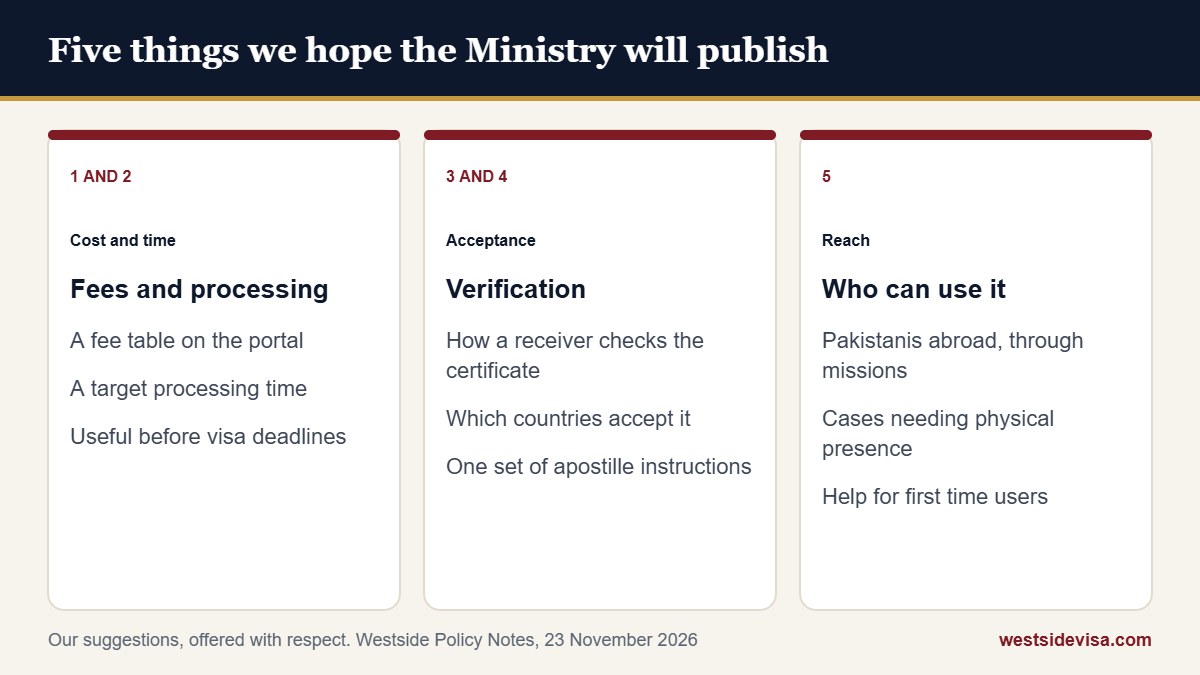
Five details that would let families plan with confidence.
Publish the fee table and a target processing time on the portal.
Explain how a foreign university, embassy or employer can verify an electronic certificate.
State which countries accept it in place of a paper stamp, and bring the apostille page in line with the new portal.
Say how Pakistanis abroad can use the system through missions.
List the cases where physical presence is still required.
What applicants should do now
What we would tell a client today: start on the portal, keep the emailed certificate and the payment record, and ask the receiving institution in writing whether it accepts the electronic certificate before you rely on it. If it does not, use the in person or courier route described on the Ministry’s pages.
About Westside Policy Notes
Westside Policy Notes are independent commentary by Westside Visa Consultants, Lahore. We are a private consultancy and are not affiliated with any ministry, embassy, high commission or visa application centre. Each note separates what is on the public record, with its source and the date we read it, from our own view, which is marked as opinion. We do not comment on individual decisions or named officers. If we have a fact wrong, write to info@westsidevisa.com and we will correct it promptly and say so on the page.
Questions applicants ask
When did the Digital Attestation System start?
It took effect on 12 October 2026, under a Ministry of Foreign Affairs circular issued on 14 October 2026.
Do I still have to visit a Ministry office?
Not in most cases, according to the circular as reported. A visit is still needed where physical presence is required; the list of those cases has not been published.
Does it include apostille?
The reports say applicants for general or apostille attestation can receive an electronic certificate. The Ministry’s apostille page still describes the in person steps, so check before you rely on it.
Will a foreign university or embassy accept the electronic certificate?
That is not yet stated publicly. Ask the receiving institution in writing before you rely on it.
How much does it cost and how long does it take?
For the in person route, the Ministry’s consular page lists apostille fees of Rs 3,000 (personal or educational), Rs 4,500 (legal) and Rs 12,000 (commercial), with no fee for general attestation. The fees charged on the portal and its processing times were not published in the sources we read on 24 November 2026.
Checked on 24 November 2026. The facts rest on the Ministry’s circular as published in the press, the Ministry’s own pages and the reports listed. Opinion is marked as opinion. General information, not legal advice.
About the author
Mujtaba Maharvi
Mujtaba Maharvi is the CEO of Westside Visa Consultants. He began his career in 2001 at the Consulate General of the Republic of Korea in Karachi and co founded Westside in the UK after his graduation from the University of West London. Since then he has guided more than 1,000 students and families through their visa files from Pakistan.
First Floor, 22 A, Sector A, Phase 5, DHA, Lahore · Monday to Saturday, 10:00 to 18:00
This guide is general information, not legal or migration advice. Westside Visa Consultants is an independent private advisory, not affiliated with any government, embassy or visa centre. Always check the official sources before you apply.
Watch: the Digital Attestation System and three cautions, in 64 seconds.
Pakistani students won more Erasmus Mundus scholarships than any other country in 2026, for the fifth year running. The record, who helped, and how to apply for 2027.